
Question Waves: Reimagining Social Search through Trust and Reciprocity
Propagation of Question Waves by Means of Trust in a Social Network
This paper introduces the "Question Waves" model for decentralized social Question Answering (Q&A) systems. It utilizes a multi-agent system where agents simulate human social behavior, modulation of effort based on trust, and a dynamic propagation strategy to find relevant answers in a P2P network while avoiding system overload.
TL;DR
The search for information is shifting from the "Library Paradigm" (centralized databases) to the "Village Paradigm" (social networks). This paper proposes a decentralized multi-agent model where "Question Waves" propagate through a social network. The core discovery? In a trust-modulated P2P network, the speed of an answer is the best indicator of its quality, making complex re-ranking algorithms unnecessary for real-time applications.
Problem & Motivation: The Burden of Being Expert
Centralized search engines like Google are phenomenal for general facts but falter on subjective, atypical, or context-heavy queries. While social platforms (Quora, Facebook Questions) attempt to fill this gap, they suffer from two critical issues:
- The Overload Problem: Expertise is a bottleneck. Asking everyone "floods" the network; asking too few people leads to zero answers.
- The "Give & Take" Disconnect: Why should an expert answer your question? Without a mechanism for reciprocity, social search systems eventually collapse due to "answerer fatigue."
The authors argue that an automated system should mimic human social intuition: we help our friends more than strangers, and we keep asking more people only if the first few fail us.
Methodology - The Core: Waves and Reciprocity
The proposed model operates on two primary pillars: Agent Behavior and Wave Propagation.
1. The Reciprocity Logic (Give & Take)
Agents represent users and maintain two types of acquaintances: Close (non-balanced) and Convenient (balanced). The quality of an answer () is not just about expertise (); it is a product of Implication () and External Factors (), such as free time.
The paper uses a specific logical conjunction to define answer quality:
This ensures that if any single factor—motivation, knowledge, or availability—is near zero, the resulting answer quality drops significantly.
2. Question Waves
Instead of a single "broadcast," the agent sends the question in sequential waves:
- Wave 1: Sent to the most trusted "inner circle."
- Waves 2-4: Sent to progressively less-trusted tiers only if Wave 1 yields no results.
Note: The model involves three roles: Questioner (originator), Mediator (forwarder), and Answerer (provider).
Experiments & Results: The "First-In" Breakthrough
The researchers simulated 200 agents in a network where each had an expertise vector and a trust-based contact list. They tested various heuristics to see which best correlated with actual answer relevance:
- Distance (D): Does a closer social distance mean a better answer?
- Trust (Tr): Does the sender's trust score predict quality?
- Receiving Order (H): Does the first answer to arrive win?
Key Findings
The results (shown in the table below) were surprising. The Receiving Order (H) consistently outperformed all other metrics.
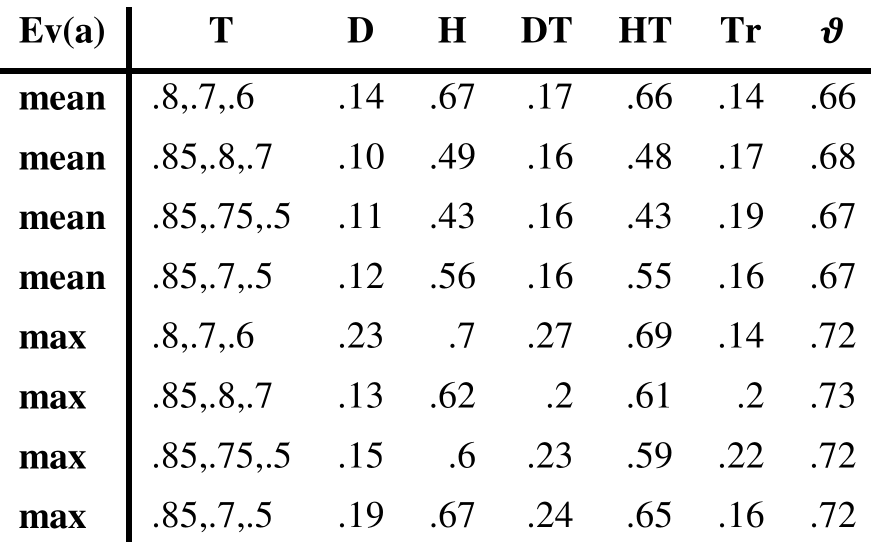
When using the max evaluation strategy, the correlation for H (Receiving Order) reached 0.70, while Tr (Trust) lingered around 0.14-0.22. This implies that the agents who are most expert and most motivated (highest and ) naturally respond faster.
Critical Analysis & Conclusion
The Takeaway
The "Question Waves" model successfully balances network load with search depth. By prioritizing social trust, it ensures that "inner circles" are consulted first. The most profound insight is the efficiency of the temporal ranking: The first answer is usually the best. This allows for ultra-fast, real-time Q&A interfaces that don't need to wait for all nodes to report back.
Limitations
- Opinion Homophily: The model assumes "correct" answers exist based on expertise. In subjective "opinion" searches, the first answer might just be the most "eager" one, not necessarily the most aligned with the user.
- Cold Start: The system relies on initial trust values (set to 0.75 in simulations). In a real-world P2P network, bootstrapping trust between strangers remains a challenge.
Future Outlook
This work paves the way for "Bottom-Up" social search engines where agents act as intelligent filters, protecting their users' time while ensuring that high-value questions reach the right minds at the right time.
Senior Editor's Note: This paper brilliantly quantifies the "intuition" of social interaction. The use of Spearman correlation to validate arrival time as a quality metric is a masterstroke for decentralized system design.