
QuickSquad: Engineering a Social-Graph-Native Engine for Fake Account Detection
QuickSquad: A new single-machine graph computing framework for detecting fake accounts in large-scale social networks
2018-11-20
Summary
Problem
Method
Results
Takeaways
Abstract
QuickSquad is a high-performance, single-machine graph computing framework specifically optimized for detecting fake accounts in large-scale social networks. By leveraging a "divide and rule" strategy tailored to the power-law distribution of social graphs, it achieves up to 5.91X speedup over general-purpose frameworks like GridGraph.
## TL;DR
Detecting fake accounts in massive social networks like Twitter or Facebook requires traversing billions of edges. Standard graph engines are often too slow because they ignore the unique "power-law" structure of social data. **QuickSquad** is a new single-machine framework that splits graphs into "Heavy" and "Light" components, using different storage and update strategies for each. The result? A framework that outperforms general-purpose engines like GridGraph by up to **5.91X**.
## The Problem: The "One Size Fits All" Trap
Most modern graph systems (like GraphChi or X-Stream) are designed for *general* graphs. However, social networks are anything but general; they follow a **Power-Law Distribution**. This means:
- **The Majority**: Most users have very few connections (Low out-degree).
- **The Elite**: A tiny fraction of users (celebrities, bots, or hubs) have millions of connections (High out-degree).
When an engine treats these two groups the same, it either suffers from excessive random I/O (treating light nodes like heavy ones) or massive redundant data loading (treating heavy nodes like light ones). Current systems are overgeneralized and hit a performance ceiling when data exceeds RAM.
## Methodology: The "Divide and Rule" Strategy
QuickSquad’s core innovation is its bimodal approach to graph processing. It divides the world into two sets: $V_h$ (Heavy) and $V_l$ (Light).
### 1. Bimodal Processing Model
Instead of a single update rule, QuickSquad uses two:
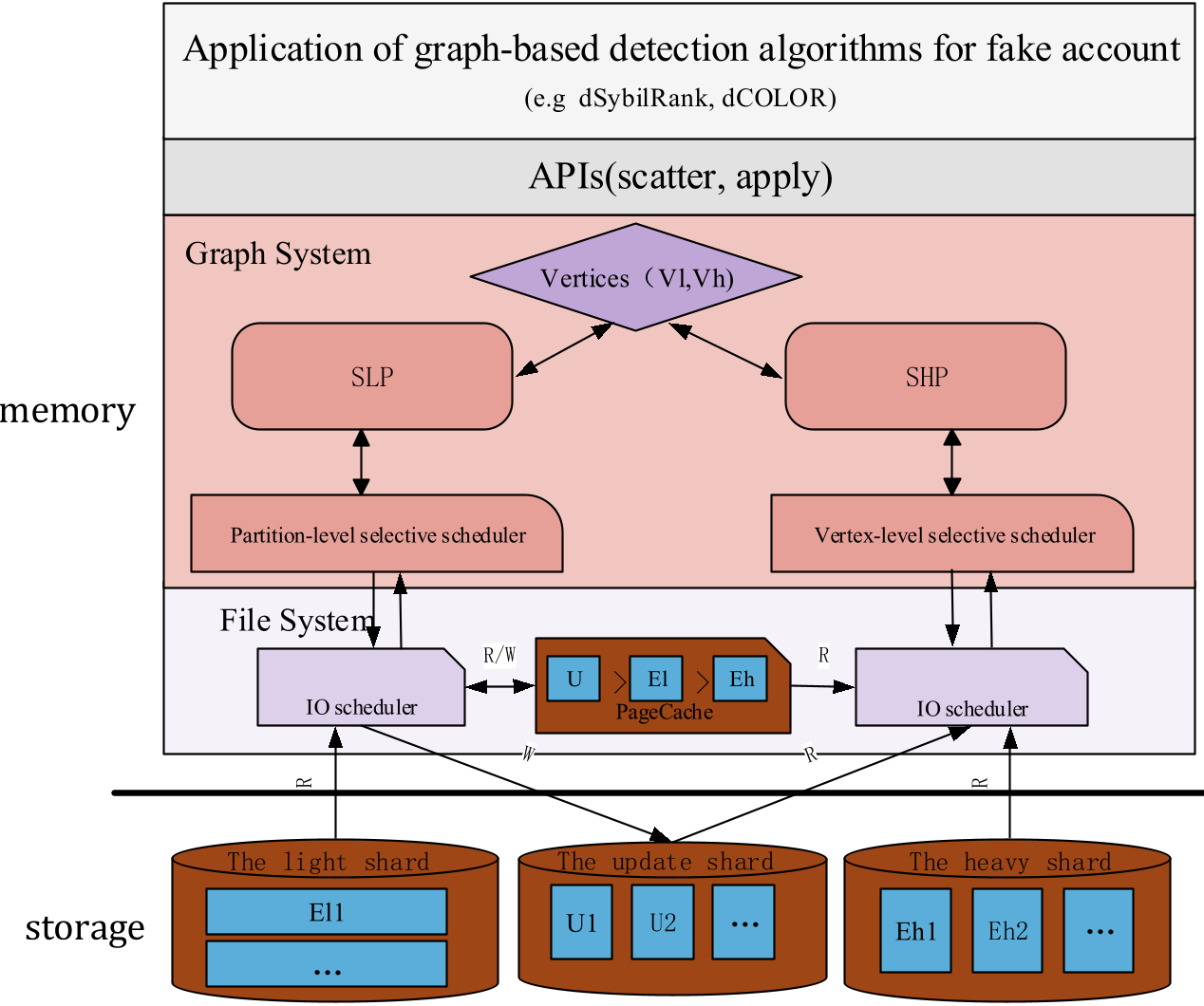
- **Streaming Light Phase (SLP)**: Uses **Edge-Based Updating**. It streams light edges and generates intermediate update files. This is efficient for nodes with few neighbors.
- **Streaming Heavy Phase (SHP)**: Uses **Vertex-Based Updating**. It keeps heavy vertex values in memory and applies updates "on-the-fly" as it streams edges. This eliminates the need for massive intermediate files for high-degree nodes.
### 2. Dual-Granularity Scheduling
Selective scheduling tells the engine which parts of the graph to skip.
- For **Light Shards**, QuickSquad uses **Partition-level** scheduling (simple and low overhead).
- For **Heavy Shards**, it uses **Vertex-level** scheduling. Because heavy nodes are so impactful, the engine meticulously tracks the active state of individual vertices to minimize unnecessary disk reads.
### 3. I/O Complexity Decoupled
By splitting the graph, QuickSquad reduces the total I/O to $3|V| + |E| + |V_h| + 2|U_l|$. Crucially, it removes the dependence on the number of partitions ($P$) that plagues frameworks like GridGraph, making it much more stable as the graph scales.
## Experiments: Crushing the Baselines
The authors compared QuickSquad against **GridGraph** using two primary algorithms: **dSybilRank** (for ranking trust) and **dCOLOR** (for community-based detection).
### Performance on Real-World Data
Using the Twitter dataset (54.9M nodes, 1.96B edges), QuickSquad demonstrated significant efficiency:
- **Speed**: It processed the Twitter graph in 459 seconds on a single server—roughly the same task took 11 clusters 33 hours in previous MapReduce implementations.
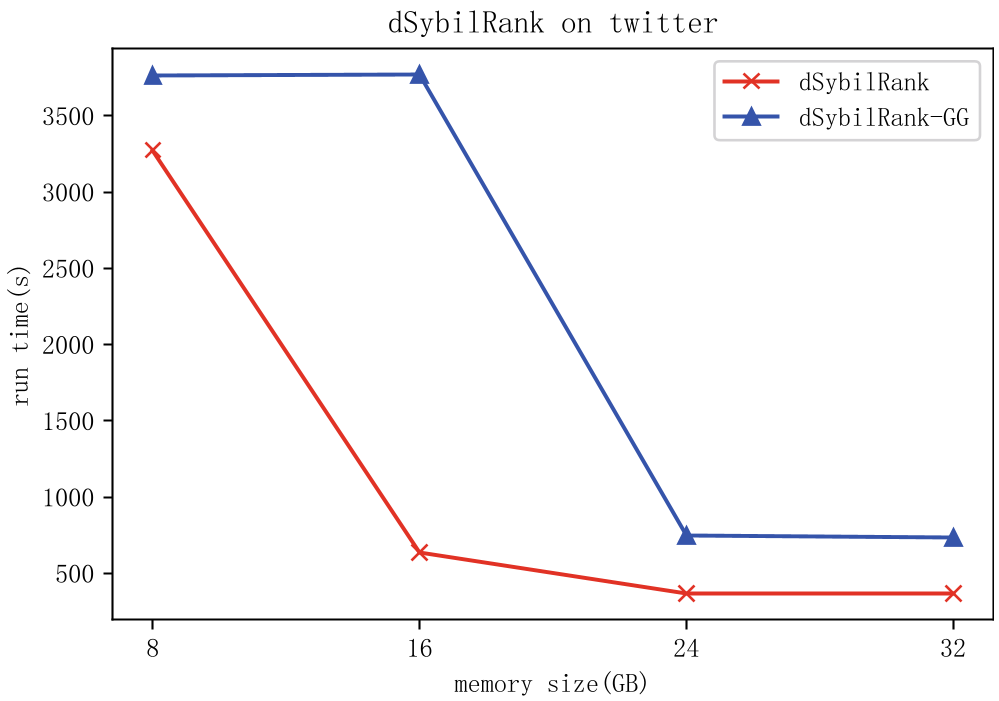
- **Memory Scalability**: As shown in the chart below, QuickSquad maintains high performance even when memory is limited (8GB vs 32GB), whereas general engines see performance cratering.
### Why it works (I/O Analysis)
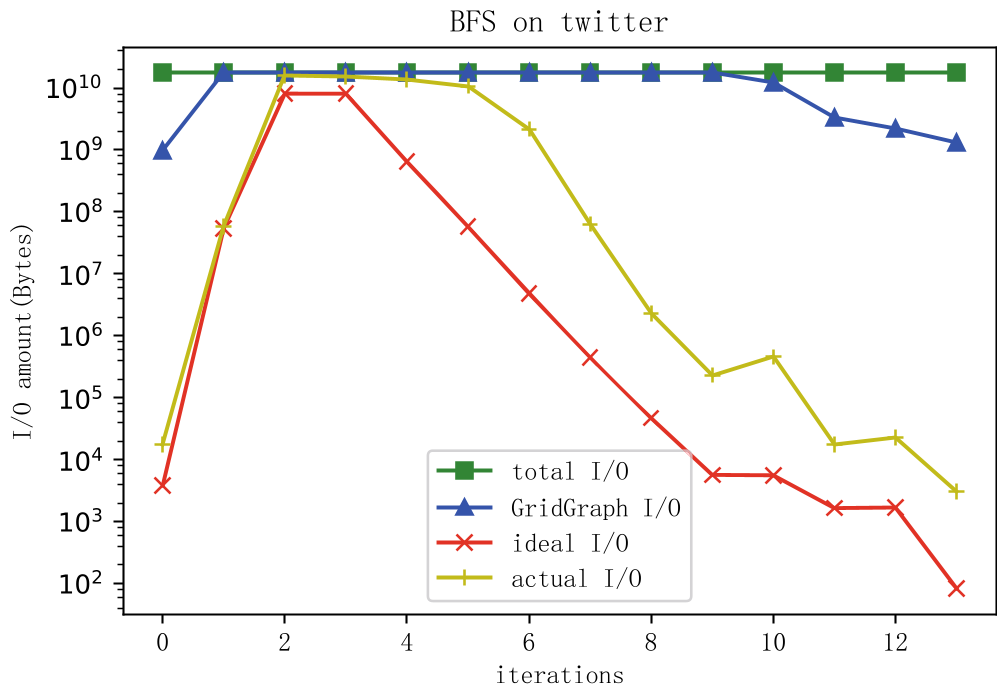
The framework's ability to focus only on "active" data allows its I/O pattern to stay remarkably close to the "Ideal I/O" line, unlike GridGraph which often loads redundant partitions.
## Critical Analysis & Future Outlook
**QuickSquad** proves that domain-specific graph hardware/software co-design is the path forward for OSN security. By acknowledging the skewed nature of social data, it avoids the "generalization tax."
**Limitations**: Currently, the system is a single-machine solution. While its performance on one machine is incredible, scaling to "Facebook-level" (trillions of edges) will require extending these bimodal strategies to distributed shared-memory clusters.
**Conclusion**: For security researchers fighting sybil attacks, QuickSquad offers a blueprint: optimize for the power law, and the performance will follow.