
QuickWalk: Accelerating Trust in the Fast Lane of Vehicular Social Networks
QuickWalk: Quick Trust Assessment for Vehicular Social Networks
The paper introduces QuickWalk (QW), a high-speed trust assessment algorithm for Vehicular Social Networks (VSNs) based on the Three-Valued Subjective Logic (3VSL) model. It aims to filter untrustworthy information by calculating trust relations between all pairs of vehicles, achieving state-of-the-art performance in computational efficiency.
TL;DR
The QuickWalk (QW) algorithm provides a breakthrough in the speed of trust assessment for Vehicular Social Networks (VSN). By refining the Three-Valued Subjective Logic (3VSL) framework and eliminating redundant mathematical operations found in previous state-of-the-art methods like OpinionWalk, QW reduces computation time by up to 70%. This ensures that vehicles can filter out "trash" information in real-time, even in rapidly changing traffic environments.
Background: The Trust Deficit in VSNs
In modern vehicular networks, cars aren't just machines; they are data hubs. However, the "Social" aspect of Vehicular Social Networks (VSN) brings a massive challenge: Trust. If a malicious or malfunctioning vehicle broadcasts a fake traffic jam, it wastes network resources and threatens road safety.
The goal is All-Pair Trust Assessment: every vehicle needs to know the trustworthiness of every other vehicle. While existing models like EigenTrust or TidalTrust use simple numerical values, they lack the nuance of uncertainty. The OpinionWalk algorithm improved this using 3VSL (which accounts for belief, disbelief, and uncertainty), but it was notoriously slow—making it impractical for a car moving at 60 mph.
Problem & Motivation: The "Infinite Loop" of Updates
The authors identified that the core inefficiency in current 3VSL models lies in the Breadth-First Search (BFS) update mechanism. Prior work updated the trust values of every node in every "hop" or level of the search.
The Insight: Once the "longest path" from a source vehicle to a target vehicle has been explored, the target's trust value remains stagnant. Continuing to calculate its value in later iterations is a waste of CPU cycles.
Methodology: Pruning the Logic Tree
QuickWalk introduces a clever categorization system to stop these redundant calculations. It divides nodes into three types based on the state of their "Individual Opinion Vector" ():
- T1: Trust value unchanged and certain.
- T2: Trust value recently updated.
- T3: Trust value still uncertain (O).
Using these types, QuickWalk applies Rule 1: if a node is finalized () and has no incoming edges from nodes that are still changing (), it is removed from the update cycle for all future steps ().
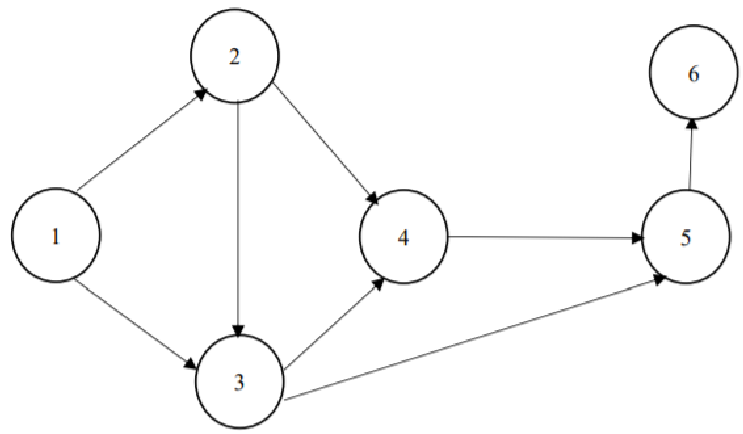 Fig 1. A typical VSN topology where QuickWalk identifies finalized paths to stop unnecessary updates.
The math behind the "discounting" and "combining" operations remains rigorous, ensuring that while the algorithm is faster, the accuracy remains identical to the slower OpinionWalk.
Experiments & Results: Speed vs. Scale
The researchers tested QuickWalk against both synthetic random graphs and the Advogato real-world dataset.
- Speedup: QW’s execution time is consistently lower, averaging 52%-80% of OpinionWalk's time on random graphs. In large-scale networks (14,000+ nodes), the saving is even more pronounced.
- Network Impact: By filtering messages through a trust threshold (e.g., 0.8), the research found a massive reduction in "noise."
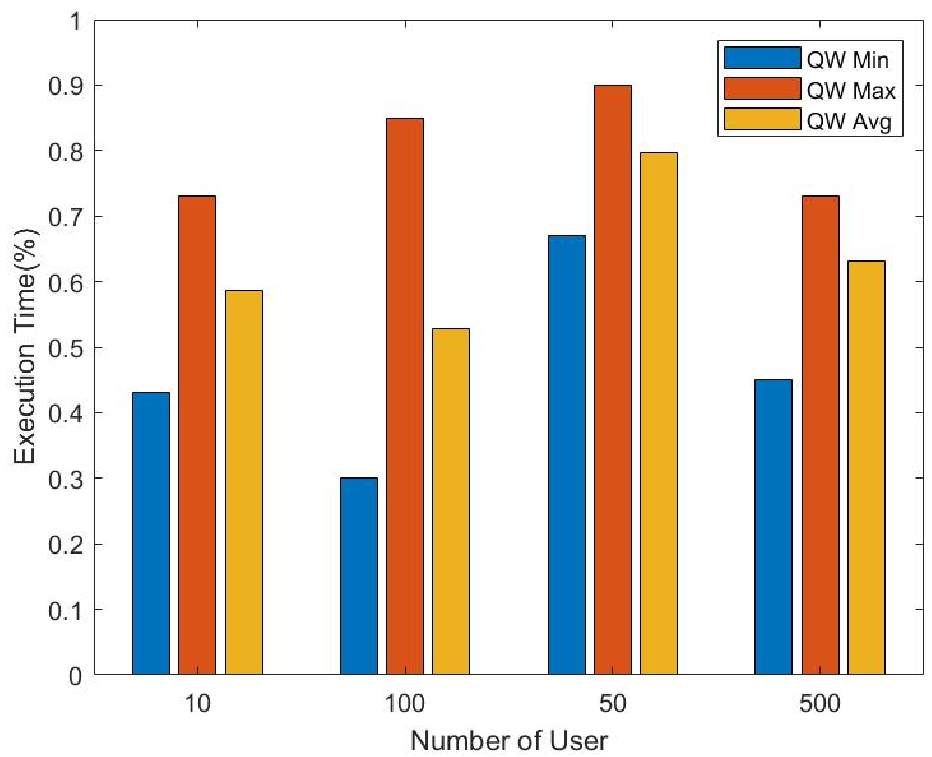 Fig 2. QuickWalk (QW) significantly outperforms OpinionWalk (OW) across various network sizes.
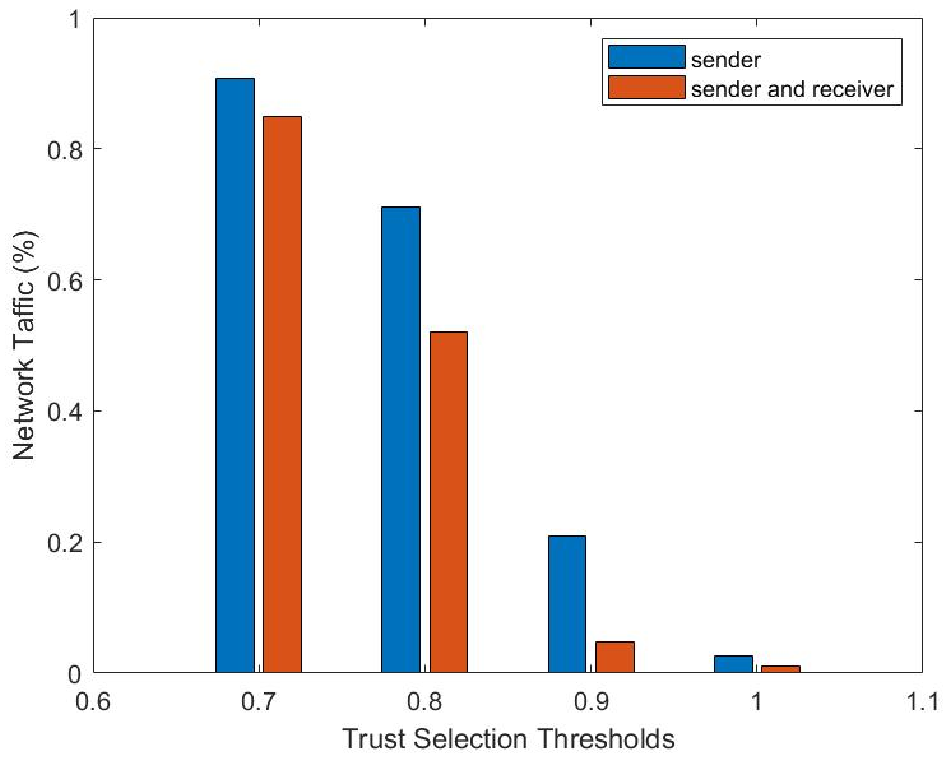 Fig 3. Impact of trust thresholds on reducing unnecessary data exchange in the network.
Critical Analysis & Conclusion
QuickWalk successfully addresses the "execution wall" of 3VSL trust models. Its main contribution is a functional optimization—the logic didn't change, but the implementation became smarter.
Takeaway: In the era of autonomous driving, where milliseconds matter, QuickWalk provides a viable path to secure, social communication between vehicles.
Limitations: The study primarily uses directed acyclic graphs for some tests. Real-world VSNs often have cycles and highly transient nodes. Future work will need to see how QW handles "High-Mobility" traces where the network topology changes faster than the algorithm can finish its levels.
Future Outlook: Integrating QuickWalk with Cloud-Assisted Vehicular Architectures could allow centralized servers to pre-calculate these vectors, sending "Trust Maps" to vehicles in real-time.