
Qwen3.5-Omni: Redefining the Omnimodal Frontier with Native Real-Time Interaction
Qwen3.5-Omni Technical Report
Qwen3.5-Omni is a state-of-the-art end-to-end omnimodal large language model that unifies the understanding and generation of text, images, audio, and video. It utilizes a Hybrid Attention Mixture-of-Experts (MoE) architecture and scales to support a 256k context window, achieving SOTA results across 215 audio-visual benchmarks.
Executive Summary
Qwen3.5-Omni represents the latest evolution in the Qwen-Omni family, transitioning from a multimodal model to a truly "omnimodal" agent. By scaling to hundreds of billions of parameters and supporting a 256k context length, it seamlessly integrates text, image, audio, and video processing. The model doesn't just "see" and "hear"—it acts, invoking tools and generating human-like speech in real-time. Positioned as a direct competitor to Gemini-1.5 Pro and GPT-4o, it sets new benchmarks in audio-visual reasoning while introducing emergent capabilities such as Audio-Visual Vibe Coding.
The Motivation: Moving Beyond Passive Perception
Prior works in multimodal LLMs often treated vision or audio as secondary "plug-ins" via adapters, leading to a bottleneck in cross-modal reasoning. Specifically, two major hurdles persisted:
- Temporal Disconnect: Traditional models struggled to synchronize audio events with visual frames over long durations (e.g., hours of video).
- Streaming Instability: In voice interactions, mismatched tokenization rates between text and speech led to "skipped words" or robotic prosody during live streaming.
Qwen3.5-Omni addresses these via a native, end-to-end pretraining strategy on over 100 million hours of audio-visual content.
Methodology: The Architecture of an Omni-Agent
1. The Thinker-Talker Framework
The model retains the decoupled Thinker-Talker architecture but upgrades both components to a Hybrid Mixture-of-Experts (MoE) design.
- The Thinker: Processes interleaved modalities (text, vision, audio) to generate high-level reasoning and text.
- The Talker: Consumes the Thinker's latent representations to synthesize speech tokens.
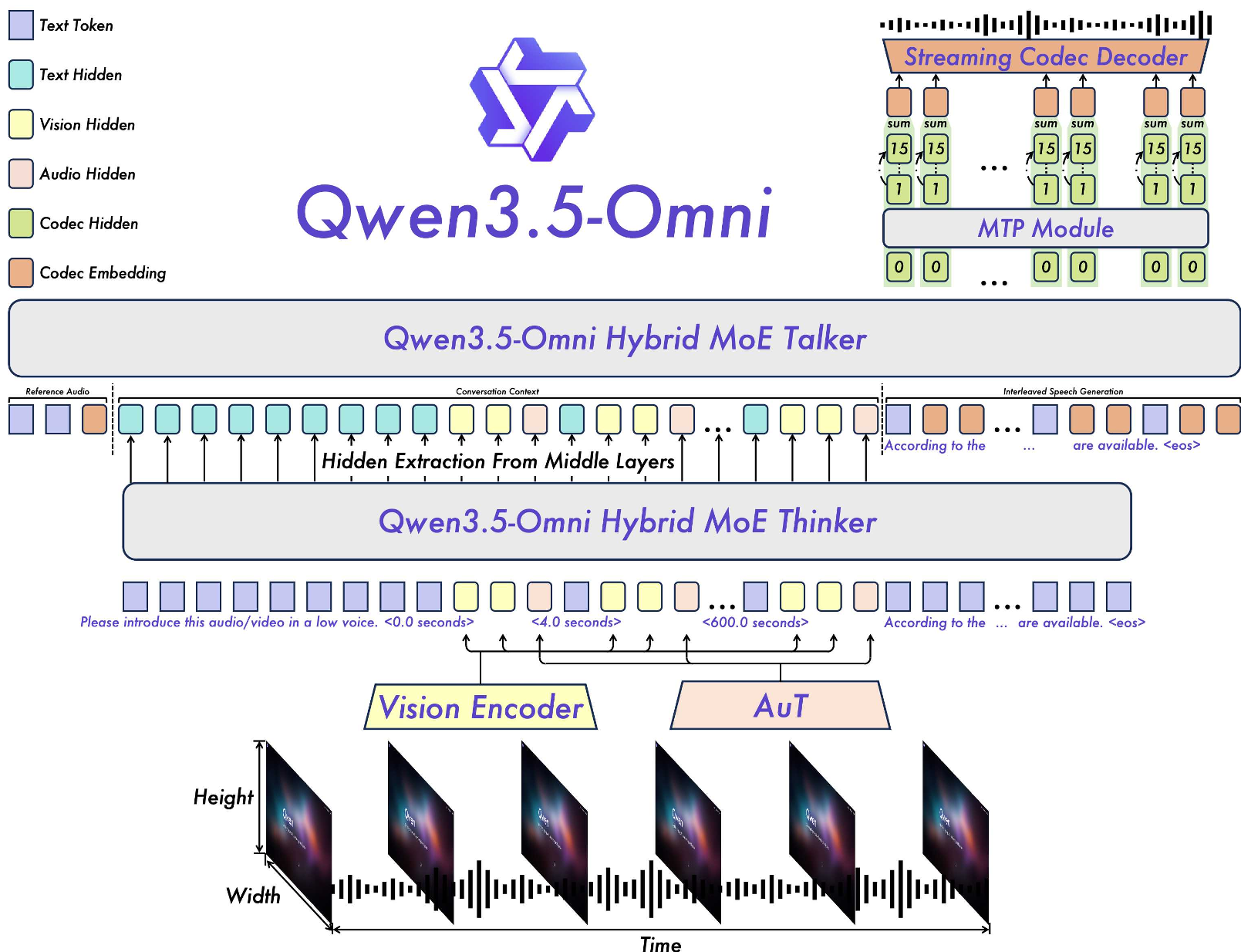 Figure: The unified Thinker-Talker pipeline supporting frame-by-frame streaming generation.
2. ARIA: Solving the Alignment Problem
A standout innovation is ARIA (Adaptive Rate Interleave Alignment). Instead of using dual-track generation which requires complex synchronization, ARIA unifies text and speech into a single interleaved stream. It uses an adaptive rate constraint to ensure the speech-to-text token ratio remains balanced, drastically improving the stability and emotional nuance of the generated voice.
3. Temporal Anchoring
To handle the massive 256k context, the authors moved away from absolute temporal IDs (which become too sparse). Instead, they use explicit text-formatted timestamps (e.g., "00:02") injected into the sequence, allowing the model to "read" time and synchronize modalities with millisecond precision.
Performance: SOTA and Emergent Skills
Qwen3.5-Omni-Plus achieves SOTA results across 215 benchmarks. Crucially, it matches or exceeds Gemini-1.5 Pro in general audio understanding and speech-to-text translation (S2TT).
Key Experimental Results
- Audio Understanding: Superior performance on RUL-MuchoMusic and SongFormBench.
- Low Latency: First-packet latency of just 235ms for audio input (Flash version).
- Emergent Capability: The model can perform Audio-Visual Vibe Coding—writing executable code directly from visual and auditory cues (e.g., watching a video of a UI and hearing a description to recreate it in code).
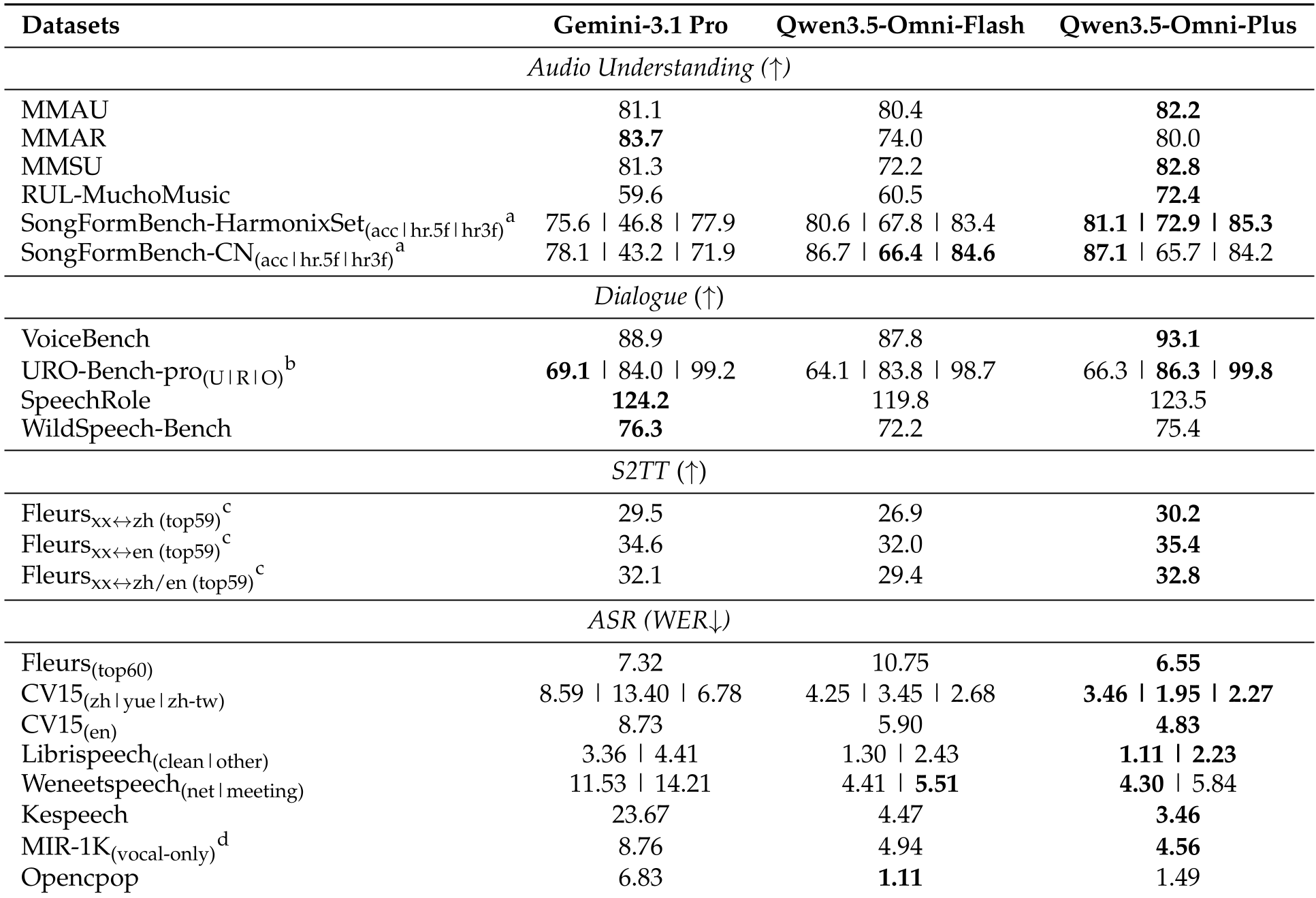 Table: Qwen3.5-Omni consistently outperforms competitors in ASR and Audio Dialogue benchmarks.
Deep Insight: Why This Matters
The industry is shifting from "models that chat" to "agents that interact." Qwen3.5-Omni proves that a native omnimodal approach—pretraining on raw audio-visual streams rather than just caption-image pairs—unlocks a higher level of "world modeling."
The introduction of ARIA is particularly significant for the future of AI assistants. By treating speech not as a post-processing step but as an integrated interleaved modality, Qwen has significantly narrowed the gap between human and machine conversational fluidity.
Limitations
While the long-context (256k) is impressive, the authors note that very high-density video inputs still pose a challenge for KV-cache management, necessitating the use of the Gated Delta Net (GDN) and Hybrid MoE to maintain throughput.
Final Takeaway
Qwen3.5-Omni isn't just a technical report; it's a blueprint for the next generation of AI agents. It demonstrates that by unifying perception and action into a single MoE-backbone, we can achieve real-time, emotionally intelligent, and tool-capable AI.