
[NeurIPS 2024] R&D-Agent-Quant: The First Multi-Agent Framework for Full-Stack Quantitative R&D
R&D-Agent-Quant: A Multi-Agent Framework for Data-Centric Factors and Model Joint Optimization
R&D-Agent-Quant (R&D-Agent(Q)) is a first-of-its-kind data-centric multi-agent framework that automates the full-stack research and development of quantitative financial strategies. It employs a coordinated Research (hypothesis generation) and Development (code implementation via Co-STEER) loop, achieving up to 2x higher annualized returns (ARR) than traditional factor libraries with 70% fewer factors.
TL;DR
Quantitative finance is moving beyond simple "AI-assisted" tools toward fully autonomous "AI Researchers." R&D-Agent(Q) is a groundbreaking framework from Microsoft Research and CMU that automates the entire quant pipeline—from mining alpha factors to architecting deep learning models. By treating R&D as an iterative, closed-loop interaction between two specialized agents, it delivers double the returns of standard benchmarks with a fraction of the complexity.
The Quantitative Wall: Why Automation Fails Today
Traditional quantitative pipelines are "siloed." A researcher might spend weeks hand-crafting factors, only to hand them off to a machine learning engineer who tunes a model on a fixed dataset. This fragmented optimization ignores a fundamental truth of financial markets: the "best" model architecture depends entirely on the features (factors) it receives, and vice-versa.
Furthermore, current LLM-based trading agents are often "hallucination-prone" black boxes. They suggest trades without explaining the underlying factor logic, making them a nightmare for risk managers who require interpretability and verifiability.
Methodology: The Factor-Model Co-Optimization Loop
R&D-Agent(Q) breaks the quant process into two core phases: Research and Development.
1. The Research Phase (Synthesis)
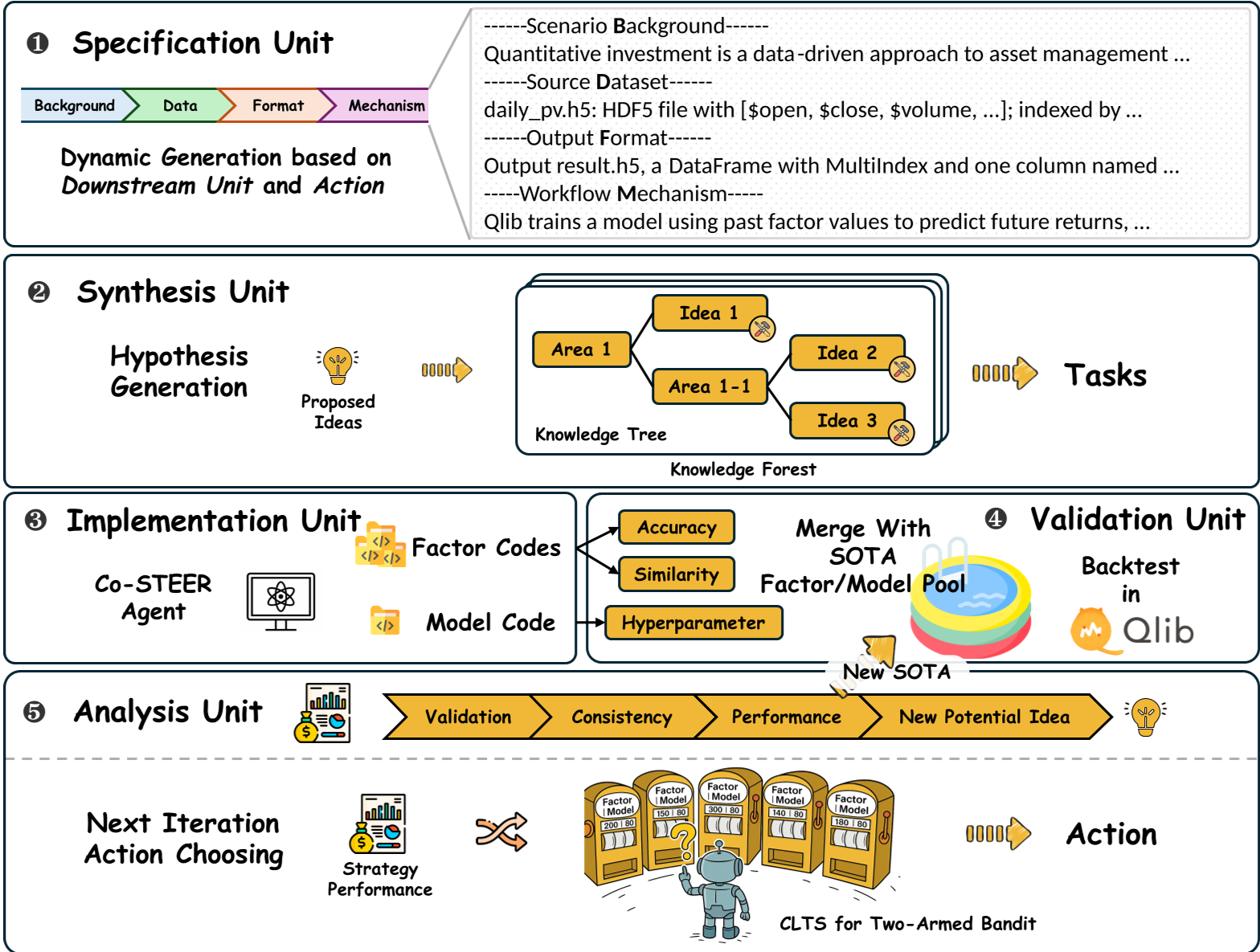
Instead of random searching, the Synthesis Unit maintains a "Knowledge Forest." It looks at historical experiments (hypotheses + feedback) and uses an LLM to generate novel, economically grounded hypotheses.
2. The Development Phase (Co-STEER)
This is where the heavy lifting happens. The Co-STEER (Collaborative Scheduling and Task Execution Engine) agent takes a hypothesis and translates it into executable Python code.
- Graph-based Reasoning: It constructs a Directed Acyclic Graph (DAG) of task dependencies.
- Knowledge Base K: It saves every successful and failed code snippet, retrieving "lessons learned" to solve new tasks faster.
3. The Bandit Scheduler: Factor or Model?
A critical innovation is the Analysis Unit, which uses a Contextual Multi-Armed Bandit (MAB). It observes the current strategy's performance (IC, ARR, Drawdown) and intelligently decides: "Should we spend the next 6 hours finding better signals (factors), or should we refine our neural network (model)?" This ensures the framework allocates its compute budget where the marginal gain is highest.
Experimental Results: Slaying the Baselines
The framework was tested on the CSI 300 (China) and NASDAQ 100 (USA) markets.
- Superior Efficiency: Compared to the industry-standard "Alpha 158" factor library, R&D-Agent(Q) achieved higher annualized returns (ARR) while using 70% fewer factors.
- Predictive Power: It outperformed specialized stock-prediction models like TRA and MASTER in Information Coefficient (IC) stability.
- Risk Control: Unlike many AI strategies that "blow up" during market shifts, the model branch acts as a risk stabilizer, significantly reducing Maximum Drawdown (MDD).

Deep Insight: The "Refine-Shift-Reuse" Pattern
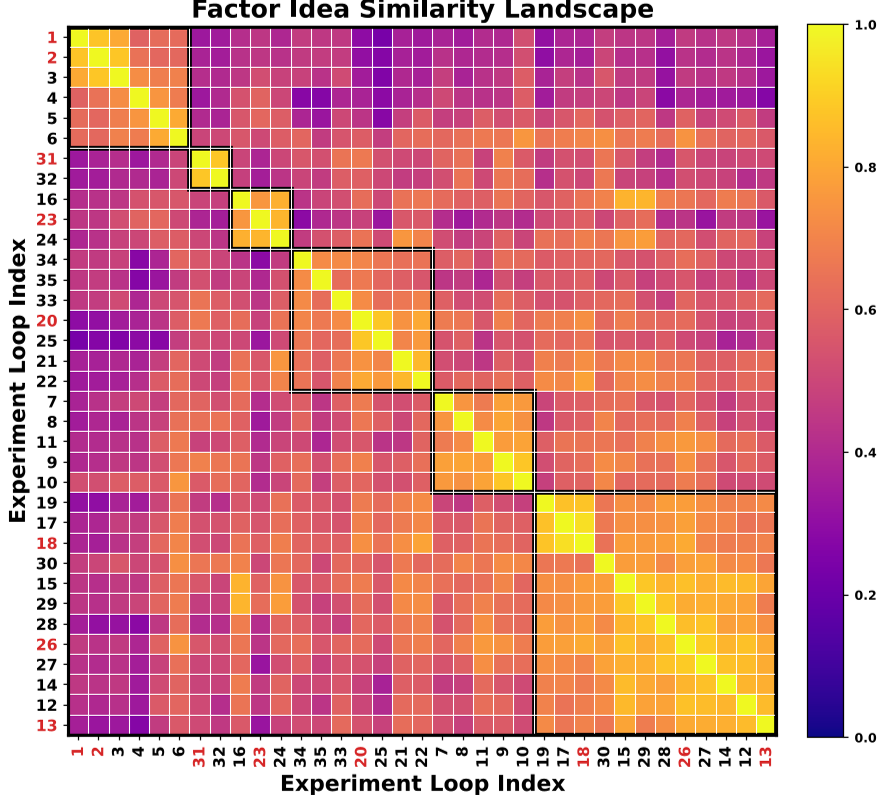
The paper includes a fascinating visualization of the agent's thought process through embedding clusters of generated hypotheses. Instead of wandering aimlessly, the agent demonstrates a Local Refinement strategy: it explores a specific economic idea (e.g., momentum), exhausts its potential through minor code tweaks, and then performs a Directional Shift to a new concept (e.g., volatility clustering). This mimics the workflow of a senior human analyst.
Critical Analysis & Future Outlook
Strengths: R&D-Agent(Q) provides executable code for every signal, solving the interpretability problem. It is also incredibly cheap—running the entire loop costs less than $10 in API tokens, making it accessible for boutique funds.
Limitations: Currently, the system relies on the LLM's internal financial knowledge. It does not yet "read" the morning news or macroeconomic reports in real-time.
The Future: The authors suggest that the next step is Multimodal Integration. Imagine an agent that reads corporate filings in PDF, parses the CEO's sentiment on a conference call, and then writes the code to turn that sentiment into a trading factor. R&D-Agent(Q) is the foundation for that future.
Conclusion
R&D-Agent(Q) is a masterclass in applying Multi-Agent Systems to a high-dimensional, noisy domain. By formalizing the quant research pipeline into a recursive, data-centric loop, it proves that "AI Researchers" are no longer a distant possibility—they are already outperforming human-crafted benchmarks.