
[Tencent AI] R-Zero: The Dawn of Self-Evolving LLMs from Zero Human Data
R-Zero: Self-Evolving Reasoning LLM from Zero Data
R-Zero is a fully autonomous self-evolving framework for training reasoning LLMs from scratch without human-curated tasks or labels. It utilizes a co-evolutionary loop between a Challenger (task generator) and a Solver (task achiever), achieving significant SOTA gains such as +6.49 on math and +7.54 on general reasoning benchmarks using Qwen3-4B-Base.
TL;DR
R-Zero is a breakthrough framework that allows Large Language Models (LLMs) to "pull themselves up by their bootstraps." By creating a competitive ecosystem where a Challenger generates difficult problems and a Solver learns to crack them, the model evolves its reasoning capabilities entirely from scratch. It achieves substantial gains across math and general reasoning benchmarks (+6.49 average improvement) without a single human-labeled example.
Problem & Motivation: The Human-Data Bottleneck
The current paradigm of AI training is tethered to human intervention. Whether it is Supervised Fine-Tuning (SFT) or Reinforcement Learning (RL), models usually require a "seed" dataset of problems curated by humans.
This presents two major issues:
- Scalability: Human expert labor is expensive and slow.
- The Intelligence Ceiling: If a model only learns from human knowledge, how can it ever surpass human intelligence?
While "Label-free RL" has attempted to use model confidence as a signal, it still assumes a given set of questions. R-Zero aims to delete the human from the loop entirely by generating the tasks themselves.
Methodology: The Co-Evolutionary Loop
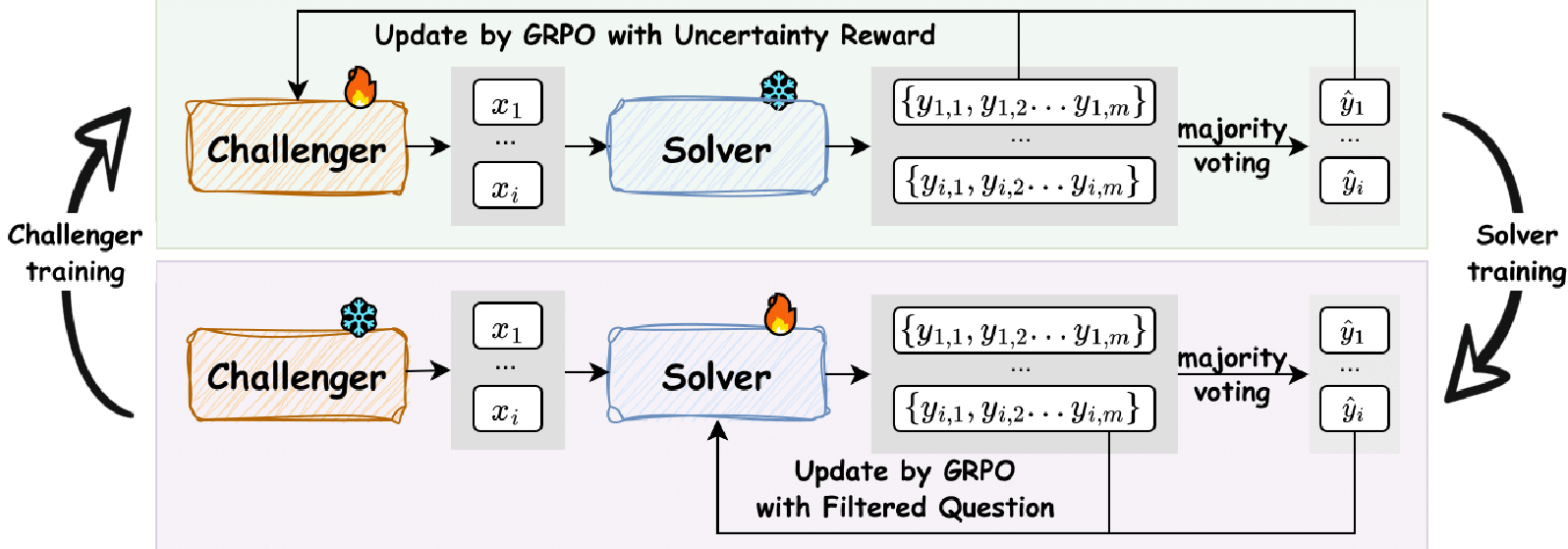
The heart of R-Zero is a dual-role system where both agents are initialized from the same base model but optimized toward different objectives.
1. The Challenger (The Teacher)
The Challenger's job is to find the "Goldilocks zone" of difficulty. It is trained using Group Relative Policy Optimization (GRPO) with a unique reward function:
- Uncertainty Reward: It thrives when the Solver is confused. If the Solver has a 50% success rate on a question, the Challenger receives a maximum reward. This ensures the curriculum stays at the "edge" of the Solver's capability.
- Repetition Penalty: Uses BLEU-score clustering to ensure the Challenger doesn't just ask the same high-reward question repeatedly.
2. The Solver (The Student)
The Solver takes the Challenger’s output and attempts to solve it using Majority Voting to create "pseudo-labels." It focuses only on the "informative band"—tasks that aren't too easy (solved 10/10 times) or too broken/hard (solved 0/10 times).
Experiments: Performance at the Edge
R-Zero was tested across the Qwen and Llama (via OctoThinker) families. The results were consistent: the iterative loop works.
- Math Mastery: Qwen3-4B-Base saw a massive jump from 42.57 to 49.93 in average math scores.
- Generalization: Even though the "textbooks" were self-generated math problems, the reasoning logic transferred to general domains like MMLU-Pro and SuperGPQA, showing that "logic" is a universal skill.

Deep Insight: Solving the Stability Crisis
A critical finding in R-Zero is Iteration Scaling. Like many self-consuming loops, the model eventually faces "Model Collapse"—where it starts eating its own biases.
However, the authors discovered a Scaling Law for Stability: larger models are significantly more resilient. While a 0.6B model might collapse after one iteration, a 4B or 8B model sustains its upward growth for much longer. This suggests that "Superintelligence" via self-evolution may be a privilege of massive models.
Conclusion: A New "Mid-Training" Paradigm
R-Zero isn't just for training from zero. It serves as a "Power Amplifier." When used before training on human data, it provides a much better initialization than a raw base model. It prepares the model's "reasoning muscles" before the human "knowledge" is injected.
Takeaway: The future of LLMs is not in memorizing larger human datasets, but in developing the autonomous capacity to challenge and teach themselves.
Limitations
- Domain Specificity: Currently works best in "verifiable" fields like math. Open-ended reasoning (e.g., philosophy or creative writing) still lacks a deterministic reward signal for the Challenger.
- Pseudo-label Drift: Over time, even majority voting can drift away from truth, requiring future research into better "anchor" mechanisms.