
Deciphering the Blueprint: Why Every Developer Needs "Race & Gender in Silicon Valley"
1214_Race and gender in silicon valley.
The paper introduces a novel Stanford University seminar, "Race & Gender in Silicon Valley," which integrates humanities and social science methodologies into the Computer Science curriculum to address systemic inequality and algorithmic bias.
TL;DR
Stanford Lecturer Cynthia Lee introduces a transformative CS seminar that shifts focus from "how to code" to "who gets to code" and "who does the code hurt?" By merging technical education with social justice frameworks, the course addresses the systemic biases baked into both the tech workforce and modern AI/Data products.
The Missing Link in CS Education
As Silicon Valley moves faster than the laws meant to regulate it, a critical gap has emerged: the "Neutrality Myth." Most CS programs treat algorithms as purely mathematical constructs, yet these systems are built by humans within a specific cultural context.
Prior curricula often failed because they treated diversity as a HR checkbox rather than a technical design constraint. This paper argues that the lack of representation isn't just a social issue—it's a product failure issue, leading to sexist apps, biased policing algorithms, and predatory data practices.
Methodology: Beyond the Binary
The syllabus isn't just about reading headlines; it’s about Identity Formation and Structural Critiques. The methodology focuses on three pillars:
- The Pipeline Myth: Analyzing how early childhood and "geek culture" define who sees themselves as a "computer person."
- Algorithmic Oppression: Using texts like Algorithms of Oppression to show how search engines and AI don't just reflect bias—they amplify it.
- Critical Agency: Teaching students to identify systemic patterns in their own workplaces and classrooms.
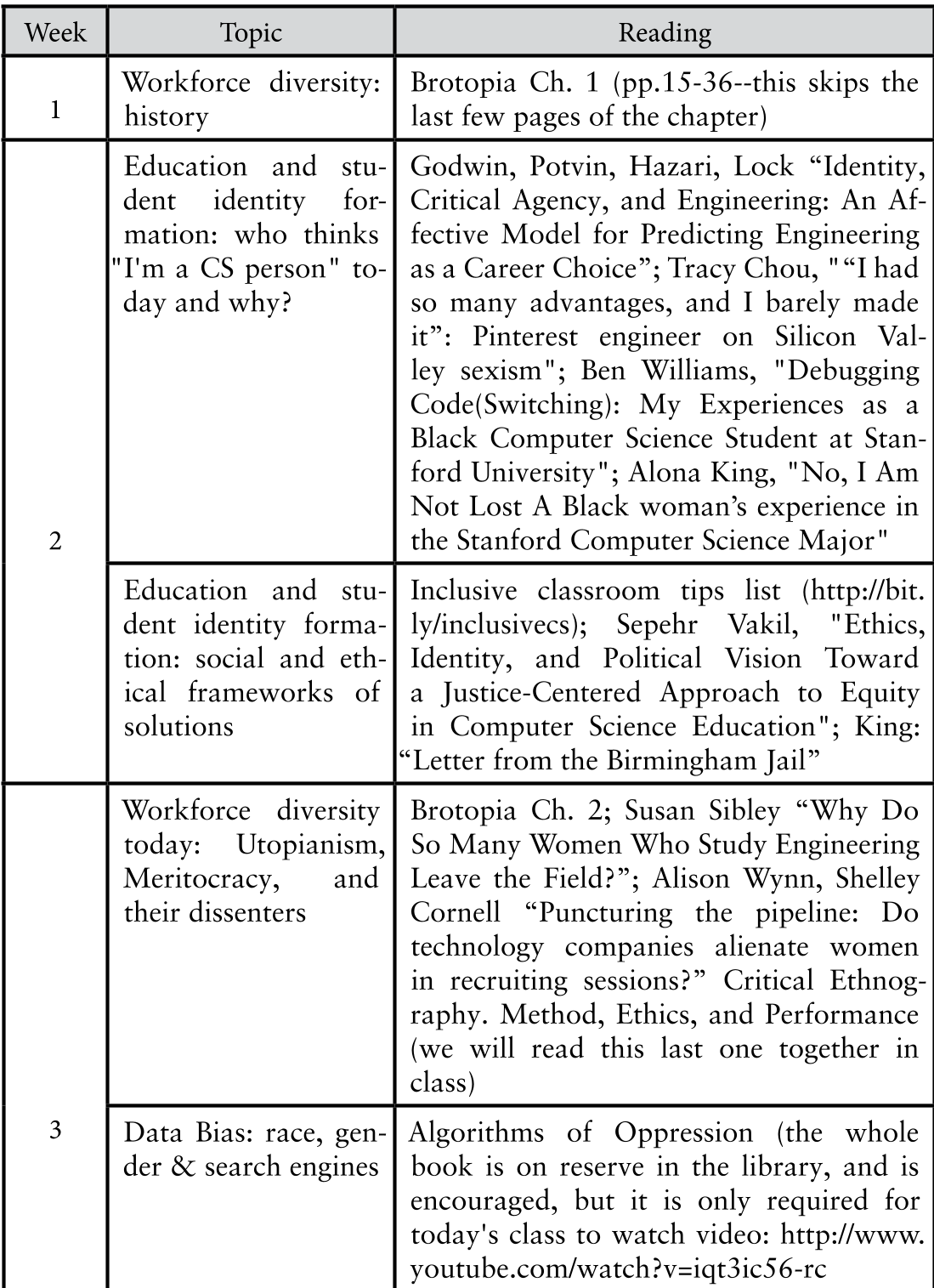 Above: The first half of the syllabus, transitioning from historical workforce diversity to the technical reality of Data Bias.
Experiments & Results: Turning Theory into Action
The course didn't just end with a final exam; it produced "Actionable Takeaways."
- Student Insight: The primary feedback was a demand for this material to be a requirement, not an elective.
- K-12 Impact: Student projects focused on "repackaging" these complex topics for high schoolers, creating a feedback loop to address the pipeline issue at its source.
- Case Study Rigor: By analyzing the "James Damore Memo" and "Brotopia" alongside police body-cam data studies, students learned to apply rigorous academic scrutiny to industry controversies.
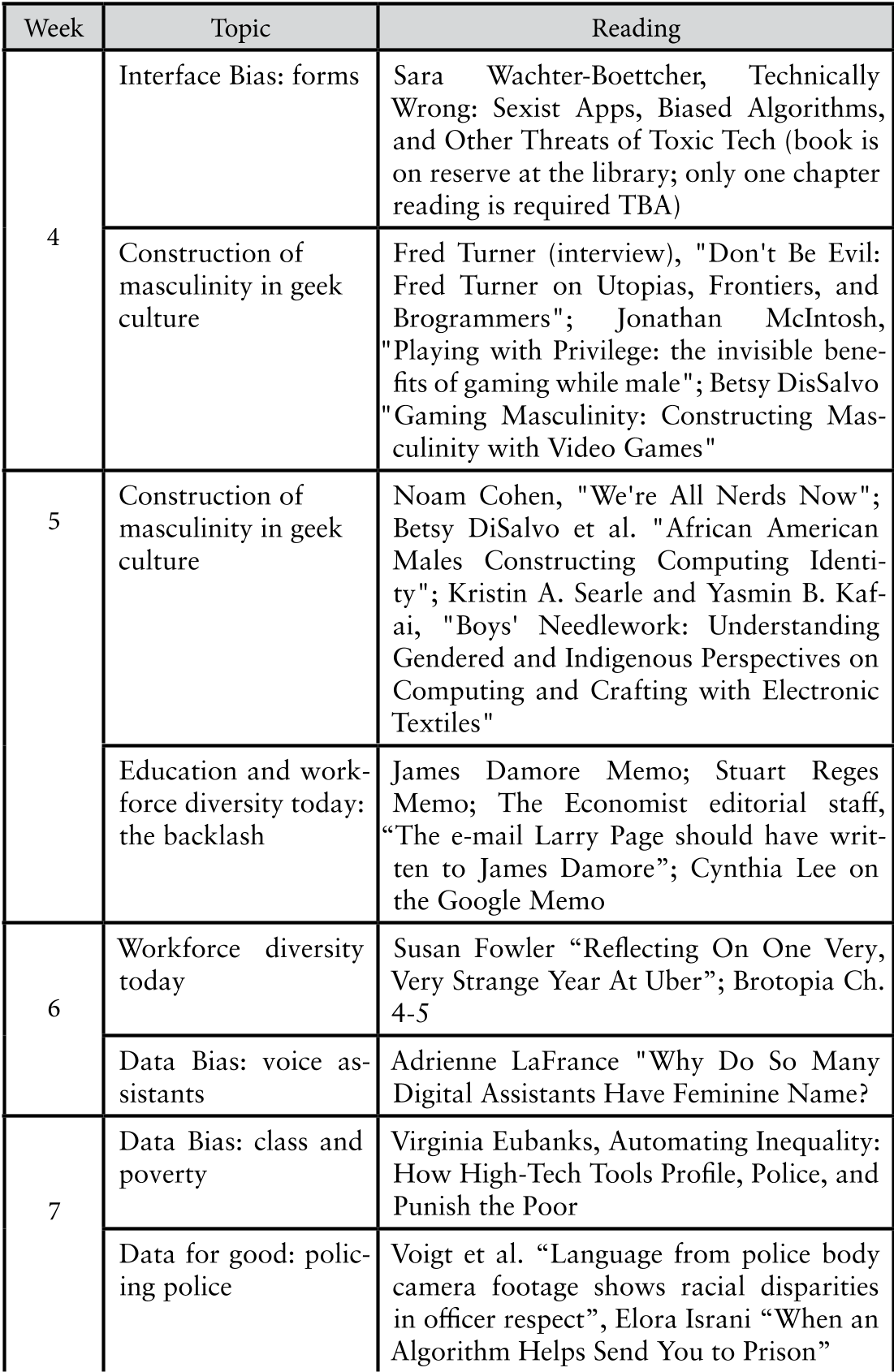 Above: The second half of the curriculum, focusing on masculinity in geek culture and the automation of inequality.
Critical Analysis: Is it Enough?
While the seminar is a massive leap forward, its impact depends on scaling. One seminar at Stanford is a drop in the bucket compared to the thousands of developers entering the field annually.
Takeaway: The real value of Cynthia Lee’s work is the reproducible syllabus. It provides a modular framework that other universities can "insert into elective courses or core CS Principles."
Future Outlook: For AI to be truly "de-biased," the builders must first understand the social history of the tools they use. This paper isn't just a course description; it's a call for a paradigm shift in how we define a "qualified" computer scientist.