
Participation or Profiteering? The Hidden Corporate Logic of Zambian Radio
Participation – In what? Radio, convergence and the corporate logic of audience input through new media in Zambia
This study investigates the integration of new media (mobile phones/internet) in Zambian radio broadcasting. It analyzes how "participation" is redefined within a corporate logic, moving beyond democratic ideals to serve commercial strategies like revenue generation and data mining.
TL;DR
In the digital age, we are told that mobile phones and the internet have turned passive listeners into active "produsers." However, Wendy Willems’ research in Zambia reveals a more complex reality: while new media broadens the reach of voices, it often subjects them to a corporate logic. Radio stations are not just looking for "voice"; they are hunting for premium SMS revenue and valuable marketing data.
Contextualizing the "Demotic Turn"
The study frames Zambian radio within the "demotic turn"—the increasing visibility of ordinary people in media content. In a country historically characterized as "media-phobic" with "reluctant liberalization," the shift from landlines to mobile phones seemed like a democratic breakthrough.
However, the transition involves a move from unsolicited participation (where listeners take the initiative) to managed participation (where producers decide who gets heard, when, and why).
Methodology: Insights from the Booth
Willems conducted interviews across six key stations:
- Public: ZNBC Radio Two
- Commercial: Radio Phoenix, Q FM, Flava FM
- Community: Radio Icengelo, Sky FM
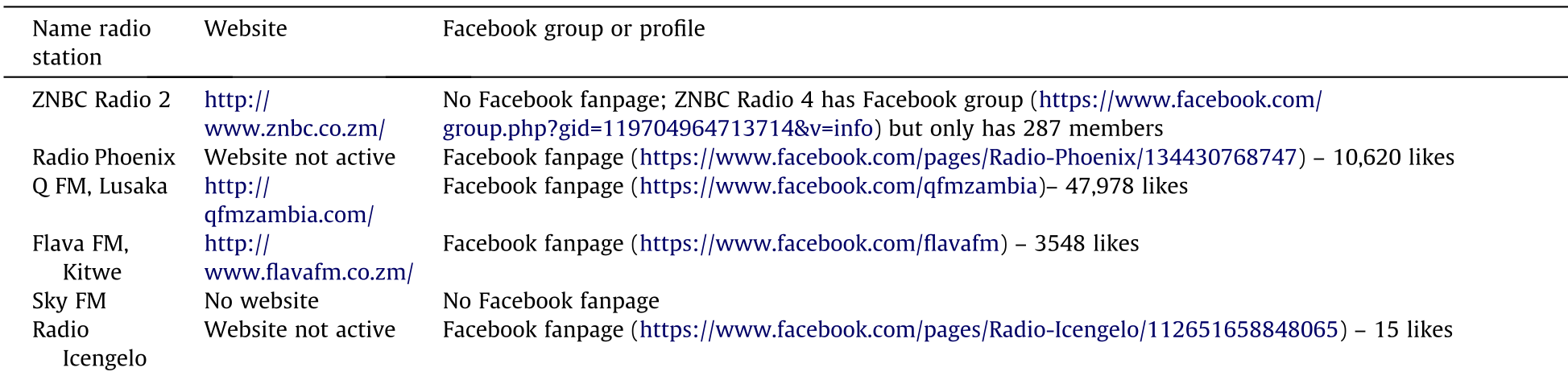 Table 1: The varying adoption of new media across Zambian radio sectors.
The Core Conflict: Voice vs. Data
The research identifies a dual transformation driven by technological convergence:
1. The Power of "Silence"
Producers admitted that while live phone calls are spontaneous and hard to control (often lacking a delay facility), SMS and Facebook comments are "safer." They are easier to censor or ignore entirely.
"For us the SMS line adds value... it is an advantage in the sense that you are able to censor some of the SMSs that are not in good taste for the nation." — ZNBC Presenter.
2. Communicative Capitalism
Participation is increasingly a revenue stream. Radio stations collaborate with mobile service providers (like MTN and Airtel) to promote premium-rate SMS short codes.
- Data Mining: Stations like Q FM archive phone numbers—not to remember the listener's opinion, but to build a database for outbound SMS advertising.
- The Commodity: The "message" loses its use-value (the content) and gains exchange-value (the cost of the SMS and the metadata generated).
The "Informed" Audience: A Glimmer of Hope
Despite the corporate capture, the internet has empowered listeners to "up their game." Access to information allows audiences to research topics in real-time. This forces presenters to be more rigorous in their reporting, as a listener in a remote district might know more about a global news story (like the Ivory Coast crisis) than the person behind the microphone.
Critical Reflection
Willems concludes that we must ask: "Participation—In what?" Are listeners participating in a democratic debate, or are they participating in the station's business model? The study suggests that while new media has undoubtedly broadened the quantity of participation, the quality and intent are under constant pressure from neoliberal market forces.
Key Takeaways for Future Research
- Technological Neutrality is a Myth: The architecture of a medium (SMS vs. Live Call) dictates the power balance between producer and audience.
- Follow the Money: In developing media markets, audience engagement strategies are often dictated by the need to survive a competitive, commercialized environment.
- Agency Persists: Despite corporate structures, listeners use the flexibility of mobile radio to turn "passive" listening into a mobile, interactive experience.
 Zambian radio's evolution from colonial feedback to digital data streams.