
Efficient Radio Map Updating: Leveraging Sparse Priors in Crowdsourced Indoor Positioning
9789_Radio Map Crowdsourcing Update Method Using Sparse Representation and Low Rank Matrix Recovery for WLAN Indoor Positioning System.
This paper proposes a radio map update method based on Sparse Representation and Low-Rank Matrix Recovery (LRMR) for WLAN indoor positioning. By leveraging the fingerprint correlation from outdated radio maps through dictionary learning, the method reconstructs accurate signal strength distributions even with sparse, noisy crowdsourced data from unprofessional volunteers.
TL;DR
Indoor positioning accuracy relies on the "Radio Map," but keeping this map updated is a logistical nightmare. This paper introduces a robust recovery method that uses Sparse Representation and Low-Rank Matrix Recovery (LRMR). By treating the radio map as a low-rank matrix and extracting structural patterns from "outdated" data, the authors can reconstruct a high-fidelity radio map from sparse, noisy samples provided by casual volunteers.
Problem & Motivation: The Crowdsourcing Paradox
In WLAN fingerprinting, the accuracy of our position depends on a pre-recorded grid of signal strengths (RSS). When Access Points (APs) move or furniture is rearranged, this grid becomes obsolete.
- The Traditional Fix: Professional site surveys are slow and expensive.
- The Crowdsourced Fix: Volunteers collect data, but it's often "dirty"—incomplete, non-uniformly distributed, and plagued by bursty transmission noise.
- The Gap: Current Matrix Completion (MC) techniques treat the radio map as a generic grid, ignoring the fact that while actual RSS values change, the spatial correlation (the layout of the building) remains largely invariant.
Methodology: Fusing the Old with the New
The core insight of this paper is that the correlation between fingerprints is more stable than the signals themselves.
1. Dictionary Learning from the Past
The authors use a sliding window approach on the outdated radio map to train an over-complete dictionary using the K-SVD algorithm. This dictionary captures the underlying patterns of signal propagation specific to that building.
2. The Robust Matrix Recovery Model
The update task is converted into a mathematical optimization problem. They seek a new map that is:
- Low Rank: Reflecting the global consistency of signal space.
- Sparsely Represented: Consistent with the dictionary from the outdated map.
- Noise-Resilient: Capable of isolating sparse noise from the observation .
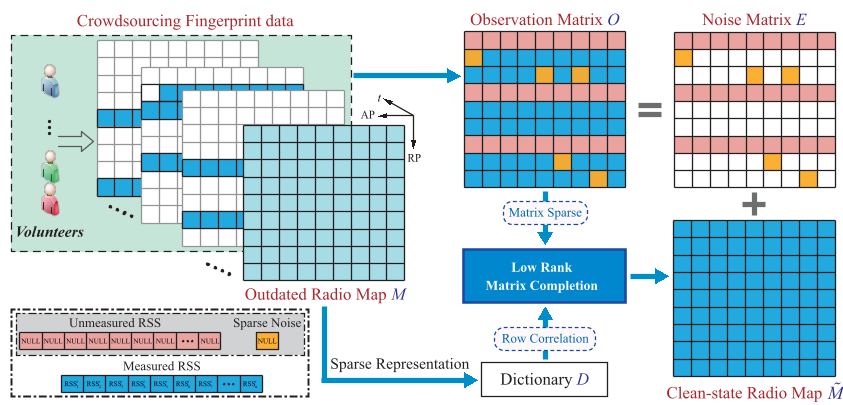 Figure 1: The system architecture showing how the outdated map (M) informs the construction of the new map (M-tilde) through sparse representation.
3. Optimization via APG and ADMM
To solve the complex Lagrangian formulation, the authors use the Alternating Direction Method of Multipliers (ADMM). To ensure the system can update fast enough for practical use, they integrate the Accelerated Proximal Gradient (APG), reducing the convergence rate to .
Experimental Validation
Testing occurred on the 12th floor of Harbin Institute of Technology, utilizing 27 APs and 823 reference points.
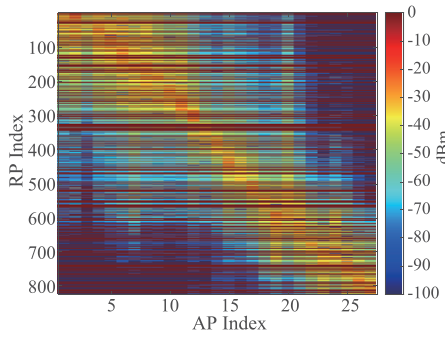 Figure 2: (a) Floor plan, (b) Clean-state ground truth, and (c) Outdated map used for dictionary training.
Key Results:
- Resilience to Sparse Data: Even when only 20-50% of the map is covered by crowdsourced data, the Root Mean Square Error (RMSE) remains below 3dB.
- Positioning Accuracy: Using KNN (), the method achieves a 90% confidence level for errors within 0.25 meters in standard crowdsourcing scenarios.
- Speed: The algorithm converges in fewer than 30 iterations, making it viable for live deployment.
Critical Analysis & Takeaways
The brilliance of this work lies in how it frames outdated data as a "Prior" rather than "Trash." By extracting the spatial manifold from the old map, it provides the low-rank algorithm with a "cheat sheet" for what the new map should look like.
Limitations:
- Structural Sensitivity: If the physical structure of the building changes significantly (e.g., a new wall is built), the dictionary learned from the outdated map may become a source of error.
- AP Density: The performance is inherently tied to the density of RSS fingerprints; very sparse AP deployments might reduce the "low-rankness" of the matrix.
Future Outlook: This framework could be extended to multi-modal sensing, where signal strength is fused with IMU (Inertial Measurement Unit) data from smartphones to further densify crowdsourced updates without extra hardware.