
RAGSys: Why Your RAG Pipeline Should Act Like a Recommender System
Ragsys: Item-cold-start recommender as rag system
The paper introduces RAGSys, a framework that re-conceptualizes In-Context Learning (ICL) as an item-cold-start recommendation problem. It proposes a retrieval algorithm combining semantic relevance, diversity via Maximal Marginal Relevance (MMR), and quality bias based on log-perplexity.
TL;DR
Standard RAG systems often suffer from "information redundancy" by only focusing on semantic similarity. RAGSys argues that retrieving demonstrations for In-Context Learning (ICL) is actually an item-cold-start recommendation problem. By prioritizing diversity and quality bias over simple similarity, RAGSys enables 8B-parameter models to outperform 70B-parameter giants on complex factual tasks like TruthfulQA.
Background: The Hidden Flaw in Semantic Search
Most developers treat RAG as a search problem: find the Top-K most similar documents to a query and stuff them into the prompt. However, if the Top-5 results are all semantically identical, you haven't given the LLM five pieces of evidence; you've given it the same piece of evidence five times. This wastes the "context budget" and fails to provide the variety of reasoning paths the LLM needs to solve a problem.
Methodology: Reimagining Retrieval as Discovery
RAGSys shifts the paradigm from Similarity to Information Gain. The authors propose a three-pillar retrieval strategy:
- Semantic Relevance: Using BERT embeddings to find demonstrations topically aligned with the query.
- Maximal Marginal Relevance (MMR): A diversity algorithm that penalizes candidates that are too similar to already selected demonstrations.
- Quality Bias (Perplexity): Prioritizing examples that the LLM "finds familiar" based on its pre-training data (measured by low perplexity).
The RAGSys Algorithm
The core of the system is a greedy selection process (Algorithm 1) that balances these three factors using λ (lambda) hyper-parameters.

Above: The quality bias formula based on normalized log-probability of the answer given the query.
A New Gold Standard for Evaluation: The DPO Metric
One of the paper's most brilliant contributions is moving away from subjective "diversity scores." Instead, they use the Direct Preference Optimization (DPO) loss formula to measure performance.
It calculates the log-ratio of the probability of a correct answer with the context versus without the context. If your retrieved demonstrations help the model generate the right answer, the DPO score goes up. This provides a mathematically grounded way to tune RAG systems.
Experiments and Results
The authors tested RAGSys across Mistral and Llama-3 families on the TruthfulQA dataset.
Key Findings:
- Diversity is King: In almost every test case,
Rel+Div(Relevance + Diversity) significantly outperformedRel(Pure Relevance). - The Size Paradox: A Llama-3-8B model equipped with RAGSys achieved better MC1 (accuracy) scores than a Llama-3-70B model using standard fixed prompts.
- The Complexity Trade-off: Interestingly, the "Quality Bias" helped Llama-3 but slightly hurt Mistral, suggesting that quality filters need to be calibrated specifically to the LLM's pre-training "expectations."
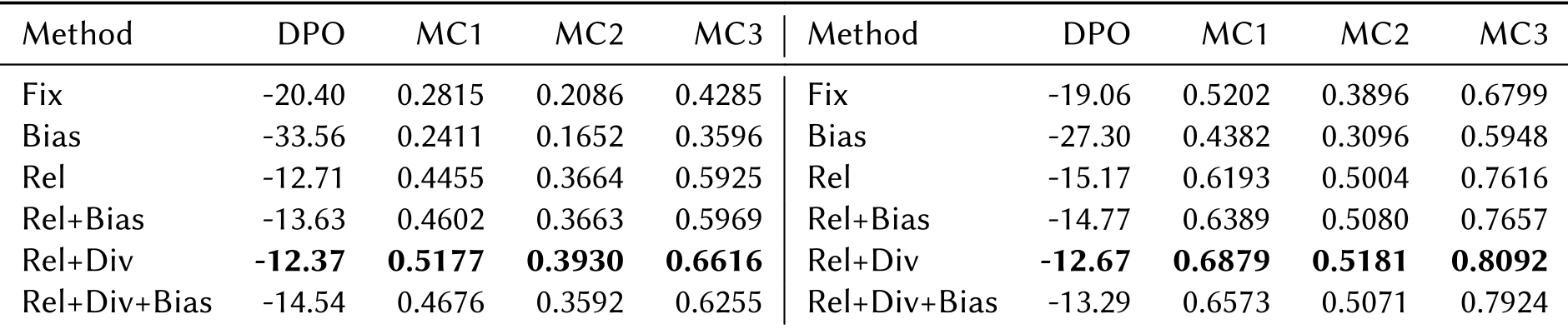
Table: Note how Rel+Div consistently elevates the DPO and MC (Multiple Choice) metrics.
Depth Insight: Diversity Metrics vs. Performance
The paper includes a fascinating visualization of the "Sweet Spot." If you have too much similarity, the model lacks information. If you have too much diversity, the information becomes irrelevant.
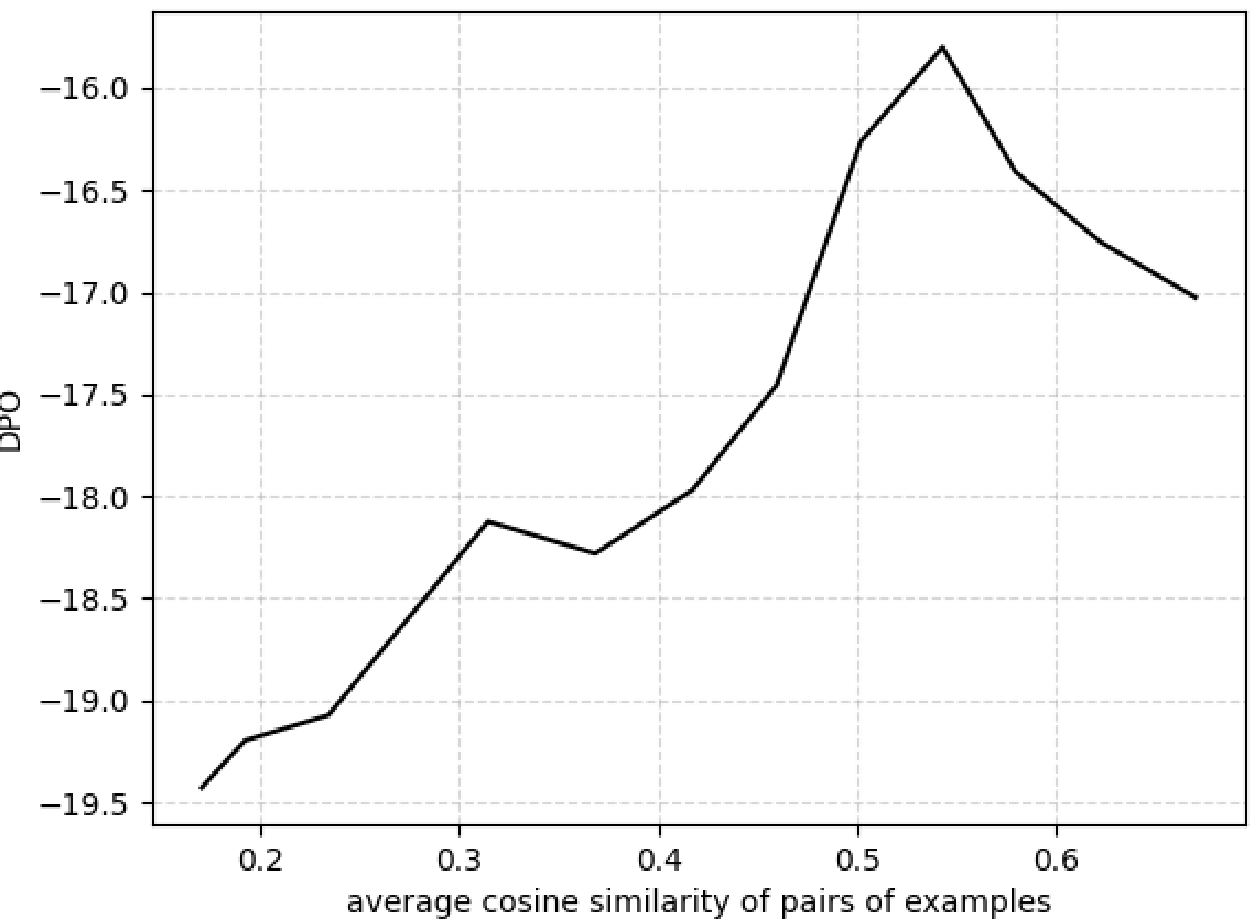
Figure 1: The non-monotonous relationship between diversity and DPO performance highlights why we need objective metrics to tune λ parameters.
Critical Analysis & Conclusion
Takeaway: The "RAG" in most current products is too simple. By borrowing techniques from Recommender Systems—specifically those designed for cold-start discovery—we can maximize the utility of the context window.
Limitations:
- Hyper-parameter sensitivity: The optimal λ values are model-dependent.
- Latency: While the paper argues latency is "free" due to batch processing in modern APIs, post-processing Top-K candidates for diversity adds a small CPU overhead.
Future Outlook: We expect "Vector Databases" to eventually integrate MMR and popularity-biasing natively, evolving into true "Context Engines" that serve the LLM exactly what it needs to learn, not just what it asks for.