
Beyond Global Accuracy: Using Nesting Ensembles to Predict ICU Infections
Random Forest Based Ensemble Classifiers for Predicting Healthcare-Associated Infections in Intensive Care Units
2016-01-01
Summary
Problem
Method
Results
Takeaways
Abstract
This paper presents an ensemble-based machine learning framework to predict healthcare-associated infections (HAI) in Intensive Care Units (ICUs). By combining Bagging and Random Forest architectures, the authors achieve a robust predictive model that maintains high performance on severely imbalanced medical datasets.
## TL;DR
Predicting Healthcare-Associated Infections (HAI) is a "needle in a haystack" problem. This paper introduces a robust framework that utilizes the combined power of **Bagging** and **Random Forests** to overcome the extreme class imbalance (6.7% infection rate) in ICU patient data. The result is a model that doesn't just guess "no infection" to stay safe, but actually identifies at-risk patients with high precision and an **87.90% ROC Area**.
## Background: The Imbalance Trap in Healthcare
In the ICU of the University Hospital of Salamanca, only about 7 out of every 100 patients acquire a device-associated infection. While this is good news for patients, it is a nightmare for Data Mining. A "dumb" model that predicts "No Infection" for everyone would be 93.3% accurate—yet it would be completely useless to a doctor trying to save lives.
Current solutions fall into three categories:
1. **Data Resampling**: Artificially inflating the minority (Oversampling) or gutting the majority (Undersampling).
2. **Cost-Sensitive Learning**: Penalizing the model more for missing an infection.
3. **Algorithmic Modification**: Changing the math of the learners themselves.
However, these often lead to **overfitting** or require subjective "cost" guesses from domain experts.
## Methodology: The Power of Nested Diversity
The authors' core insight is that **diversity is the antidote to instability**. Instead of just one model, they use an ensemble (a group) of models. Specifically, they focus on two heavy-hitters: **Bagging** and **Random Forest**.
### Why this combination?
* **Random Forest** is already an ensemble of decision trees that uses feature randomness.
* **Bagging (Bootstrap Aggregating)** creates multiple versions of a training set through random sampling with replacement.
By using Random Forest *as the base learner* for Bagging, the authors create a "nested ensemble." This double-layer approach effectively smooths out the bias that usually plagues imbalanced datasets.
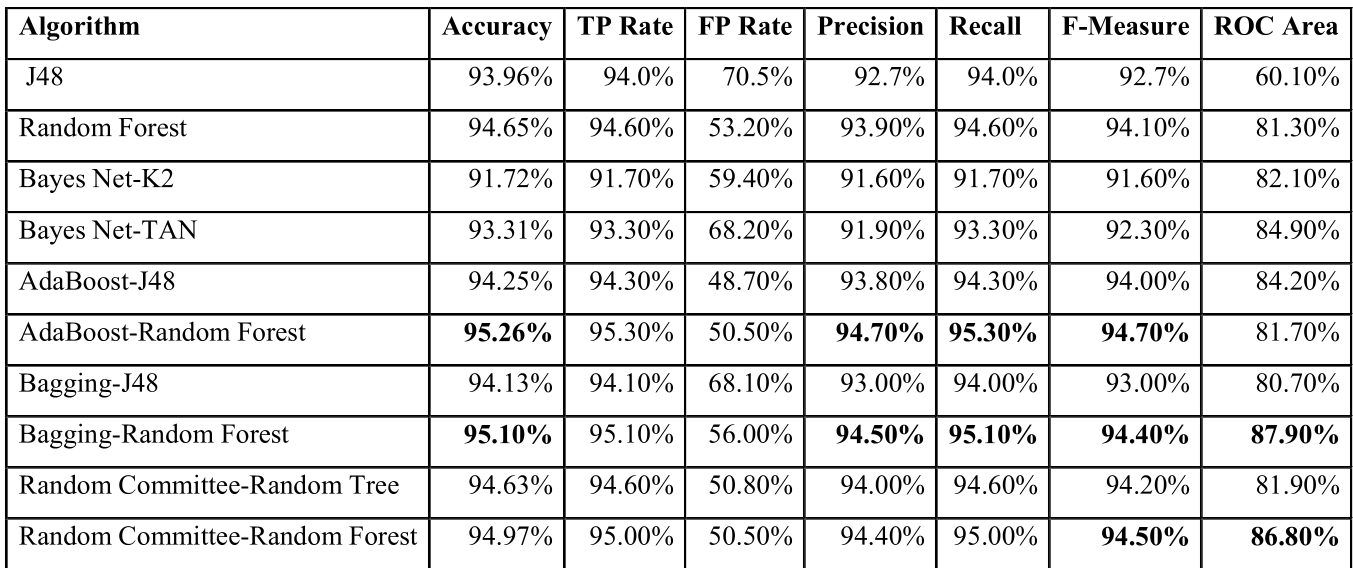
*Table 1: Performance metrics across various single and ensemble classifiers. Note the high ROC Area for Bagging-Random Forest.*
## Experiments and Results
The study tested several configurations, including J48 trees, Bayesian Networks (TAN, K2), and various combinations of AdaBoost and Bagging.
### Key Findings:
- **Bagging + Random Forest** emerged as the winner. It achieved an **ROC Area of 87.90%**, significantly higher than the simple J48 tree (60.10%).
- **AdaBoost + Random Forest** achieved slightly higher accuracy (95.30%) but had a lower ROC Area.
- **Diversity Matters**: The results show that Random Forest, when used as a base classifier for any ensemble, consistently improves the precision of the minority class.
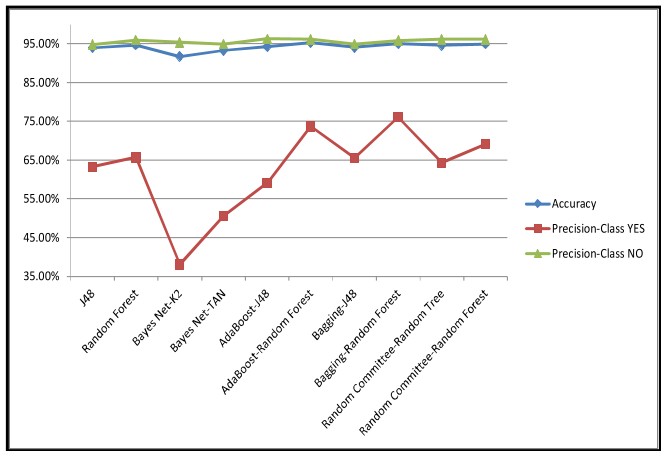
*Fig 1: Comparison of Precision, Recall, and F-measure across models. Ensemble methods clearly dominate the left side of the chart.*
## Final Insight: The Engineering of Reliability
The real value of this research lies in its avoidance of "synthetic" data. By using ensemble methods to manage imbalance, the researchers avoid the risk of overfitting that comes with duplicating minority samples (Oversampling).
For clinical practitioners, this translates to a more reliable early-warning system. The model identifies risk factors like **APACHE II scores, Mechanical Ventilation duration, and Catheter usage** without being blinded by the fact that infections are relatively rare.
### Limitations & Future Work
While the ensemble approach is powerful, it is also computationally more expensive than a single tree. Future research could explore **Feature Selection** to prune unnecessary variables (like specific patient demographics) further to increase the "signal" in the minority class before it even reaches the ensemble.