
GoldAI Sachs: Bridging Human Genetics and Deep Learning for Smart Fintech Investment
The Random Neural Network with a Genetic Algorithm and Deep Learning Clusters in Fintech: Smart Investment
This paper introduces a biologically-inspired "GoldAI Sachs" Fintech framework combining Random Neural Networks (RNN) with a novel Genetic Algorithm. It utilizes Deep Learning Clusters and Reinforcement Learning to simulate a human-brain-like decision structure for automated "Smart Investment" in bond and derivative markets.
TL;DR
The paper presents GoldAI Sachs, an advanced financial decision-making system built on the Random Neural Network (RNN). By emulating the modular structure of the human brain and the transmission mechanism of the human genome, the system integrates Reinforcement Learning for immediate market actions, Deep Learning Clusters for identity and memory, and a novel Genetic Algorithm to preserve and pass on learned strategies to future iterations of the model.
Problem & Motivation: Beyond Simple Predictions
The financial market is a chaotic environment where "learning" isn't just about predicting the next price point—it's about surviving through adaptation. Most traditional AI models in Fintech are either:
- Too Rigid: Failing to adapt when market conditions shift from bull to bear.
- Biologically Inaccurate: Using genetic algorithms that simply swap parameter values rather than evolving systemic behaviors.
The author's intuition is that intelligence should be modular. In the human brain, clusters of neurons specialize in specific tasks (memory, strategy, reflex). This paper seeks to replicate that hierarchy to manage the inherent trade-off between risk and reward.
Methodology: The "Genomic" Neural Architecture
The core of the system is a hierarchy of specialized "Bankers":
1. The Asset Banker (The Reflex)
Utilizing Reinforcement Learning, individual bankers manage specific assets. They use two interconnected neurons—one for "Buy" (q0) and one for "Sell" (q1)—to make split-second decisions based on immediate rewards (profit).
2. Deep Learning Clusters (The Memory & Identity)
Unlike a flat network, this model uses clusters of neurons (G-Networks). These clusters provide "identity" by memorizing the specific volatility and behavior of assets like Bonds vs. Derivatives.
3. The Genetic learning Algorithm (The Evolution)
This is the most innovative part of the paper. The author models the genome using an auto-encoder that maps network weights into four nucleoids: Cytosine (C), Guanine (G), Adenine (A), and Thymine (T).
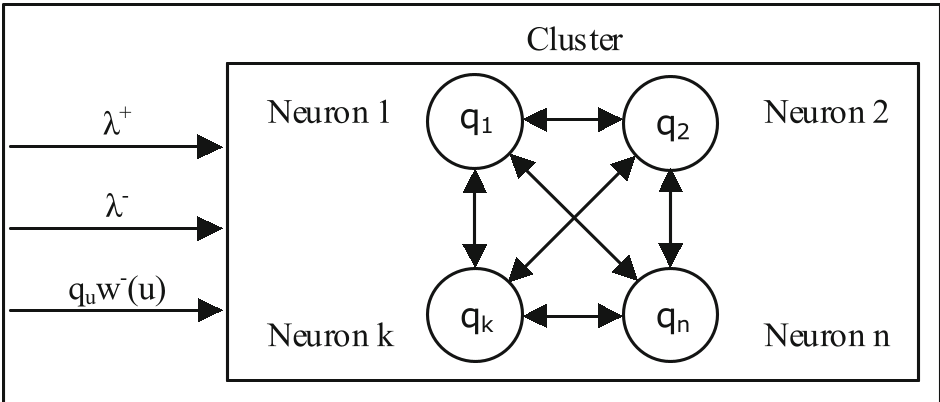 Fig: The modular cluster structure mimicking brain region specialization.
The transmission of "knowledge" isn't about neurons themselves, but the combination of genes (weights) between the input and output layers. The auto-encoder ensures that the "organism" (the model's state) can be perfectly replicated in the next generation using a Moore-Penrose pseudoinverse calculation.
Experiments: Validating "AI Morgan"
The system was tested on eight diverse assets, split into:
- Bond Market: Low risk, slow reward.
- Derivative Market: High risk, fast reward.
A "CEO Banker" (dubbed AI Morgan) managed the overall risk appetite (Beta). When Beta was set to 0.8 (high risk), the system aggressively targeted derivatives, achieving significantly higher total profits (9,280).
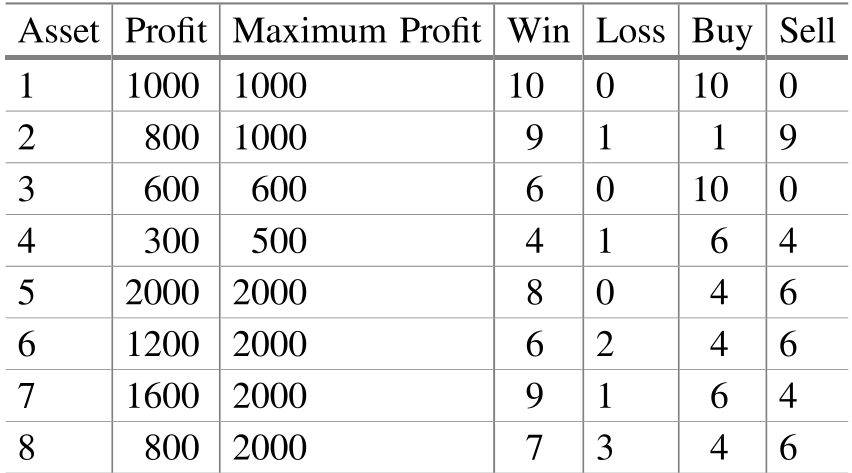 Table: Performance of Asset Bankers across different market conditions.
Key Insight from Ablation: The Reinforcement Learning component adapted instantly to assets that started with downward price trends, even though the models were initialized with a "Buy" bias. This demonstrates high plasticity.
Critical Analysis & Conclusion
Takeaway
The paper successfully demonstrates that Random Neural Networks (which use spikes/impulses rather than analog signals) combined with a genomic weight-transfer system can outperform standard black-box models in Fintech. The use of a "Management Cluster" (CEO Banker) allows for strategic risk balancing that individual neurons cannot achieve alone.
Limitations
While the results are promising, the 11-day simulation window is relatively short for a "genetic" evolution study. Furthermore, the model has yet to be tested in the high-volatility "Wild West" of cryptocurrency, where traditional risk/reward ratios often collapse.
Future Outlook
The author intends to extend this to Cryptocurrency Fintech, providing a fascinating test case for whether genomic AI can survive the extreme environments of digital assets. For researchers, this opens a new path for "Generational AI" where models don't just learn from data, but inherit wisdom from their predecessors.