
Local Parallel Radial-Trace TFPF: Breaking the Constraint of Window Length in Seismic Denoising
Random-Noise Attenuation for Seismic Data by Local Parallel Radial-Trace TFPF
The paper introduces a novel "Local Parallel Radial-Trace Time-Frequency Peak Filtering" (Local Parallel Radial-Trace TFPF) method for seismic random-noise attenuation. By performing TFPF along the local slopes of reflection events identified via radial scanning, it achieves superior noise suppression while preserving high-frequency signal components.
TL;DR
Seismic data processing faces a constant battle against random noise. While Time-Frequency Peak Filtering (TFPF) is a powerful ally, it has long been hampered by its sensitivity to "Window Length" (WL). This paper proposes a breakthrough: instead of filtering trace-by-trace, we filter along the local parallel radial trajectories of the seismic events. This shift in perspective lowers the signal's apparent frequency, improves its linearity, and allows for robust denoising without the typical signal distortion.
Background: The Dilemma of Linearity
TFPF works by encoding a noisy signal into the instantaneous frequency (IF) of a frequency-modulated analytic signal. Its "magic" relies on a crucial mathematical assumption: the signal must be locally linear.
In conventional TFPF, developers use a fixed window (PWVD) to approximate this linearity. However, seismic events are rarely perfectly linear across time. If you choose a window that is too long, the signal's curvature causes a "deterministic bias"—essentially smoothing out the very peaks and troughs you want to keep. If you choose a window that is too short, the random noise remains largely untouched.
The Insight: "Stretching" the Signal through Radial Traces
The authors' core contribution is recognizing that the direction of filtering matters more than the filter itself. By borrowing concepts from the Radial-Trace Transform (RTT), they propose that if we filter along the slope of the seismic event rather than vertically down a single channel:
- The signal is sampled at nearly the same phase.
- The apparent frequency of the event is significantly lowered.
- The signal linearity within any given window is greatly increased.
Methodology: Local Radial Scanning
To find the optimal filtering path, the algorithm employs a local radial scanning technique:
- Scanning: For a target point, the algorithm scans a range of potential slopes ().
- Maximization: It calculates the sum of absolute values along these slopes. Because random noise tends to cancel out, the slope that maximizes this sum corresponds to the true alignment of the reflection event.
- Filtering: TFPF is then applied along this optimized, locally parallel path.
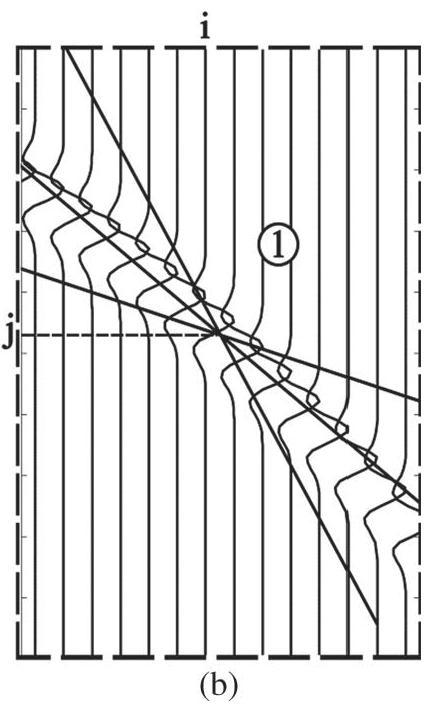 Fig 1: Conceptual visualization of radial traces (a) and their extraction (b), showing how alignment reduces apparent signal frequency.
Experimental Validation
The paper pits the proposed method against Conventional TFPF and Radial-Trace TFPF (which uses a fixed 45° angle).
Quantitative Edge
As shown in the table below, the SNR improvements are stark. While conventional TFPF peaks at a SNR of -7.47 dB before degrading due to oversmoothing, the Local Parallel Radial-Trace TFPF continues to improve as the window length increases, reaching an impressive -0.20 dB.
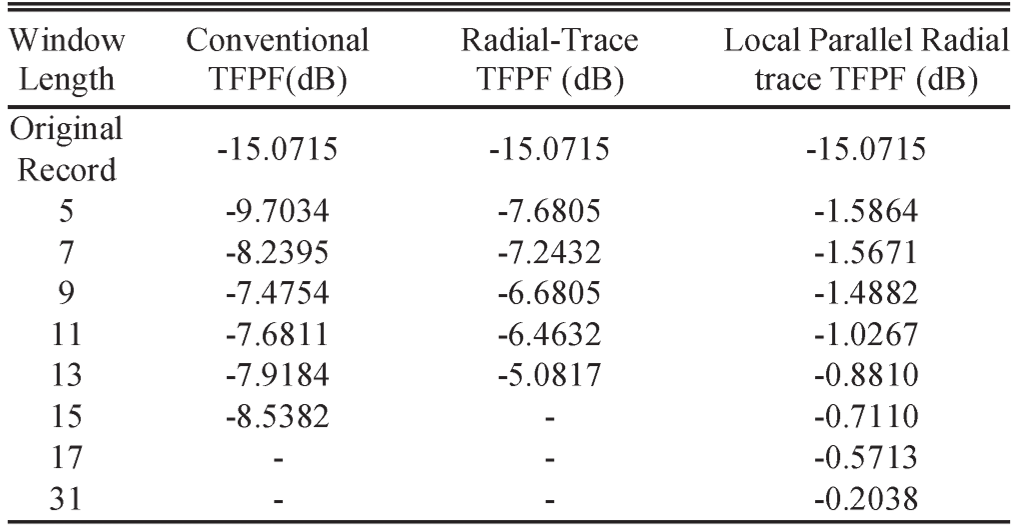 Table 1: SNR comparison showing the proposed method's superiority and insensitivity to increasing Window Length.
Visual Evidence: Field Data
When applied to real seismic shot gathers, the difference is visually obvious. In areas with weak reflection events (S2), conventional methods often lose the signal entirely when trying to suppress noise. The proposed method, however, maintains the continuity of these events, making them "clearer and more coherent."
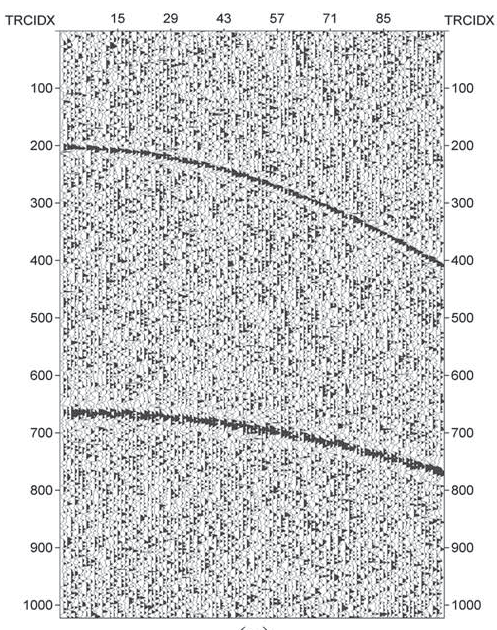 Fig 2: Comparison of (a) Noisy Record, (b) Conventional TFPF, (c) Radial-Trace TFPF, and (d) the proposed Local Parallel Radial-Trace TFPF.
Critical Insight & Conclusion
The elegance of this paper lies in its "geometric solution to a temporal problem." By recognizing that seismic data is a 2D fabric rather than a collection of 1D strings, the authors use spatial correlation to satisfy the mathematical requirements of TFPF.
Key Takeaways:
- Flexibility: There is no longer a need to meticulously tune Window Length for different dominant frequencies.
- Preservation: High-frequency components, which are usually the first casualty of denoising, are preserved because their "local linearity" is enhanced by the radial path.
- Future Impact: This principle of "filtering along the event" could be a foundational step for more advanced adaptive filtering techniques in complex structural imaging.
Limitations
While powerful, the method relies on a local linearity assumption. In extremely complex geological areas with heavy diffraction or multi-pathing, the "local slope" may become ambiguous, potentially requiring more sophisticated multi-directional scanning.