
Reddit's Butterfly Effect: How a Single Random Vote Steers Global Attention
Random Voting Effects in Social-Digital Spaces: A case study of Reddit Post Submissions
This paper presents a large-scale in-vivo experiment on Reddit (N = 93,019) to investigate herding effects in social-digital spaces. By randomly assigning "upvotes" or "downvotes" to new posts, the authors quantify how minor initial rating manipulations significantly alter the long-term collective judgment and final visibility of content.
TL;DR
In a massive live experiment on Reddit, researchers found that giving a brand-new post a single random "upvote" increases its chance of becoming a viral hit by nearly 25%. Conversely, a single "downvote" significantly suppresses its average reach. This study reveals the fragile nature of collective intelligence in digital spaces, proving that our "democratic" content curation is easily swayed by minor initial biases.
The Fragile Wisdom of the Crowd
We like to believe that platforms like Reddit or Hacker News are meritocracies: the best content rises to the top through the "Wisdom of the Crowd." However, this wisdom relies on the independence of voters. When we see a post has already been upvoted, we are victims of Herding Behavior—a psychological tendency to follow the group's lead rather than our own critical judgment.
The authors identifies a critical vulnerability: if a single vote can change the trajectory of information, then the entire mechanism of digital curation is susceptible to manipulation, bots, and accidental bias.
Methodology: The "Invisible" Nudge
To test this, the researchers ran a bot for six months that intercepted 93,019 new Reddit posts. They used three treatment groups:
- Up-treated: Received 1 artificial upvote.
- Down-treated: Received 1 artificial downvote.
- Control: No intervention.
They also introduced a random delay (from 0 to 60 minutes) to see if the "timing" of the manipulation mattered. Four days later, they harvested the final scores to measure the "echo" of that first artificial vote.
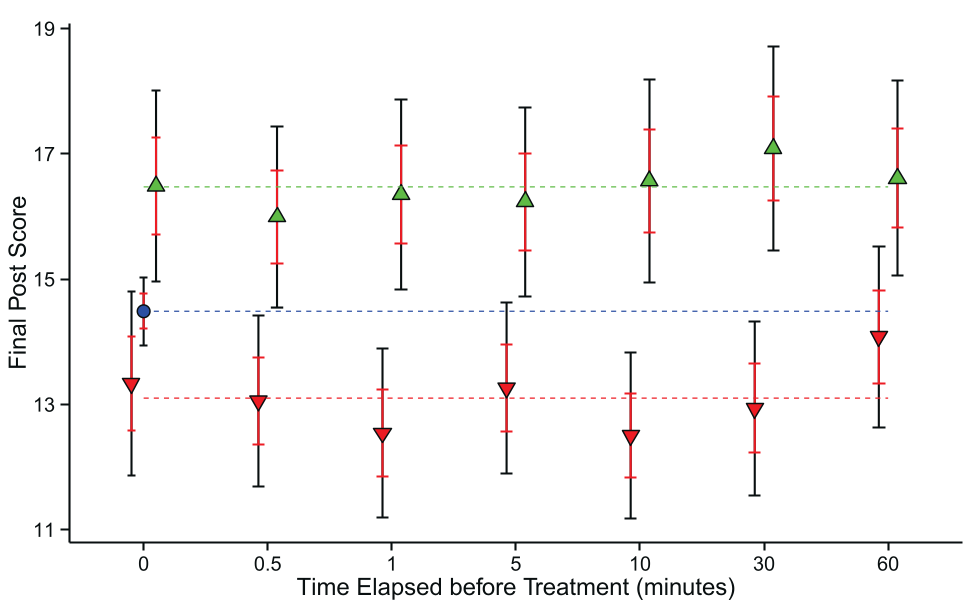 Figure 1: Comparison of final scores. Note how the distribution shifts positively for up-treated posts and negatively for down-treated ones.
Key Insights: Success is a Self-Fulfilling Prophecy
The results were striking in their asymmetry and scale:
- The Upvote Multiplier: An initial upvote led to an 11.02% higher final score on average. More importantly, it increased the likelihood of a post reaching a "mega-viral" status (score > 2000) by 24.6%.
- The Power of Negativity: Unlike previous studies on comments (e.g., Muchnik et al.), this study found that negative ratings do matter. A single downvote reduced the final score by over 5%.
- Threshold of Resilience: Interestingly, for the "top 1%" of posts that truly trended, the negative treatment had no effect. This suggests that while negativity can kill "average" content, it cannot stop a true viral phenomenon once it crosses a certain threshold of popularity.
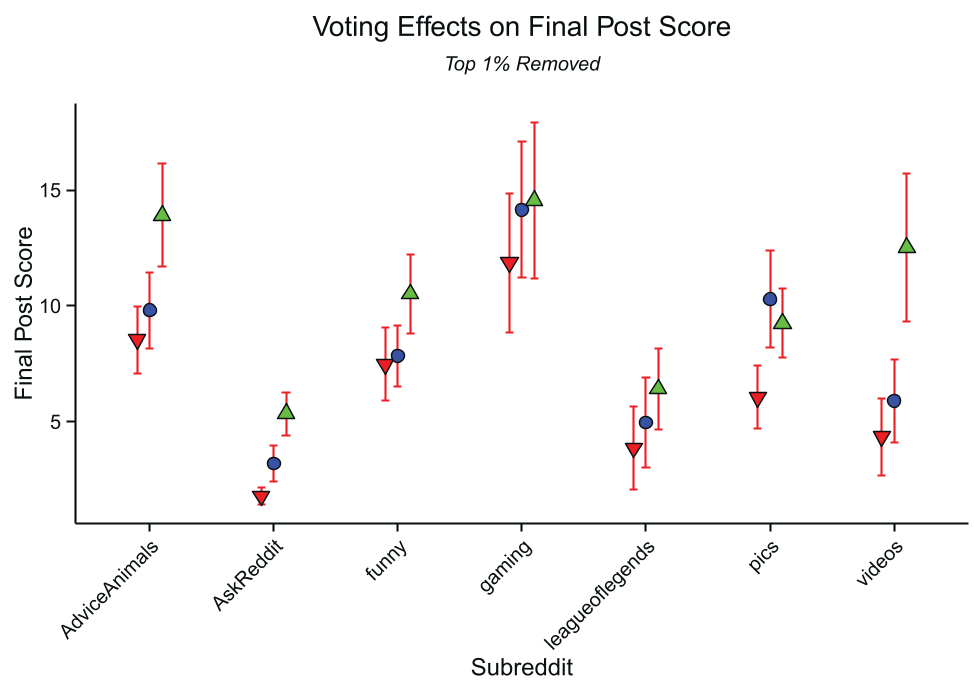 Figure 2: The probability of reaching high scores. The "Up-treated" line (blue) stays significantly higher, showing a massive advantage in the race to the front page.
Why Does This Happen? (The Academic Perspective)
The paper argues that Reddit's dynamic ranking system creates a Positive Feedback Loop. A post with a slightly higher score is ranked higher, making it visible to more people, who then are socially conditioned (herding) to upvote it further. This creates a "Matthew Effect"—to those who have (votes), more shall be given.
Crucially, Reddit is a "social non-network." Unlike Facebook, where you follow friends, Reddit users follow content. The study shows that herding happens even without social ties; the "number" next to a post acts as a powerful surrogate for quality.
Future Implications & Limitations
This research underscores the urgent need for:
- Anti-Manipulation Algorithms: Platforms must detect "vote chaining" or coordinated early voting (sybil attacks) that can artificially push mediocre content to the mainstream.
- The 1-9-90 Rule: Only a tiny fraction of users (~0.25% on Reddit) actually vote. This means the "wisdom" we see is actually the opinion of an extremely small, potentially biased minority.
Limitations: The study notes that Reddit "fuzzes" votes as an anti-spam measure, though the aggregate scores are accurate. Furthermore, different subreddits (e.g., r/AskReddit vs r/pics) showed varying levels of susceptibility to these effects, suggesting that community culture can sometimes act as a buffer against herding.
Conclusion
Next time you see a post with 50,000 upvotes, remember: its journey to the top may have started with a single, potentially random, lucky click. In the digital space, popularity is not just a measure of quality—it is a result of initial momentum and collective imitation.