
Breaking the Imbalance: Efficient Sampling for Massive Bipartite Social Graphs
Random walk-based graphical sampling in unbalanced heterogeneous bipartite social graphs
This paper introduces specialized random walk-based sampling techniques—Link Sampling and Stratified Sampling—specifically designed for Unbalanced Heterogeneous Bipartite Graphs (UHBGs). By integrating the Metropolis-Hastings algorithm and degree distribution priors, the authors achieve high-fidelity graph representation even in web-scale social networks like Facebook and LinkedIn.
TL;DR
In the era of web-scale data, social networks are often modeled as Unbalanced Heterogeneous Bipartite Graphs (UHBGs)—think billions of fans connected to a few thousand celebrity pages. Standard sampling fails here because it gets "lost" in the scale difference. This paper introduces a Random Walk-based Stratified Sampler that uses the Metropolis-Hastings algorithm to provide unbiased, statistically accurate snapshots of these massive graphs.
The Motivation: Why Standard Random Walks Fail
In a balanced graph, a random walker moves freely. However, in UHBGs, the "Wall" nodes (e.g., brand pages) have degrees orders of magnitude higher than "User" nodes. A generic random walk will be skewed and "trapped" by these high-degree hubs, failing to represent the true diversity of the user base.
The core challenge is two-fold:
- Bias: Higher degree nodes are over-sampled.
- Efficiency: Standard Metropolis-Hastings (MH) algorithms, while unbiased, suffer from low acceptance rates in UHBGs, wasting computational cycles.
Methodology: Stratified Random Walks
The authors propose two primary innovations: Link Sampling (LS) and Stratified Sampling (SS).
1. Link Sampling (LS)
Instead of uniform random walking, LS treats the two sides of the bipartite graph independently. It utilizes the MH algorithm to ensure every node on a single side has an equal chance of being picked, regardless of its degree.
2. Stratified Sampling (SS) - The Optimized Core
SS takes LS further. Once a "Wall" node is selected via an MH walk, the sampler independently samples its neighbors (users). This "stratification" ensures that the number of sampled users is proportional to the wall's degree, effectively preserving the structural properties of the local neighborhood while maintaining global efficiency.
 Algorithm 2: The architecture for Stratified Sampling, designed to handle high degree variance.
Mathematical Rigor: MLE Estimation
To prove the quality of the sample, the authors don't just look at the graph; they derive the Maximum Likelihood Estimator (MLE) for the power-law distribution (). By solving equations involving the Riemann zeta function (), they can estimate the original graph's parameters from the tiny sampled subset.
Experiments: Real-World Validation
The researchers tested their methods on three major datasets:
- SYN: A controlled synthetic dataset.
- FB (Facebook): A massive crawl of 143 million users and 520 million edges.
- LNK (LinkedIn): A focused dataset on employer-employee relationships.
Performance Comparison
The results demonstrate that Stratified Sampling (SS) consistently yields the most accurate values (the exponent of the power-law distribution), nearly mimicking the "Full Data" behavior.
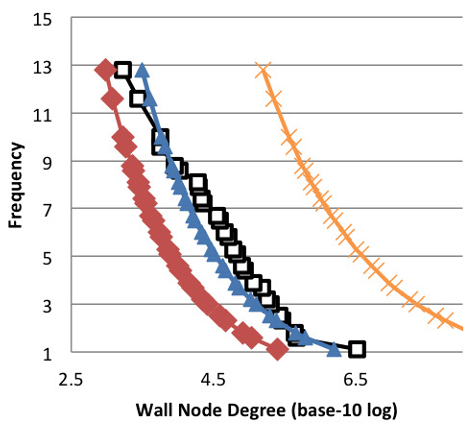 Figure 1: Visualization showing that the SS estimator (smooth curves) aligns almost perfectly with the actual Facebook and LinkedIn degree distributions.
| Dataset | True | SS Estimate | NS (Baseline) Estimate |
|---|---|---|---|
| 2.289 | 1.894 | 3.501 | |
| 10.75 | 9.743 | 12.08 |
Critical Insights & Takeaways
This work highlights that when dealing with Heterogeneous Bipartite Graphs, a "one-size-fits-all" sampling approach is a recipe for statistical error.
- Logic over Brute Force: By understanding the degree distribution (Power-law), we can design samplers that counteract the "trap" of high-degree nodes.
- Scalability: The method allows researchers to study Facebook-scale dynamics without needing the entire 520M edge adjacency matrix in memory.
- Limitations: While statistically robust, the current work focuses primarily on preserving degree distributions. Future work is needed to see if community structures or clustering coefficients are preserved with equal fidelity.
For developers and data scientists building recommendation systems, this stratified approach provides a blueprint for generating representative training subsets from skewed, massive-scale interaction data.