
Deconstructing Connection: Distinguishing Social Influence and Homophily in Dynamic Networks
Randomization tests for distinguishing social influence and homophily effects
This paper introduces a novel randomization framework to distinguish between social influence and homophily effects in dynamic networks using temporal data. By employing choice-based randomization tests, the method assesses the significance of correlation gains in attributes and links from one time step to another, achieving state-of-the-art diagnostic capabilities for relational autocorrelation.
TL;DR
Why do friends share the same interests? Is it because they influenced each other, or because they were similar to begin with? This paper provides a rigorous statistical framework to answer this. By utilizing dynamic network data and a novel choice-based randomization test, the authors decouple the effects of Social Influence and Homophily, providing a model-free way to test for significance in how networks evolve.
The "Chicken and Egg" Problem of Social Networks
In almost any social dataset, we observe Relational Autocorrelation: linked individuals (nodes) tend to have similar attributes. However, autocorrelation is a result, not a cause. It stems from two distinct processes:
- Social Influence: You change your behavior to match your friends.
- Homophily: You choose friends who already behave like you.
For years, researchers struggled to separate these using static snapshots. If you only see a graph at one point in time, you can't tell if the similarity preceded the link or followed it. While dynamic data (multiple time steps) offers a solution, previous methods were either too reliant on specific graph models or couldn't handle networks where both links and attributes change simultaneously.
Methodology: The Choice-Based Randomization Test
The core innovation is a model-free randomization technique. Instead of assuming a mathematical distribution for how people behave, the authors look at the changes (additions and deletions of links or attributes) between Time and Time .
The Logic of the Null Hypothesis
- To test for Homophily: We keep attribute changes real but randomize who forms new links. If the real data shows significantly more links between similar people than the randomized versions, homophily is present.
- To test for Influence: We keep the network structure real but randomize which nodes "adopt" new attributes. If real nodes adopt attributes their neighbors already have more often than in the random trials, social influence is at play.
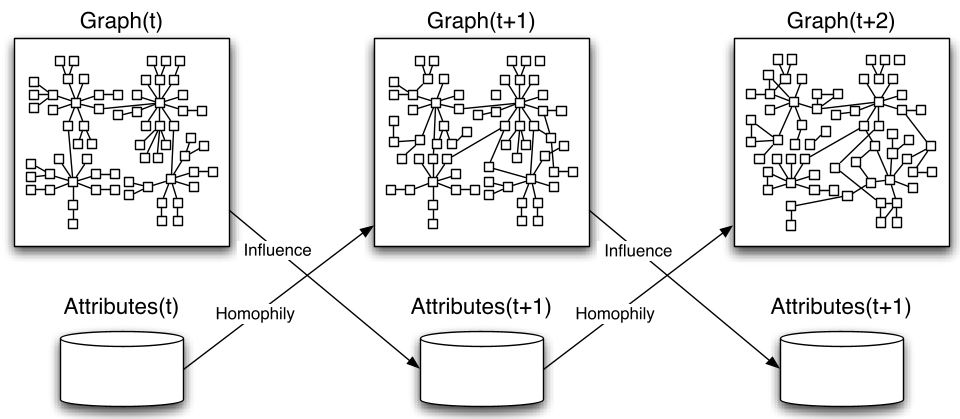
The authors use a Greedy Assignment approach to perform these swaps, ensuring that the degree counts for nodes and attributes remain consistent during randomization, which prevents "Type I" errors (false positives).
Experimental Insights: Facebook Groups
The researchers applied this to the Purdue University Facebook network (2008–2009). The results were fascinatingly granular:
- Homophily-Driven Groups: Groups like Boiler Gold Rush (freshman orientation) and Levee Tan showed high homophily. People who already visited the same places or were in the same cohort were more likely to become friends.
- Influence-Driven Groups: Political groups (e.g., NOBAMA IN 08) and activism groups (e.g., Habitat for Humanity) showed high social influence. Here, existing friend networks likely persuaded individuals to join the cause.
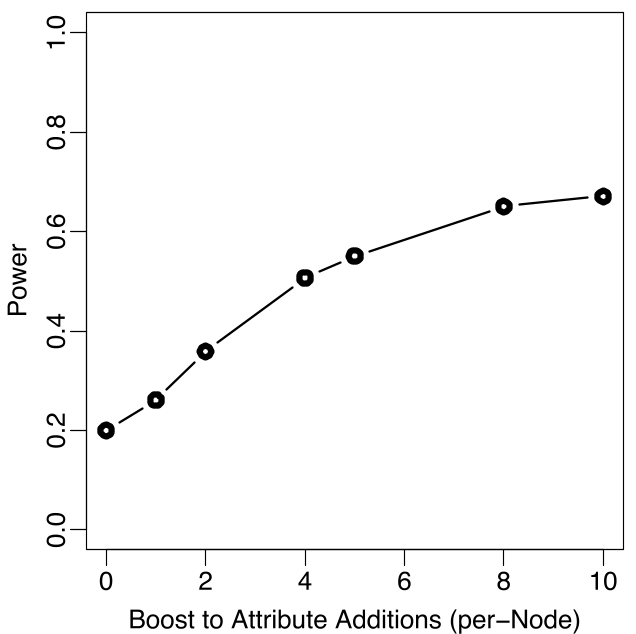 The charts above demonstrate that the test's power increases significantly as the amount of change (attribute or link updates) in the dataset grows.
Why This Matters
Understanding the "Why" behind network correlation has massive implications for:
- Viral Marketing: Should you target "influencers" (Influence) or look for clusters of similar people (Homophily)?
- Public Health: Is a behavior like smoking spreading through peer pressure or are smokers just congregating?
- Algorithmic Bias: If our recommendation engines assume influence when the cause is actually homophily, we might inadvertently create echo chambers.
Conclusion & Limitations
The paper successfully provides a "Data-Driven" diagnostic tool that handles the messy reality of links and attributes changing at once. However, it is hungry for data: the "Power" of the test (its ability to find an effect) drops if there are very few changes between time steps. Future work involving higher-order structural similarity could further refine our understanding of these social dynamics.
Takeaway: In the world of social data, correlation is just the beginning. To truly understand a system, you must randomize the choices individuals make to see what drives the collective outcome.