
UserRank: Bridging Cold Starts via Socially-Aware Random Walks
A randomwalk based model incorporating social information for recommendations
The paper introduces a hybrid collaborative filtering (CF) model that leverages a Markovian random walk on a directed graph. The method, termed UserRank, integrates user-item ratings, item content (tags), user profiles, and social network information to achieve State-of-the-Art (SOTA) performance in personalized and group recommendations.
TL;DR
This paper presents a hybrid recommendation framework that models users, items, and social metadata as a single directed graph. By utilizing a personalized Markovian random walk (similar to PageRank), the system overcomes the notorious "cold start" problem. The core innovation lies in the exponential weight assignment based on rating deviations, allowing the model to outperform standard graph-based CF methods in both precision and recall.
Problem & Motivation: Beyond the Sparse Matrix
Most Recommendation Systems (RS) treat the user-item interaction matrix as an island. However, this leads to two critical failures:
- Data Sparsity: Most users only rate a tiny fraction of available items.
- Cold Start: New users provide zero signals, leaving the system "blind."
The authors argue that users are not independent entities. Their tastes are influenced by their social circles (Homophily) and are reflected in their demographic profiles. While previous graph methods like ItemRank or L+ used simple link structures, they often ignored the intensity of user preferences or the rich context of social networks.
Methodology: The Unified Hybrid Graph
The researchers transform the recommendation task into a graph topology problem.
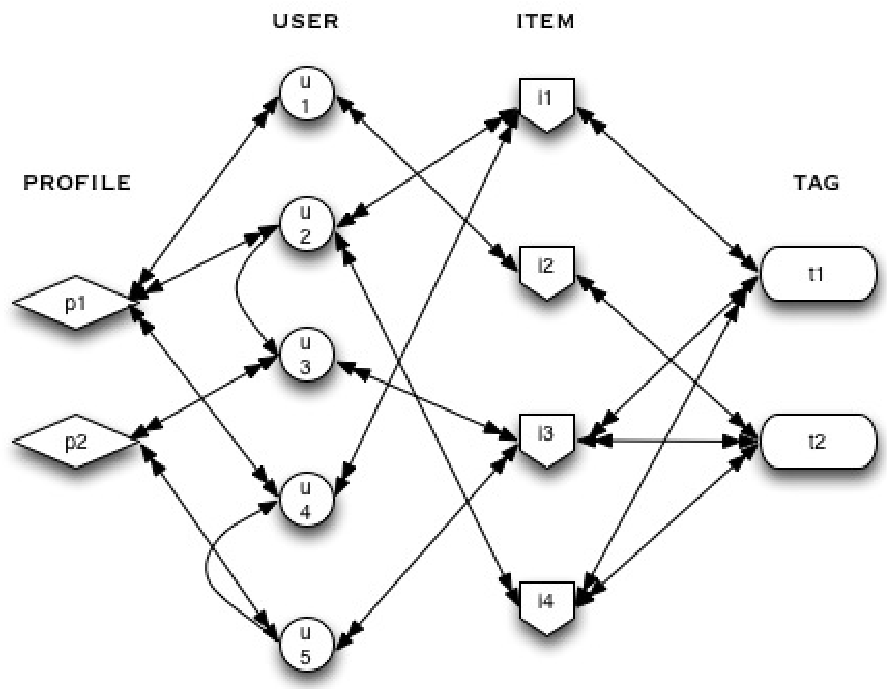
1. Graph Architecture
The model constructs a directed graph where nodes include:
- Users & Items: The primary nodes.
- Tags (Item Content): Genres, actors, or categories.
- Profiles: User age, occupation, and gender.
- Social Ties: Direct "Trust" or "Friendship" links.
2. Intelligent Weighting
Instead of unit weights, the authors propose a specific weight assignment for User-Item edges: This ensures that if a user rates an item significantly higher than their average (), the random walk is much more likely to traverse that edge, effectively "following the passion" of the user.
3. The Random Walk Mechanism
Similar to PageRank, the model calculates a rank score : Where is a personalized vector (teleportation) pointing to the target user. This allows the system to calculate the "importance" of every item in the graph relative to that specific user.
Experiments & Results
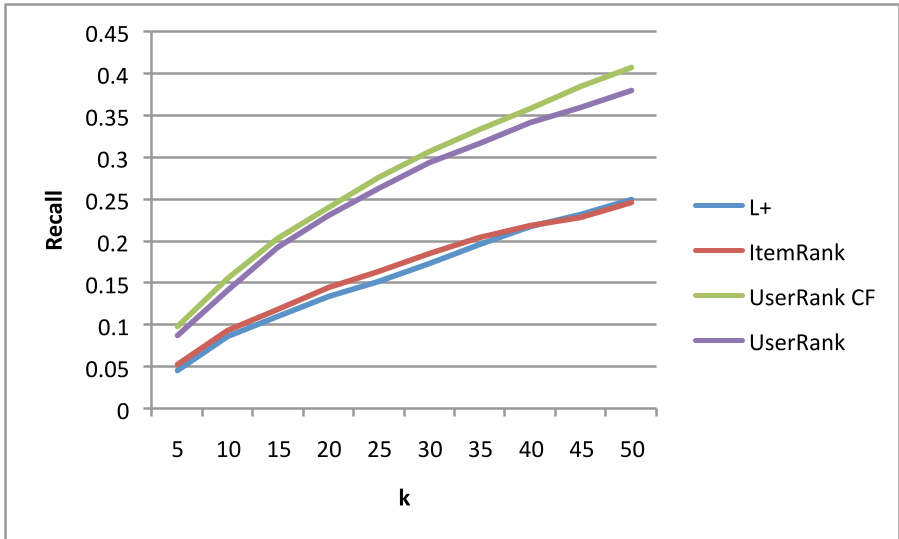
The model was validated on MovieLens and Epinions. Two metrics were key: Recall (finding the hits) and Percentile (how high relevant items are ranked).
SOTA Comparison
As shown in the charts below, the "UserRank" method consistently achieves higher recall than previous benchmarks like ItemRank.
The "Cold Start" Breakthrough
The most impressive result is found in the Cold Start scenario. When rating data is removed, the model relies on the social graph and user profiles. In Epinions, the percentile score improved significantly when social info was integrated, proving that "who you know" is a valid proxy for "what you like" when you are a new user.
Critical Analysis & Conclusion
Takeaway
The integration of social information isn't just a "nice-to-have"; it's a structural necessity for modern RS to handle new users. By using a random walk over a hybrid graph, the authors provide a mathematically sound way to propagate "taste" across disparate data types (behavioral, social, and content).
Limitations
- Computational Complexity: Running power iterations for every user can be expensive, though the authors suggest incremental updates.
- Weight Sensitivity: The exponential weighting scheme relies heavily on the quality of explicit ratings. In systems with only implicit feedback (clicks), this would require a different weight formulation.
Future Outlook
This work pre-dates the explosion of Graph Convolutional Networks (GCNs). However, the intuition here—that recommendation is essentially a node relevance problem on a multi-modal manifold—directly informs how modern GNN-based recommenders like Pinterest's PinSage are designed today.