
RankFlow: Elevating Document Reranking via Multi-Role Agentic Workflows
RankFlow: A Multi-Role Collaborative Reranking Workflow Utilizing Large Language Models
RankFlow is a multi-role collaborative reranking framework that decomposes the information retrieval reranking task into four specialized LLM agents: Rewriter, Answerer, Summarizer, and Reranker. Utilizing GPT-4, it achieves new SOTA results on major benchmarks, notably outperforming RankGPT-4 by over 5 points in NDCG@10 on the NovelEval dataset.
TL;DR
Document reranking is the "last mile" of search, and it's notoriously difficult for LLMs when inputs are noisy. RankFlow introduces a multi-agent pipeline—Rewriter, Answerer, Summarizer, and Reranker—to clean queries and compress passages before the final sort. This structured approach isn't just more accurate; it's proven to be more cost-effective and robust across models from LLaMA-3-8B to GPT-4.
The Problem: The Noise Bottleneck in Reranking
In a typical Zero-shot reranking scenario, we feed an LLM a query and a list of candidate passages. However, real-world data is messy:
- Vague Queries: Users often type "wifi vs bluetooth" instead of "comparative analysis of transmission protocols."
- Redundant Passages: Retrieved documents are often bloated with irrelevant SEO fluff or repetitive text.
- LLM Cognitive Load: Standard listwise reranking requires the model to hold dozens of long passages in its "head" simultaneously, leading to degraded reasoning.
Methodology: The Four Pillars of RankFlow
The authors argue that a single prompt is insufficient. Instead, they propose a collaborative workflow that treats reranking as a manufacturing line.
1. The Rewriter & The Answerer (Query Enrichment)
The Rewriter transforms the user's shorthand into a formal information request. The Answerer then generates a "gold standard" pseudo-passage based on the LLM's internal knowledge. By concatenating the rewritten query with this pseudo-answer, the system creates a high-dimensional semantic target for the reranker.
2. The Summarizer (Data Distillation)
Perhaps the most critical step for efficiency, the Summarizer strips passages of grammatical noise and redundancy. This reduces the token count significantly, allowing the subsequent Reranker to focus purely on core facts rather than parsing syntax.
3. The Reranker (Reasoning Engine)
The final stage utilizes a sliding window approach but adds three crucial layers:
- Detailed Relevance Standards: Explicitly defining what constitutes a "Perfect" vs "Relevant" match.
- Chain-of-Thought (CoT): Forcing the model to explain why a passage ranks higher before outputting the index.
- Format Constraints: Ensuring output consistency to prevent parsing errors.
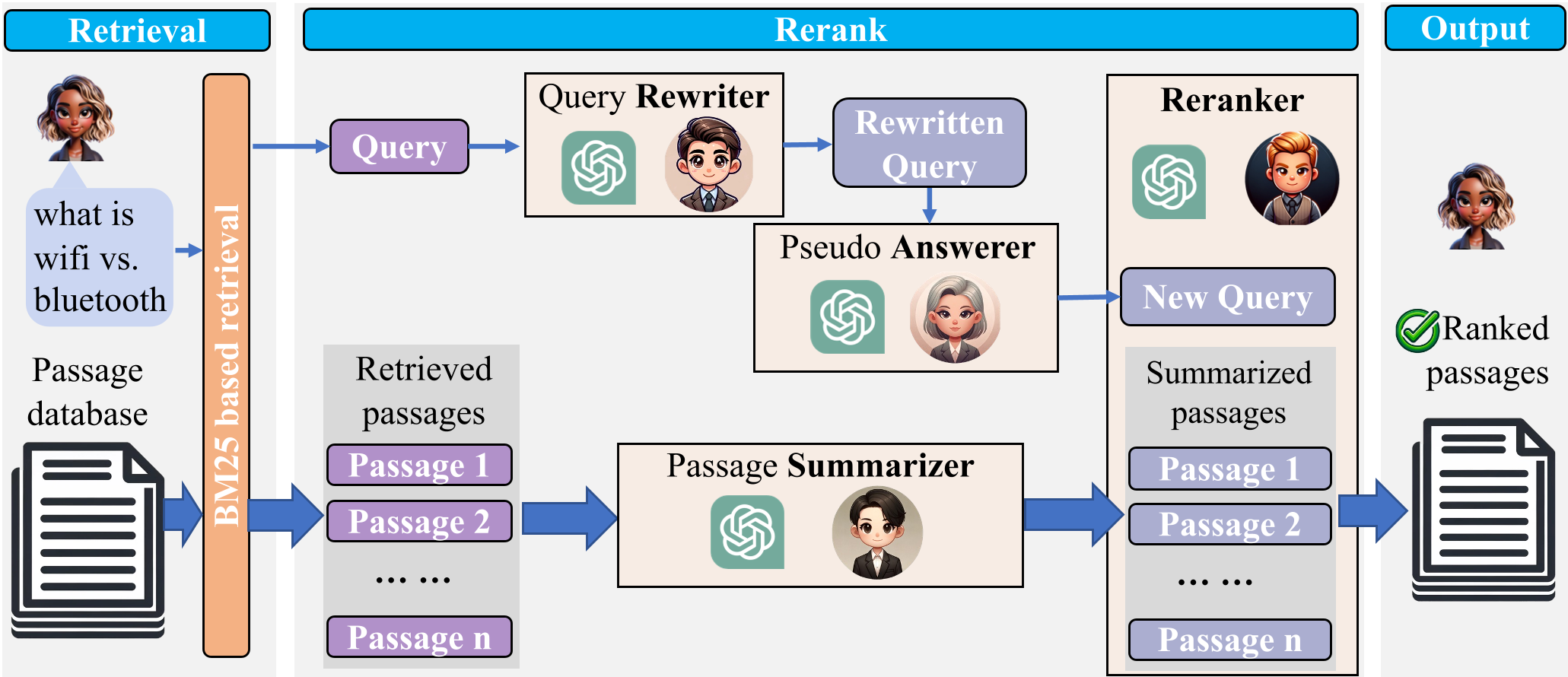 Figure 1: The RankFlow pipeline showing the sequential flow from raw input to refined ranking.
Experimental Performance: SOTA and Beyond
The results across TREC-DL and BEIR benchmarks confirm that "cleaner data" beats "more data."
| Dataset | RankGPT-4 (Baseline) | RankFlow | Improvement |
|---|---|---|---|
| TREC-DL19 (nDCG@10) | 74.89 | 76.65 | +1.76 |
| Robust04 (nDCG@10) | 59.74 | 64.88 | +5.14 |
| NovelEval (nDCG@10) | 89.18 | 94.21 | +5.03 |
Notably, RankFlow's performance on NovelEval (a dataset created to avoid GPT-4 training data leakage) demonstrates its true zero-shot generalization capability.
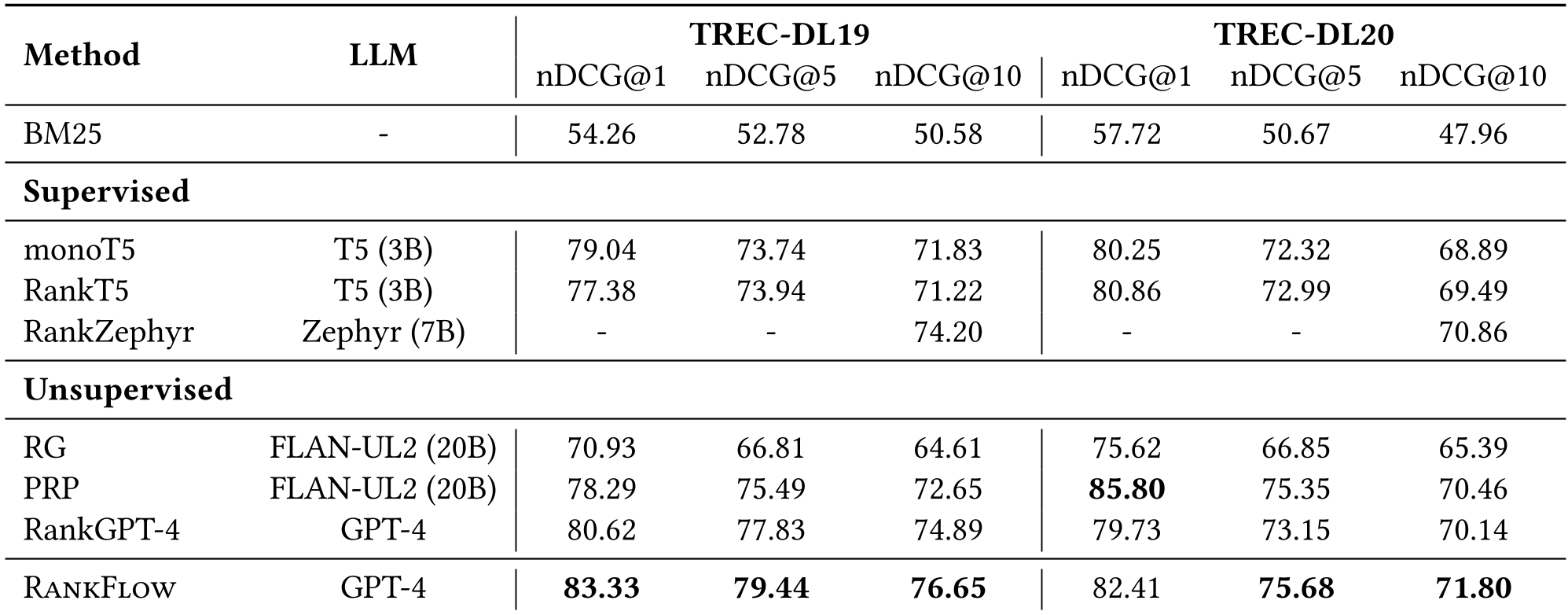 Table 2: Performance on TREC-DL datasets highlighting RankFlow's lead over supervised and unsupervised baselines.
Cost and Efficiency: The "Local Passage" Advantage
While multi-stage agent workflows often imply higher costs, RankFlow introduces a "Local Passage" variant. By caching summarized passages and rewritten queries, the system actually becomes 26.8% faster and 29.6% cheaper than a standard RankGPT-4 call, because the final reranking window—the most token-intensive part—is significantly compressed.
Critical Insight: Why it Works
The "magic" of RankFlow lies in Information Density. By summarizing passages, the model increases the signal-to-noise ratio within the Transformer's self-attention mechanism. On smaller models like LLaMA-3-8B, which often collapse under long, noisy contexts, RankFlow provided a massive 5-point jump, proving that workflow design can compensate for model scale.
Conclusion & Future Outlook
RankFlow proves that the future of LLM-based IR isn't just bigger models, but smarter workflows. By specializing roles, we can mitigate the inherent weaknesses of LLMs (context limits, instruction drift) while maximizing their strengths (semantic synthesis). Future iterations may involve dynamic role selection, where the system decides whether a query needs a Rewriter based on its initial ambiguity.
Takeaway: In the era of RAG and AI-driven search, the quality of your "data flow" is just as important as the quality of your "weights."