
PN Centrality: Identifying the "Foes" in Large-Scale Social Networks
Ranking based comparative analysis of graph centrality measures to detect negative nodes in online social networks
This paper presents a ranking-based comparative analysis of graph centrality measures (Degree, Status, PII, and PN Centrality) specifically for detecting "negative nodes"—malicious or antagonistic users—in large-scale Online Social Networks (OSNs). The authors identify PN centrality as the most effective measure and propose an optimized attenuation factor () to adapt it for massive datasets like Epinions, Slashdot, and Wikipedia.
TL;DR
Social networks aren't just about "likes" and "follows"; they are defined by trust and distrust. This paper tackles the challenge of identifying negative nodes (malicious actors/outsiders) in large-scale networks. While traditional metrics fail as data scales, the authors optimize PN Centrality to achieve near-perfect accuracy in detecting antagonistic users within datasets containing thousands of nodes.
The "Positivity" Bias in Network Science
For decades, social network analysis (SNA) relied on Freeman’s core metrics: Degree, Betweenness, and Closeness. These work well when information flows smoothly (Positive Ties). However, Negative Ties (distrust, enmity) behave differently—they are sparse and lack transitivity.
The problem? Prior work on negative node detection was tested only on tiny datasets (like the 1967 monks' monastery study). When the authors applied these old methods to modern data from Epinions or Wikipedia, they found a critical flaw: negative nodes were being hidden. A user with numerous negative ties to "popular" people was often ranked as highly central (positive), allowing malicious actors to masquerade as influential figures.
Methodology: The Search for the "Anti-Influencer"
The authors compared four specific mixed-data measures:
- Degree Centrality: Simple count of positive minus negative ties.
- Status Measure: Eigenvector-based status (fails in large networks due to complex/imaginary eigenvalues).
- PII (Political Independence Index): Measures power in alliances (adversary dependent).
- PN Centrality: A sophisticated path-based measure specifically designed for mixed networks.
The Core Innovation: Optimizing
The standard formula for PN Centrality is: Where (Positive matrix minus twice the Negative matrix).
In large networks, the original attenuation factor becomes mathematically insignificant as (total nodes) grows. The authors' breakthrough was replacing this with . This local normalization ensures the "negative influence" doesn't get washed out by the sheer size of the graph.
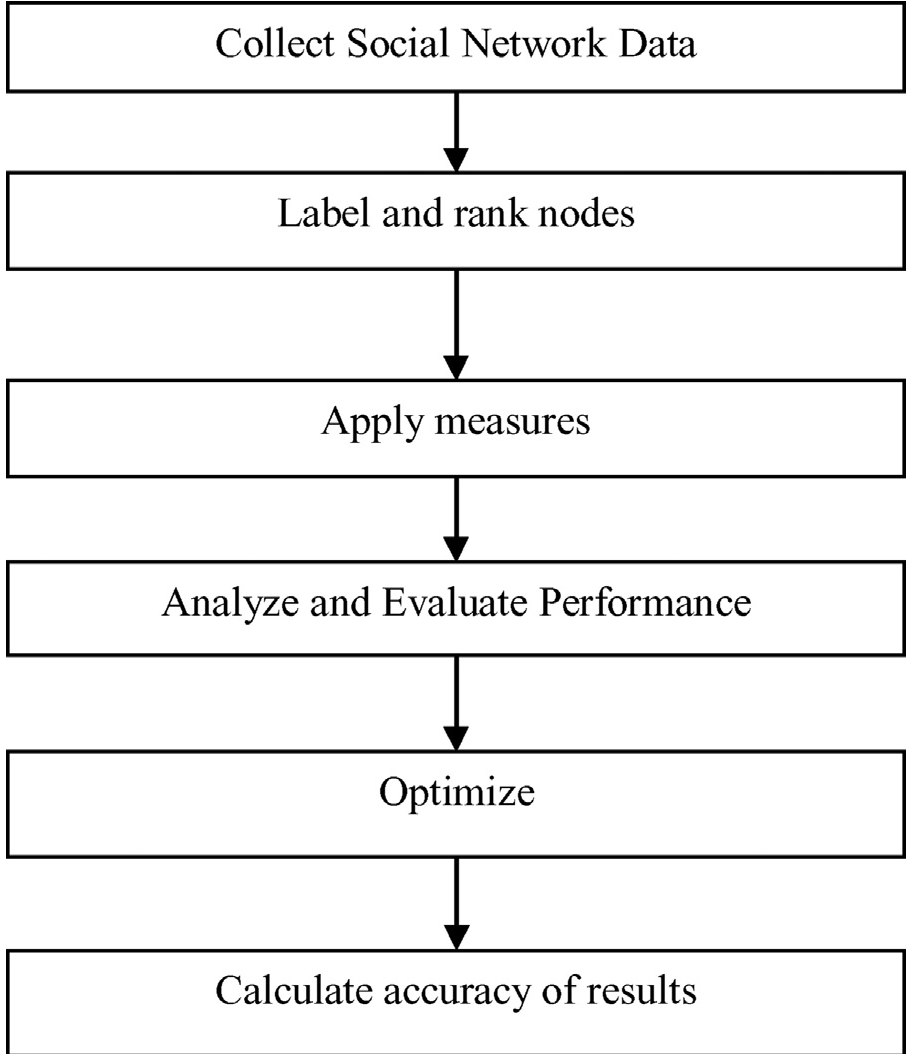 Fig 1: The proposed workflow for labeling, extracting, and optimizing centrality in OSNs.
Experimental Showdown
The authors used three massive signed datasets from the Stanford Large Network Analysis Platform (SNAP):
- Epinions: A trust/distrust network of product reviewers.
- Slashdot Zoo: A "friend vs. foe" tagging system.
- Wikipedia: A voting history for admin elections.
Comparing the Curves
As seen in the comparison graphs, the standard Degree ranking (red) fluctuates wildly from the "Actual Ranking" (dark blue straight line). PN Centrality (green), after optimization, shows the highest degree of overlap with the ground truth.
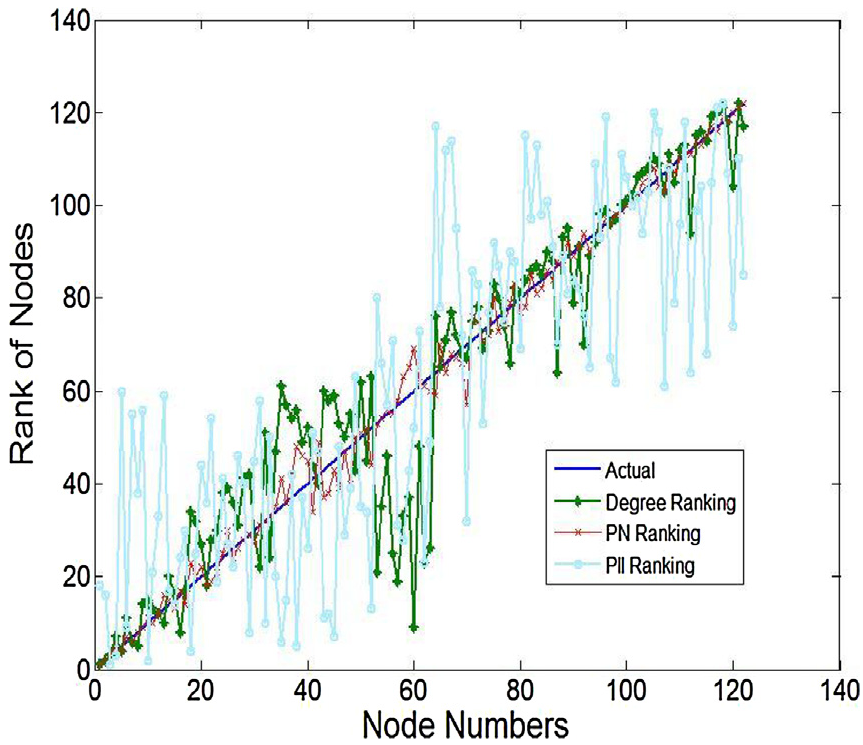 Comparison of Degree (Red), PII (Sky Blue), and PN (Green) against the Ground Truth.
Quantitative Victory
The statistical validation was definitive:
- Kendall Rank Correlation: The optimized PN () achieved 0.998 on Slashdot, compared to just 0.73 for Degree.
- F-Score: The optimized measure hit a perfect 100% accuracy in classifying negative vs. positive nodes in Wikipedia and Epinions samples, whereas PII struggled around 59-61%.
Critical Analysis & Conclusion
Takeaway
The research proves that PN Centrality is the superior metric for signed networks, provided the attenuation factor is calculated based on the maximum degree of the combined trust/distrust matrix rather than the total number of nodes in the system.
Limitations
While highly accurate, the PN measure involves matrix inversion , which is computationally expensive () for truly massive, billion-node graphs without using iterative approximation methods.
Future Work
The next frontier is applying these optimized measures to real-time anomaly detection—stopping sybil attacks and bot-manipulated "dislike" campaigns as they happen, rather than via post-hoc analysis.