
Ranking Designs and Users: Beyond the Popularity Contest in Social Networks
Ranking Designs and Users in Online Social Networks
This paper introduces a mutual ranking algorithm for online design communities (e.g., Dribbble, Behance) that leverages the bipartite social network structure of users and designs. By extending the PageRank intuition, the method co-ranks users and designs based on their recursive influence: important designs are those created/liked by high-ranking users, and vice-versa.
TL;DR
In online design communities like Dribbble, popularity (likes) is often mistaken for quality. This paper proposes a recursive ranking algorithm that treats interactions like academic citations: a "like" from a master designer is worth more than a "like" from a casual observer. By co-ranking users and designs through iterative PageRank updates, the authors reveal high-quality content that raw popularity metrics often bury.
Background: The Limits of "Likes"
Most social platforms today operate on a first-order metric system. If Design A has 100 likes and Design B has 50, Design A is ranked higher. However, this ignores the network topology. If those 50 likes for Design B came from industry leaders and design directors, Design B is arguably more "important" to the professional community than a mass-marketed design with 100 casual likes.
The authors argue that we need a ranking system where:
- Designs derive value from the rank of their creators and promoters.
- Users derive value from the rank of the designs they create and like.
Methodology: Recursive Bipartite Ranking
The core innovation lies in how the authors handle the bipartite nature (two distinct types of nodes: Users and Designs) of the social network.
1. Graph Induction
Since PageRank traditionally operates on homogeneous nodes, the authors induce two separate graphs:
- User Graph (): Users are connected if they interact with the same design.
- Design Graph (): Designs are connected if they are interacted with by the same user.
2. The Iterative Step
Instead of static edge weights, the weight of an edge between two users is determined by the rank of the design that connects them. Similarly, the edge between two designs is weighted by the rank of the user who created or liked them.
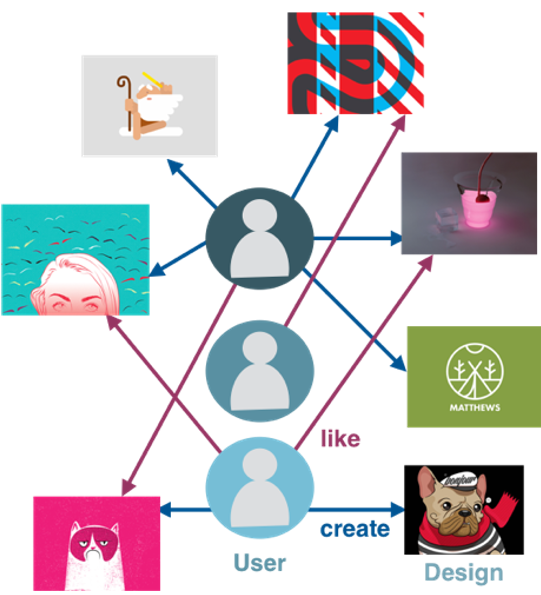 Figure: The bipartite interaction between users and designs is transformed into induced graphs where influence flows through shared nodes.
3. Algorithm Logic
The algorithm follows a "ping-pong" approach:
- Initialize design ranks.
- Update user ranks using PageRank on the design-weighted user graph.
- Update design ranks using PageRank on the user-weighted design graph.
- Repeat until the ranks stabilize (convergence).
The "Curator" Factor
A significant contribution of this model is the inclusion of curators ( - Liking matrix) alongside creators ( - Creation matrix). By tuning parameters and , the system can decide how much "authority" a user gains from simply having good taste (liking high-rank designs) versus actually producing them.
Empirical Results
The authors tested their algorithm on both a simulated network of 8 users and a real-world dataset scraped from Dribbble.
Key Findings:
- Convergence: The algorithm successfully converged on real-world data, proving its stability.
- Significant Re-ranking: While there is a positive correlation with likes (see Figure 6), the individual shifts are massive. On average, a design moved 21 spots in a 100-design sample.
- Quality Discovery: As shown in the comparison table below, designs with significantly fewer likes were able to break into the Top 10 by virtue of "secondary network effects"—proving that the algorithm captures "expert consensus" rather than just "crowd noise."
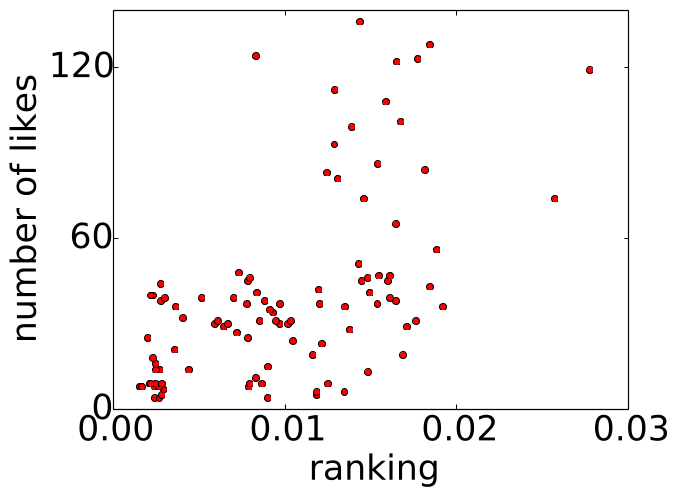 Figure: The algorithm maintains a general trend with popularity but introduces critical deviations where quality exceeds raw visibility.
Critical Insight: Why This Matters
The shift from "Like-counting" to "Authority-ranking" has profound implications for the UI/UX of social platforms. It addresses the Discovery Problem: how do new, talented designers get noticed if the front page is always dominated by established users with massive follower counts?
By weighting likes from high-authority users more heavily, this algorithm provides a "fast-track" for quality content to rise through the ranks, even if it hasn't yet reached a mass audience.
Limitations and Future Work
As this is a "work-in-progress," the authors identify several missing pieces:
- Parameter Optimization: Currently, weights () are set manually. Future iterations could learn these from historical engagement data.
- Formal Convergence Proof: While empirical convergence was observed, a rigorous mathematical proof is still needed.
- Multimodal Features: The model does not yet account for "following" relationships or "collections," which are common in modern social design networks.
Conclusion
This paper serves as a bridge between classical transition-matrix mathematics (PageRank) and modern social community management. It reminds us that in specialized design communities, not all voices are—or should be—equal.