
LurkerRank: Shining a Light on the Social Media Silent Majority
“Who's out there?” Identifying and ranking lurkers in social networks
The paper introduces "LurkerRank," a novel framework for identifying and ranking passive members (lurkers) in social networks based on graph topology. By repurposing eigenvector-based centrality like PageRank and alpha-centrality, the authors establish the first computational approach to quantify lurking behavior rather than just treating it as the absence of activity.
TL;DR
While most social network algorithms are obsessed with finding the "loudest" voices (influencers), this paper introduces LurkerRank. It is the first formal computational method to identify and rank the 90% of users who listen but don't speak, using social network topology to turn the logic of PageRank on its head.
Problem & Motivation: The Value of the Hidden Audience
In social science, a "lurker" is someone who consumes community resources without contributing back. In the world of Big Data, these users are often invisible because they don't generate "events" like posts or retweets.
The authors argue that ranking lurkers is just as important as ranking leaders. Why?
- De-lurking: Identifying high-potential lurkers allows platforms to trigger participation.
- Filtering: Lurkers are most susceptible to information overload; understanding their profile helps in tailoring content.
- Business Logic: This "silent audience" is the primary target for advertising and knowledge consumption.
Existing metrics like PageRank fail here. PageRank rewards "authorities" who receive many links. But in a lurking context, receiving many links (following many people) without being followed back is a sign of passivity, not authority.
Methodology: The Logic of Absorption
The core innovation is Topology-Driven Lurking. The authors propose that a user's "lurking strength" is not just about having fewer followers than followees, but about who they are following.
The authors define three nuances of lurking:
- In-neighbors-driven: You are a bigger lurker if you follow people who are highly influential (non-lurkers).
- Out-neighbors-driven: You are a bigger lurker if the people you do follow are also lurkers (forming a passive cluster).
- LurkerRank (LR): An integrated approach using PageRank-style power iterations.
The LurkerRank Formula
The LRin variant calculates a score based on the out/in-degree ratio of a node's neighbors, effectively measuring how much "un-replied knowledge" is flowing into a node.
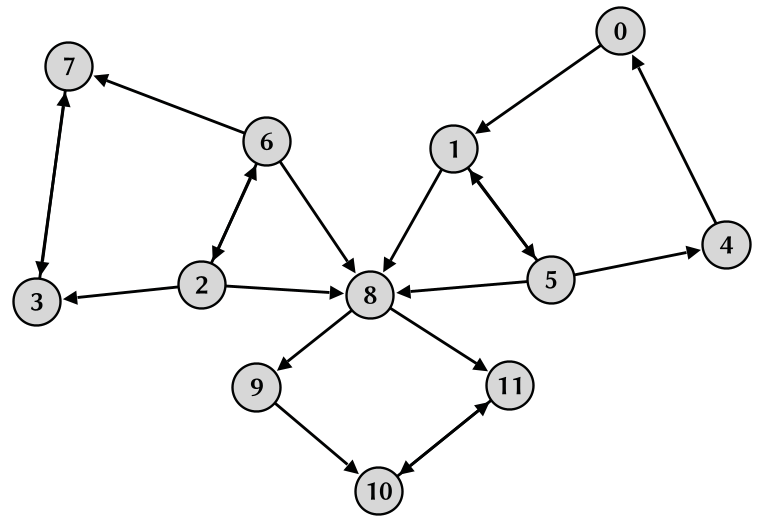 Fig 1: A sample network where node 8 is identified as a primary lurker because it consumes information from two distinct influential components.
Experiments & Results: Lurkers vs. Spammers
The authors tested their methods on a massive Twitter dataset (16M nodes, 132M links) and FriendFeed.
Quantitative SOTA Comparison
Using Fagin’s intersection metric and Bpref, the authors compared LurkerRank against PageRank (PR), Alpha-Centrality (AC), and the Fair-Bets (FB) model.
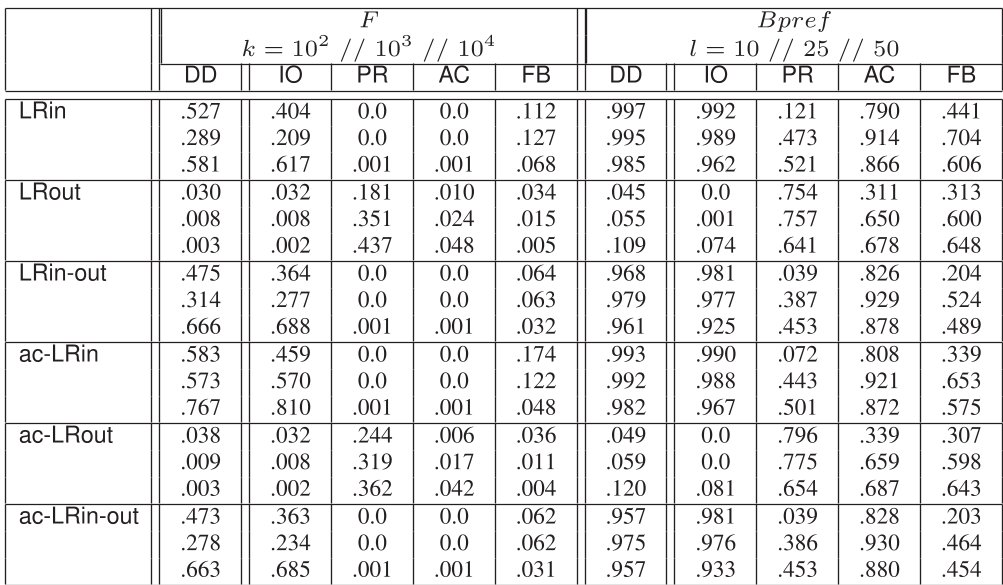 Table 1: Performance on Twitter. Note how LRin significantly aligns with the Data-Driven (DD) ground truth compared to PageRank.
The Qualitative "Aha!" Moment
In a fascinating qualitative analysis, the authors looked at the Top 20 users ranked by each method:
- PageRank/Alpha-Centrality: Mistakenly ranked Barack Obama (B.O.) as a top lurker because he has many incoming links. In reality, he is an influencer.
- Fair-Bets (FB): Mistakenly ranked spammers and suspended accounts as lurkers.
- LurkerRank (LRin): Corrected these errors. The top-ranked users were genuine long-time participants who had zero retweets but were deeply embedded in following active community members.
Critical Analysis & Future Work
The beauty of LurkerRank is its simplicity; it uses the same computational "machinery" as the algorithms that built search engines but re-tunes the "physics" of the graph to find sinks instead of sources.
Limitations:
- Context Blindness: The current model is purely topological. A user might be an expert in "Machine Learning" but a lurker in "Fine Arts."
- Temporal Shifts: Lurking isn't always a permanent state. Users often lurk to learn "etiquette" before becoming active (Legitimate Peripheral Participation).
Future Outlook: The next frontier is Context-Biased Lurking. By combining this topology with NLP (Natural Language Processing), platforms could identify why someone is silent—are they intimidated, uninterested, or simply satisfied as an observer?
Conclusion
"Who's out there?" is no longer a rhetorical question. With LurkerRank, we have a mathematical lens to see the "dark matter" of social networks, providing a path to engage the silent 90% of the digital world.