
Identifying the Gatekeepers: Accelerating Mediator Ranking in Massive Social Networks
Ranking Method for Mediators in Social Network
This paper introduces a fast approximation algorithm for ranking "mediators"—nodes critical for cross-community communication—in large-scale social networks. By shifting from global shortest-path analysis to local adjacency relationship evaluations, the method achieves a significant complexity reduction from to while maintaining a high rank correlation (>0.8) with the strict solution.
TL;DR
In open innovation organizations, "Mediators"—nodes that facilitate communication between disparate groups—are as vital as leaders. However, identifying them traditionally requires computations, which is a death sentence for large datasets. This paper proposes a local approximation method that slashes complexity to by focusing on adjacency relationships, retaining over 80% rank accuracy compared to the total-network analysis.
Background: The Power of the "In-Between"
In the study of social networks, we often obsess over Leaders (high-degree nodes). But in "Open Innovation" (think IBM or Intel), the real value often lies in the Mediators. These are the gatekeepers who bridge the gaps between different departments or external experts. If a mediator leaves, the network doesn't just lose a person; it loses a critical communication bridge, causing collaboration costs to skyrocket.
The Problem: The Wall
The "Strict" way to find these people is to:
- Measure the Average Shortest Path Length of the whole network.
- Remove a node.
- Re-measure the path length and see how much it increased.
- Repeat for every single node.
Because calculating the shortest path alone is (using Dijkstra's for all pairs), repeating this for every node leads to an astronomical complexity. For a network of just 1,000 people, is an uncomputable number for standard business applications.
The Insight: Locality is Proxy for Global Importance
The authors, Saga and Tsuji, propose a brilliant shift in perspective: A mediator is important if their neighbors are not well-connected to each other.
If Node V's friends are all friends with each other (a dense local cloth), removing V doesn't hurt much. But if Node V is the only link between those people (a sparse local structure), V is an indispensable mediator.
The Algorithm (The "How")
The score for a node with neighbors is calculated by looking at (the number of links each neighbor has to other neighbors of ):
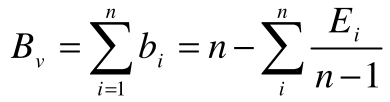
This transforms a global shortest-path problem into a local counting problem. The complexity drops to because we only look at immediate neighbors for each node.
Experimental Evidence
The researchers tested this against the "Strict" solution using random corporate-style networks (ring structures with groups and random cross-links).
1. High Fidelity
The approximation isn't just fast; it's accurate. The Spearman rank correlation stays consistently above 0.8, meaning the top-ranked mediators in the fast version are almost identical to those in the slow, "perfect" version.
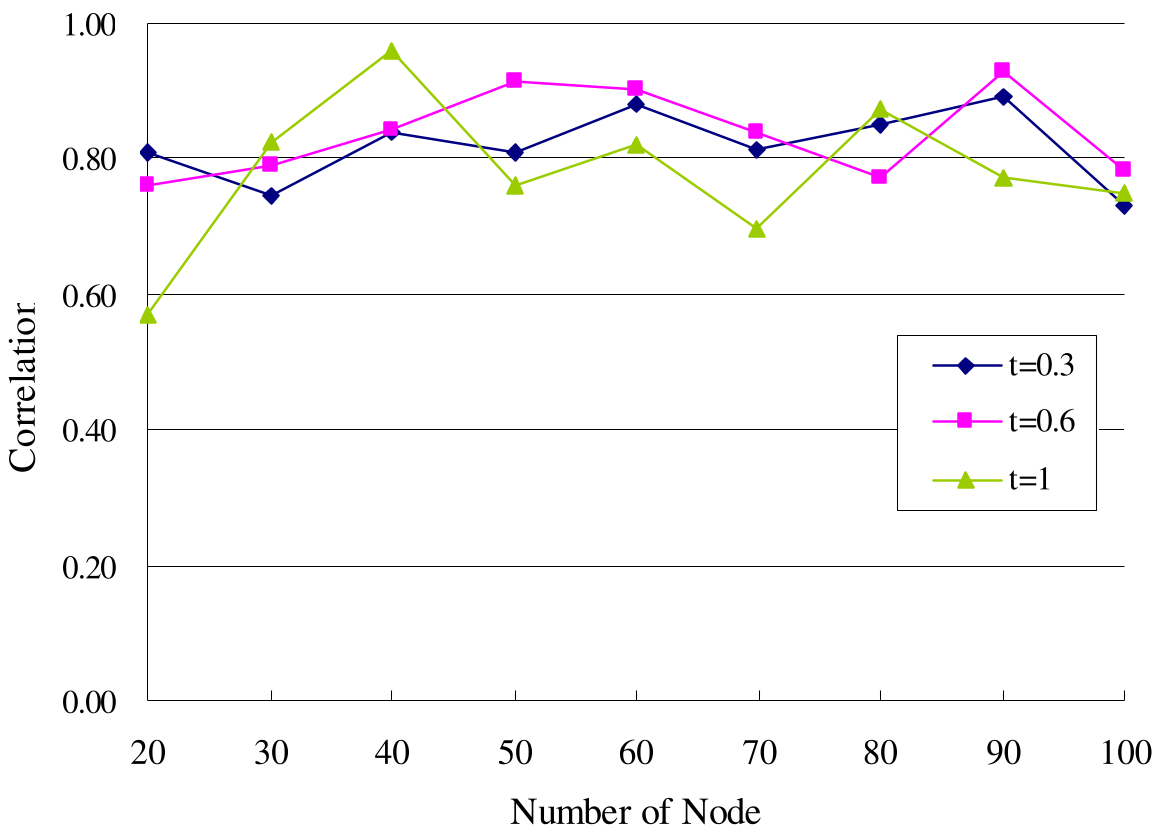 Figure: The correlation remains stable regardless of network density (t-value).
2. Radical Speedup
The performance gains are most visible in the computation time charts. While the strict method's time consumption grows exponentially, the proposed method remains nearly flat even as node counts increase.
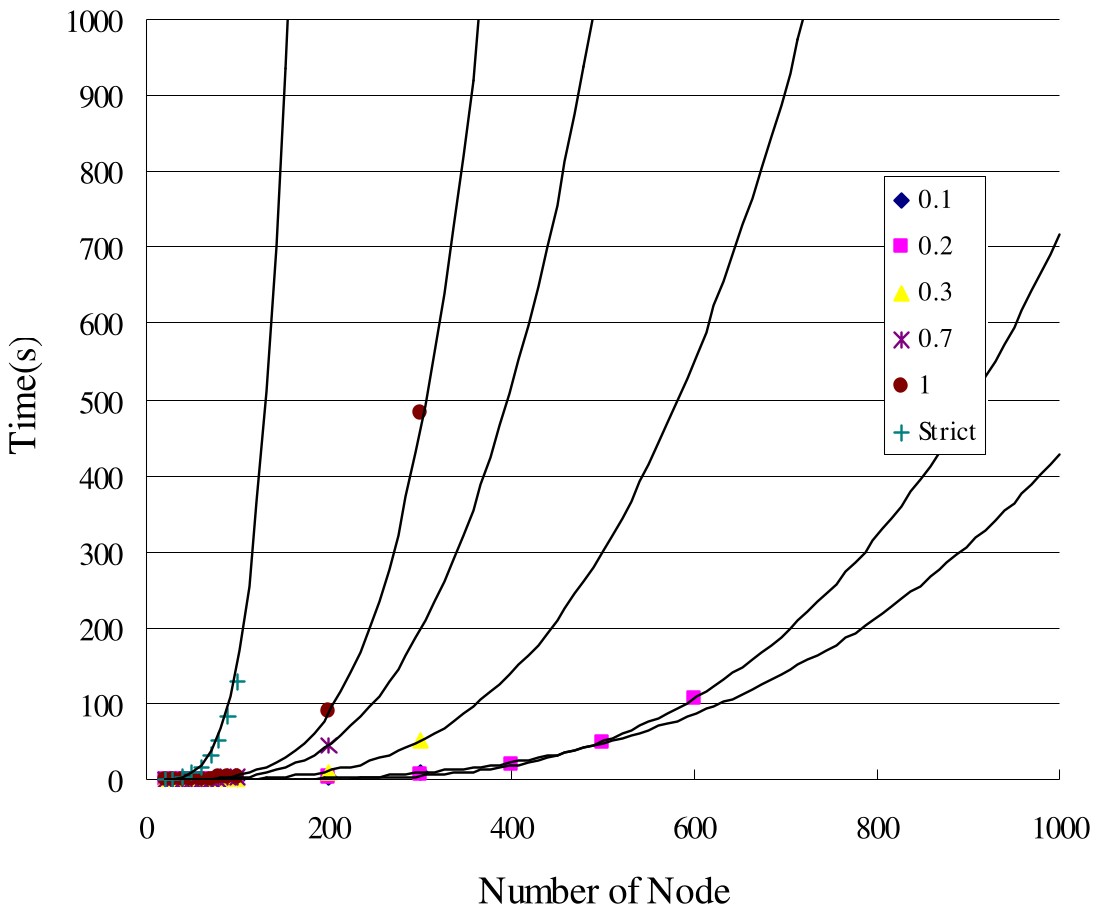 Figure: The gap between and in practical execution.
Critical Analysis & Takeaways
This work provides a pragmatic bridge between Graph Theory and Management Science.
- Why it works: It targets the physical intuition of "Structural Holes." A mediator fills a hole; their importance is the "cost" of that hole being reopened.
- Limitation: The paper acknowledges that it doesn't compare against Betweenness Centrality (), which is a common middle-ground. However, even can be too slow for the billion-node graphs of the modern web, making this approach even more relevant today.
- Future Impact: This method could be used in real-time HR analytics to identify at-risk employees whose departure would "fracture" organizational communication before it's too late.
In the era of Big Data, an approximate answer today is often worth more than a perfect answer next year. By focusing on local "neighborhoods," we can finally map the gatekeepers of our largest social ecosystems.