
Bridging Keywords and Connections: A New Era of Social Network Ranking
Ranking Structural Parameters for Social Networks
The paper introduces a novel link-ranking methodology for Social Network search, bridging the gap between Keyword-based Information Retrieval and structural graph analysis. By extending the Cohesive Arc Measure (CAM), the authors propose a ranking system that prioritizes links connecting nodes with complementary information, facilitating efficient retrieval through an optimized Steiner tree heuristic called SNSA.
TL;DR
Social networks produce over a third of modern web content, yet searching them remains difficult because information is scattered across users and their interactions. This paper proposes a ranking function that prioritizes structural links over individual nodes. By using a "feature vector" representations of content and an optimized link-weighting algorithm (Cohesive Arc Measure), the authors demonstrate that they can find relevant "answer trees" in Twitter data in under 100 milliseconds.
The Core Challenge: Why PageRank Isn't Enough
In the world of Google and traditional web search, a page is considered authoritative if many other pages link to it. However, in a Social Network, the "links" (friendships, mentions, messages) are more critical than the users themselves.
Current systems suffer from two major flaws:
- Content Fragmentation: A single user rarely has all the answers to a complex query. The answer often lies in a group of linked users.
- Reliability Assumption: Traditional IR assumes content relevance equals node relevance. In SNS, relevance is social—it requires recommendations and structural trust.
Methodology: The Logic of Links
The authors argue that the relevance of a link should depend on how well it helps satisfy a multi-keyword query.
1. The Feature Vector
Instead of a single score, every node is assigned a vector : where represents the tf-idf weight of a specific keyword. This allows the system to track exactly which part of a query a user can answer.
2. The Cohesive Arc Measure (CAM)
The "magic" happens in how links are weighted. The authors use a cross-product of feature vectors: The Intuition: A link gets a higher score if node A has keyword "Winter" and node B has keyword "Festival." If both have "Winter," the link is less useful for completing the query.

Efficiency through SNSA
To make this work in real-time, the paper introduces the Social Network Search Algorithm (SNSA). It uses a Node-Keyword Index (NKI) which doesn't just store who has a keyword, but also how far away they are from other nodes.
(Note: Refer to Algorithm 1 in the paper for the specific bidirectional expansion logic.)
Experimental Insights: Twitter Case Study
The researchers tested their approach on a real-world crawl of Twitter, involving 1,701 users and millions of interactions.
- Speed: Even for top-20 results, query time stayed below 100ms.
- The "Small World" Effect: They found that relevant info is rarely more than 3 hops away.
- Clustered Interests: For celebrity queries (e.g., "Lindsay Lohan"), users tend to use all keywords together, making the search faster but the link structure less "spread out."
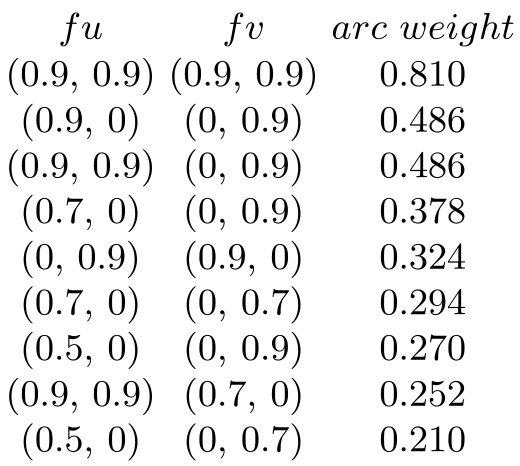 Table 1: Example of how arc weights are calculated based on complementary keyword vectors.
Final Verdict
This paper offers a pragmatic bridge between graph theory and information retrieval. While it focuses on keyword search, the underlying philosophy—that edges should be ranked by their ability to connect disparate pieces of information—is a powerful insight for recommendation engines and social discovery tools.
Limitations: The study was performed on a relatively small user set (1,701 users). Scaling this to hundreds of millions of users would require significant distributed indexing strategies beyond the distance-based threshold mentioned.