
Rat Running the G20: How Collective Intelligence Reclaims the Disrupted City
Rat running the G20: collective intelligence for navigating the disrupted city
This paper explores how urban residents utilize "Collective Intelligence" (CI) to navigate mobility disruptions during the 2014 G20 Summit in Brisbane. By analyzing high-resolution walking data and focus group insights, the study identifies socio-technical strategies that enable citizens to reclaim and reconstruct urban space amidst heavy securitization.
TL;DR
When world leaders descended on Brisbane for the 2014 G20 Summit, the city became a "Declared Area" of fences, checkpoints, and surveillance. This paper investigates how everyday citizens—particularly those from migrant communities—used digital tools and collective sociality to "rat run" through these disruptions, effectively using collective intelligence to rewrite the narrative of their own streets.
The Friction Between Control and Flow
The G20 Summit was a "pre-planned disruption." Unlike a natural disaster, the turmoil was manufactured through the G20 (Safety and Security) Act 2013, which deployed 5,000 police agents and $100 million in security.
The authors argue that this created a clash between the "Conceived Space" (the city as mapped by authorities and media) and the "Lived Space" (the city as experienced by those walking it). The motivation for this study was to see how citizens didn't just follow orders, but used technology to find their own "path of least resistance."
Methodology: Walking as Telling
The researchers utilized "Walkshops", where 14 participants tracked their movements using the MapMyWalk app. By exporting KML files into Google Earth, the team could visualize exactly where participants detoured, stayed, or explored.
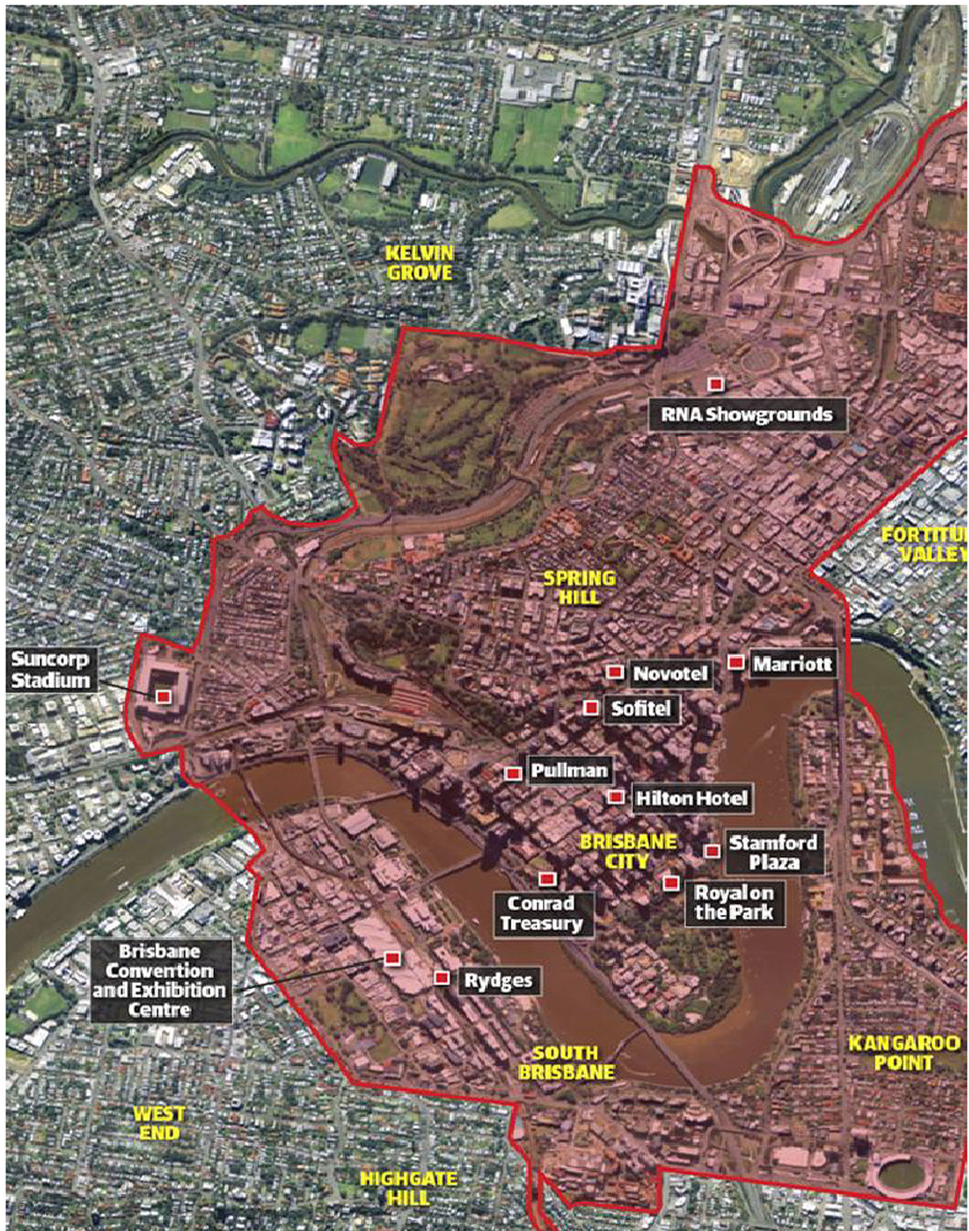 Above: The study tracked residents as they navigated the "Declared Area" using geo-location services.
The Core Insight: Three Urban Imaginaries
The researchers discovered that navigation wasn't just about the shortest route; it was about the internal narrative the walker held. They categorized these into three "imaginaries":
- The Experienced City (Past): Walkers used nostalgia and memories of "quiet streets" to find tranquility in the disruption. They sought "empty laneways" to recapture a sense of childhood play.
- The imMEDIAte City (Present): This was the city of fear and spectacle, shaped by news reports of helicopters and police "packs." This imaginary led to conservative routes through high-visibility, "safe" areas like Queen Street Mall.
- The Desired City (Future): Participants viewed the G20 as a rite of passage for Brisbane to become a "global city" like Sydney or Melbourne, projecting their hopes for better public transport onto their current walks.
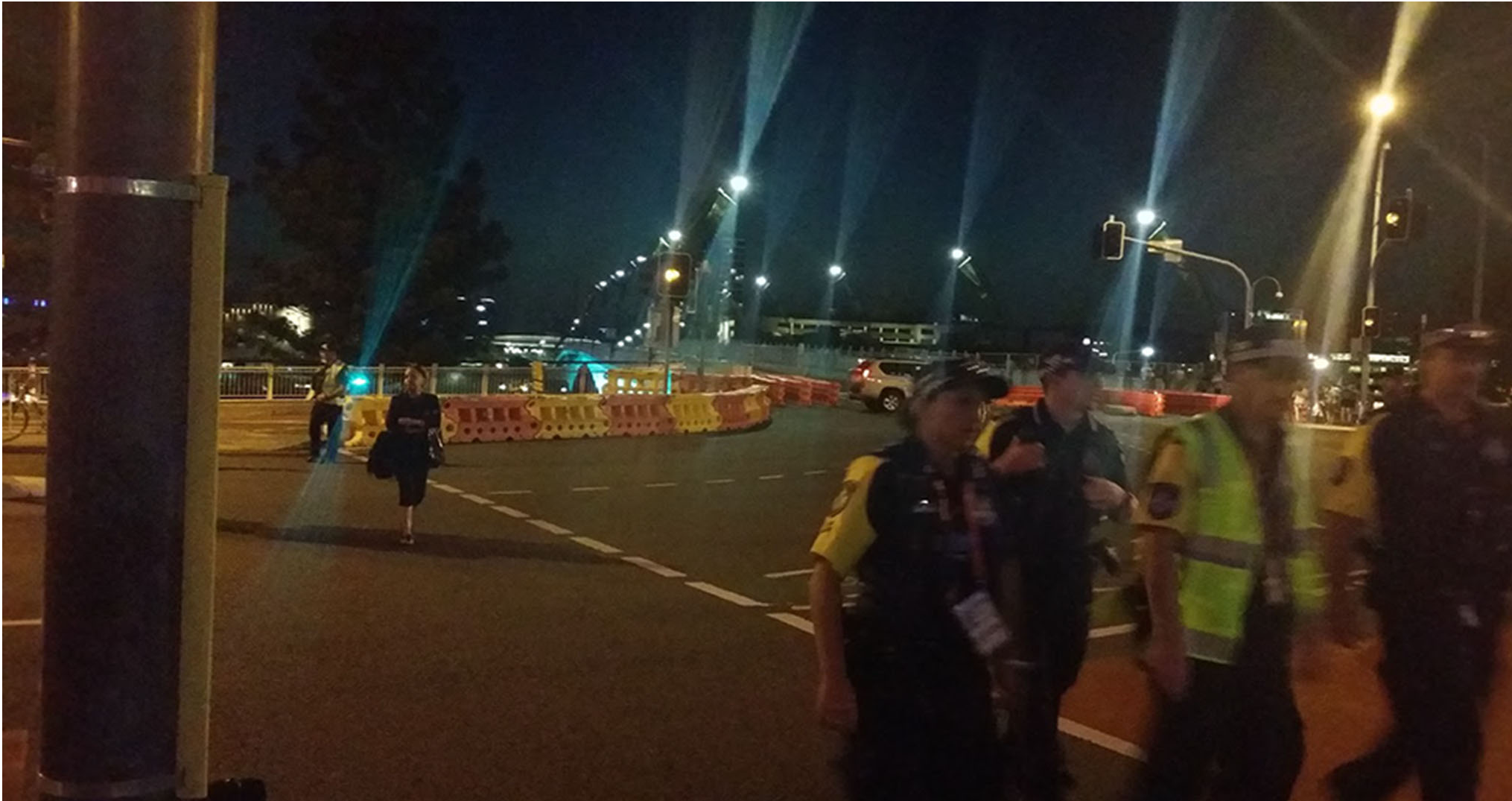 Heavy police presence (as seen above) created a "spectacle" that simultaneously made participants feel protected and targeted.
Collective Intelligence in Niche Networks
A standout finding is the power of Networked Sociality. Latin American participants relied heavily on a Facebook group, "Colombianos en Brisbane" (CiB).
- Why it worked: It offered "hyper-local" expertise that official apps like Google Maps or TransLink couldn't provide.
- The CI Factor: Members shared "rat running" tips (e.g., avoiding check-points to save time) based on real-time, peer-to-peer experiences. This is collective intelligence in its purest form—unstructured, unplanned, yet highly effective.
Critical Analysis & Conclusion
This paper successfully bridges the gap between high-level urban theory (Lefebvre, de Certeau) and the practical reality of Urban Informatics. It proves that "Collective Intelligence" is more than just big data; it's the "audio-visual narratives" and digital "word-of-mouth" that allow humans to adapt to rigid systems.
Limitations: The sample size (14 people) is small and heavily skewed towards one demographic (Latin American migrants). While this gives deep cultural insight, it may not represent the broader Brisbane population.
Future Outlook: As cities become more surveilled, the ability for citizens to "enunciate" their own space through shared digital narratives will be the ultimate tool for urban resilience. The "Right to the City" now passes through our smartphones.