
RATE: Elevating Social Trust via Recommendation-Aware Selection
RATE: Recommendation-aware Trust Evaluation in Online Social Networks
The paper introduces RATE (Recommendation-aware Trust Evaluation), a novel framework for Online Social Networks (OSNs) that optimizes recommender selection for trust prediction. It models the selection of "juror-like" neighbors as an optimization problem focusing on trustworthiness, influence, uncertainty, and cost.
TL;DR
Determining who to trust in Online Social Networks (OSNs) is often a "who you know" problem. The RATE (Recommendation-aware Trust Evaluation) framework shifts the focus from simple trust-path calculations to a sophisticated Recommender Selection Problem (RSP). By optimizing for accuracy, risk, and cost, RATE improves trust prediction accuracy by over 24% while slashing social "costs" by 30%.
Background: Beyond Simple Transitivity
In the classic trust model—"If Alice trusts Bob, and Bob trusts Charlie, then Alice might trust Charlie"—research has long focused on the aggregation of these paths. However, real-world social networks are noisy. Not every neighbor is a good recommender. Prior works often treated all available paths as equal or focused solely on trust ratings, ignoring that some friends are more influential, some are more consistent, and some are "expensive" to consult in terms of social capital or computational resources.
The "Quality of Recommender" (QoR) Insight
The core philosophy of RATE is that quality matters more than quantity. The authors define the Quality of Recommender (QoR) using four pillars:
- Trustworthiness (): The subjective honesty and capability of the recommender.
- Influence (): An objective measure of how much a recommender's opinion typically sways the source.
- Uncertainty (): The fluctuation of a recommender's past performance (risk).
- Cost (): The resource consumption required to obtain the recommendation.
By framing this as a Multi-Objective Optimization problem, the source can tune weights (e.g., "I care more about low risk than low cost") to find the perfect subset of peers.
Methodology: The BasicRATE Algorithm
Unlike static methods that pick the top neighbors, RATE uses a heuristic based on Information Diffusion. It sorts neighbors by their utility and keeps adding them until the "visibility" (the size of the reachable neighbor set) begins to plateau or decrease in efficiency.
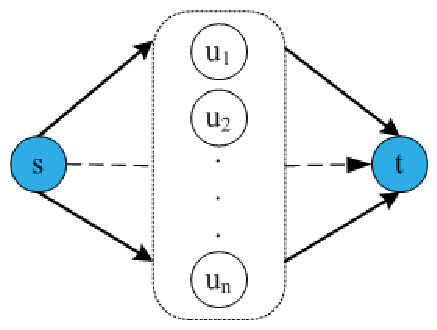 Figure 1: Conceptual overview of source (s) selecting optimal neighbors to evaluate target (t).
Experiments & Real-World Validation
Using the Epinions dataset—a benchmark for real trust networks—the researchers compared RATE against standard average and maximal trust strategies across different path lengths (hops).
Key Findings:
- Precision and Recall: RATE outperformed traditional models significantly, yielding an FScore improvement of at least 24.64%.
- The Power of Sorting: Simply sorting neighbors by QoR before selection drastically reduced uncertainty (-41.87%) and cost (-41.30%).
- Length vs. Trust: Accuracy drops as the "Max Length" of the path increases, confirming the intuition that trust degrades as it travels further from the source.
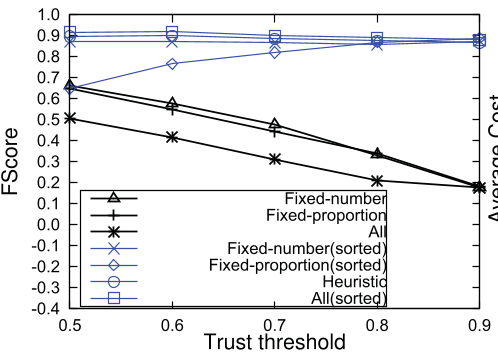 Figure 2: Experimental results showing FScore improvements and the impact of the trust threshold.
Critical Analysis & Future Outlook
RATE effectively bridges the gap between Recommender Systems and Trust Evaluation. By treating trust as a personalized recommendation task, it acknowledges that trust is not just a mathematical scalar but a social transaction involving risk and influence.
Limitations: The current model assumes that weights for trust, influence, and cost are provided by the user. Future iterations could benefit from automated weight learning—where the system learns a user's risk tolerance based on past interactions.
Takeaway: For developers of decentralized platforms or social marketplaces, RATE provides a blueprint for building "curated" trust graphs that are both efficient and highly accurate.