
Bridging the Physical and Digital: Prefilling Rating Matrices via Social Strength
Rating Matrix Prefilling Algorithm Based on Users' Social Strength
This paper proposes a Rating Matrix Prefilling Algorithm based on Users' Social Strength, leveraging an Entropy-Based Model (EBM) to infer social relationships from spatiotemporal check-in data. The method utilizes these social connections to pre-populate sparse rating matrices before applying traditional user-based Collaborative Filtering (CF) to achieve higher recommendation accuracy.
TL;DR
The paper tackles the notorious Data Sparsity problem in recommender systems by mining "Social Strength" from physical location data. By calculating how often and where people co-occur in the real world (using spatiotemporal datasets like Gowalla), the authors prefill the gaps in the rating matrix, allowing traditional User-based Collaborative Filtering (UCF) to perform significantly better in sparse environments.
Problem & Motivation: The Sparsity Wall
Collaborative Filtering is the backbone of modern recommendation, but it hits a wall when users have few ratings—the Cold Start and Data Sparsity problem. In the Gowalla dataset used here, the sparsity is a staggering 0.9635, meaning over 96% of the user-item matrix is empty.
The authors' core Insight is that online interests are reflected in physical movements. If two people visit the same niche theaters or boutiques at the same time, their "Social Strength" is high, and their interests likely overlap even if they haven't explicitly rated the same items online.
Methodology: From Locations to Likelihoods
1. Inferring Social Strength with EBM
Instead of treating social links as binary (friend or not), the paper uses an Entropy-Based Model (EBM). This model isn't just about "how many times" users meet, but "where" they meet.
- User Diversity: Measures the variety of locations where co-occurrences happen.
- Weighted Frequency: Gives more weight to co-occurrences in "un-crowded" places. Meeting at a crowded airport is likely a coincidence; meeting at a small local gallery is a strong signal of shared interest.
2. The Prefilling Strategy
Before the recommendation engine runs, the system calculates a predicted score for unrated items using the users' social neighbors. This "thickens" the matrix, providing more anchor points for the Pearson Correlation used in the secondary UCF phase.
 (Formula 5: Calculating weighted frequency to capture local coincidences at un-crowded places)
Experiments & Results
The authors compared their algorithm against three industry staples:
- User-Based CF
- Item-Based CF
- Slope One
Key Performance Metric: MAE
The Mean Absolute Error (MAE) was used to measure accuracy. A lower MAE indicates the predicted rating is closer to the actual user behavior.
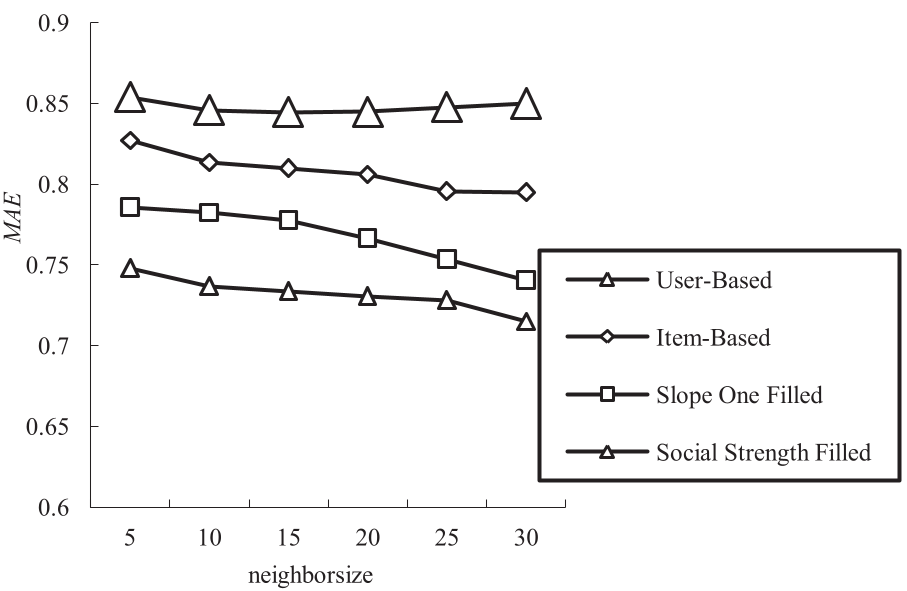 Figure 1: MAE comparison across different neighbor sizes. The Social Strength-based approach consistently outperforms the baselines.
The results demonstrate that as the neighbor size increases, the error margin drops further, proving that social strength is a robust indicator of user preference.
Critical Analysis & Conclusion
Takeaway
Building a recommendation system solely on explicit ratings is no longer enough. This work proves that spatiotemporal behavior is a "latent rating" that can effectively pre-train or pre-fill models to overcome sparsity.
Limitations
- Privacy: Using high-fidelity GPS data (latitude/longtitude) raises significant privacy concerns.
- Length of Stay: As noted by the authors, their current model only counts "check-ins" but doesn't know if a user stayed for 5 minutes or 5 hours—a crucial distinction for social depth.
Future Outlook
The next step for this line of research involves integrating Length of Stay and Semantic Location Data (e.g., categorizing locations as "Work", "Hobbiest", or "Social") to further refine the social strength calculation.