
RPS: Mining Social Sentiment from Textual Reviews to Revolutionize Rating Prediction
Rating Prediction based on Social Sentiment from Textual Reviews
The paper introduces a Sentiment-based Rating Prediction method (RPS) that leverages unstructured textual reviews to enhance recommendation accuracy. It integrates user sentiment similarity, interpersonal sentimental influence, and item reputation into a Probabilistic Matrix Factorization (PMF) framework, achieving SOTA performance on Yelp datasets.
TL;DR
Quantifying "emotive intensity" rather than just binary likes is the key to the next generation of Recommender Systems. This paper proposes RPS (Sentiment-based Rating Prediction), a framework that mines unstructured reviews to extract three core signals: User Similarity, Interpersonal Influence, and Item Reputation. By fusing these into Matrix Factorization, the authors achieve a ~27% improvement in prediction accuracy over standard baselines.
Background & Motivation: Moving Beyond the "Star"
Most recommendation engines are "star-hungry"—they starve when users don't provide explicit numerical ratings. However, users are often verbose in the comments. The authors argue that a "4-star" rating is a lossy compression of a user's true feelings. A review saying "The food was extraordinarily delicious but the wait was slightly long" contains a nuances that a simple number cannot capture.
The authors identify a gap in social recommendation: Interpersonal Influence. In the real world, we trust friends who have strong, clear opinions (high sentimental variance) more than those who are perpetually "okay" with everything. RPS is designed to capture this human intuition mathematically.
Methodology: The RPS Architecture
The RPS model doesn't just look at keywords; it builds a linguistic pipeline to transform text into latent features.
1. Fine-Grained Sentiment Measurement
Instead of simple polarity, the authors use a triple-dictionary approach (Sentiment, Degree, and Negation) and apply LDA (Latent Dirichlet Allocation) to map sentiments to specific product features (e.g., "price", "service").
2. The Three Pillars of PRS
- User Sentiment Similarity: Measures how similarly two friends feel about various categories (e.g., do we both love spicy food but hate loud music?).
- Interpersonal Sentiment Influence: This is the "Influencer" factor. If a friend's reviews shows high variance (strong likes and dislikes), their weight in the recommendation model increases.
- Item Reputation Similarity: Items are characterized by the distribution of sentiment they receive. If two restaurants have similar "reputation profiles," they are mapped closer in the latent space.
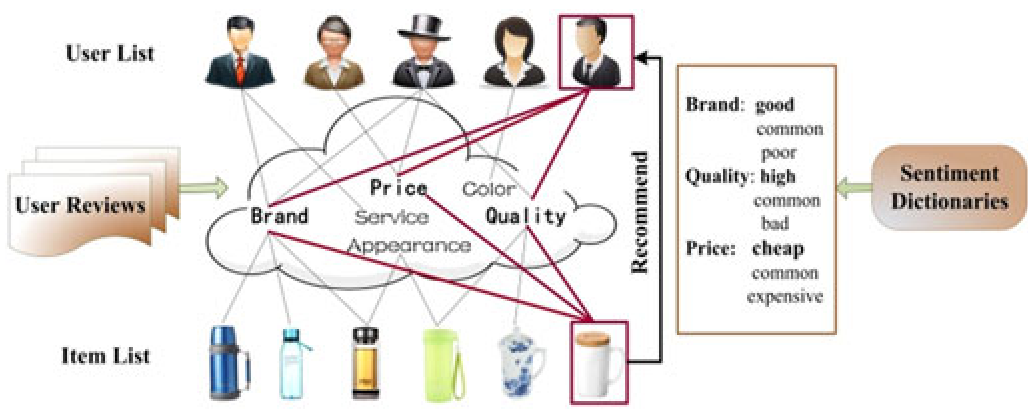 Figure 1: The motivation of RPS—linking feature-level sentiment from reviews to the final recommendation.
Fusing Sentiment into Matrix Factorization
The core of the paper is the extension of the Probabilistic Matrix Factorization (PMF) objective function. The authors add three regularization terms representing the social sentiment factors:
This ensures that the latent vectors for users () and items () are not just optimized to minimize rating error, but are also "pulled" towards their social and reputational peers.
Experimental Battleground: Yelp Performance
The authors tested RPS across eight Yelp categories (Active Life, Restaurants, etc.).
Key Findings:
- RPS vs. Basic MF: A massive 26.92% reduction in RMSE. This proves that textual context is a powerhouse for accuracy.
- RPS vs. EFM: Even compared to modern "Explicit Factor Models" that use features, RPS wins by ~10% because it accounts for the social spread of sentiment.
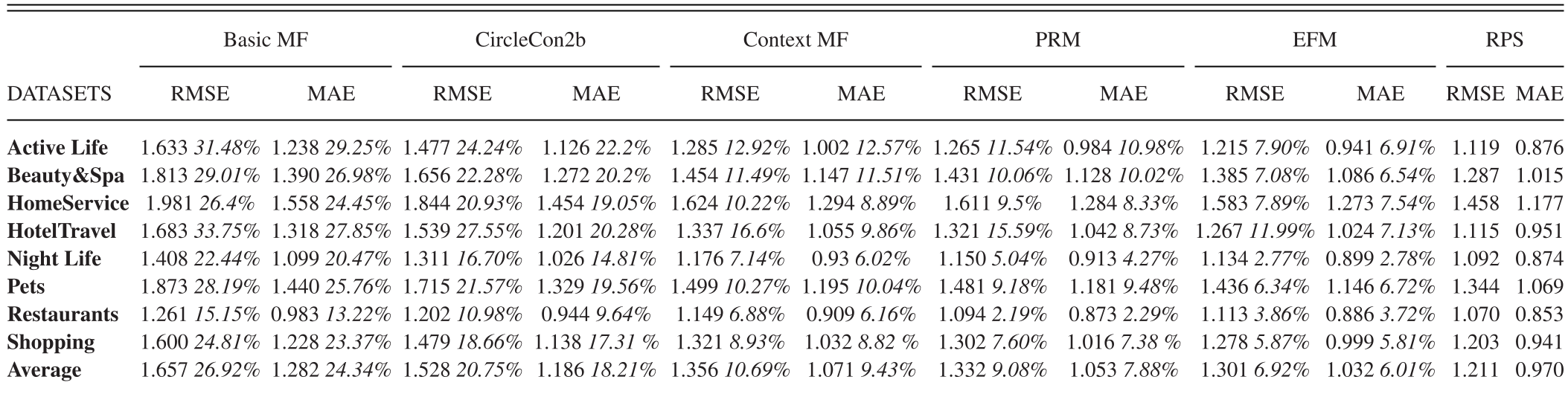 Table 1: Performance comparison—RPS (last column) consistently shows the lowest error metrics across all datasets.
The Sentiment Variance Insight
Perhaps the most fascinating result is the impact of sentimental variance. The model performs significantly better for users whose friends have "clear like and dislike sentiment" (). If your social circle is indifferent, the model has less "signal" to work with.
Critical Perspective: Limits and Future Paths
While RPS is a significant leap, it relies on lexicons (dictionaries). In the era of LLMs (Large Language Models), the "dictionary" approach feels slightly dated. Slang, sarcasm, and evolving internet lingo might bypass static word lists.
Future Outlook: The next logical step for this research is to replace the manual sentiment pipeline with Transformer-based embeddings (like BERT or GPT) while retaining the brilliant "interpersonal variance" and "reputation distribution" logic introduced here.
Conclusion
This paper is a masterclass in feature engineering for social networks. It proves that sentiment is not just a "bonus" feature but a fundamental dimension of user behavior that, when modeled correctly through variance and reputation, can solve the data sparsity issues plaguing modern Recommender Systems.