
Beyond Perfection: Bounded Optimality as the Bridge Between Theory and Real-World AI
Rationality and Intelligence: A Brief Update
This paper, authored by Stuart Russell, proposes Bounded Optimality as a rigorous formal definition for intelligence. It updates the conceptual trajectory from perfect rationality to feasible agent programs, establishing a framework where intelligence is measured by a system's ability to maximize utility given its inherent computational constraints.
TL;DR
Stuart Russell’s seminal update on "Rationality and Intelligence" argues that our quest for "Perfect Rationality" in AI is a pursuit of a ghost. Instead, the field should converge on Bounded Optimality: the search for the best possible agent program that can actually run on a finite machine. This paradigm shift reconciles the mathematical rigor of decision theory with the messy, limited reality of silicon and synapses.
The "Perfect" Problem: Why AI Theory often Fails Practice
Historically, AI has been haunted by the ghost of Perfect Rationality (). In this view, an intelligent system always takes the action that maximizes expected utility. While mathematically beautiful, it is physically impossible. Real-world problems are computationally intractable (NP-hard or worse), and real agents take time to think.
The author dissects the evolution of rational definitions:
- Calculative Rationality (): A program is rational if it eventually computes the perfect answer. (Problem: It might take years to decide a chess move).
- Metalevel Rationality (): Optimizing the "value of computation" itself. (Problem: You end up needing a "meta-meta-meta-level" to decide how long to spend deciding how long to spend thinking—a conceptual infinite regress).
Methodology: The Architecture of Bounded Optimality
Russell proposes Bounded Optimality () as the only viable candidate for a formal definition of intelligence.
The Formal Shift
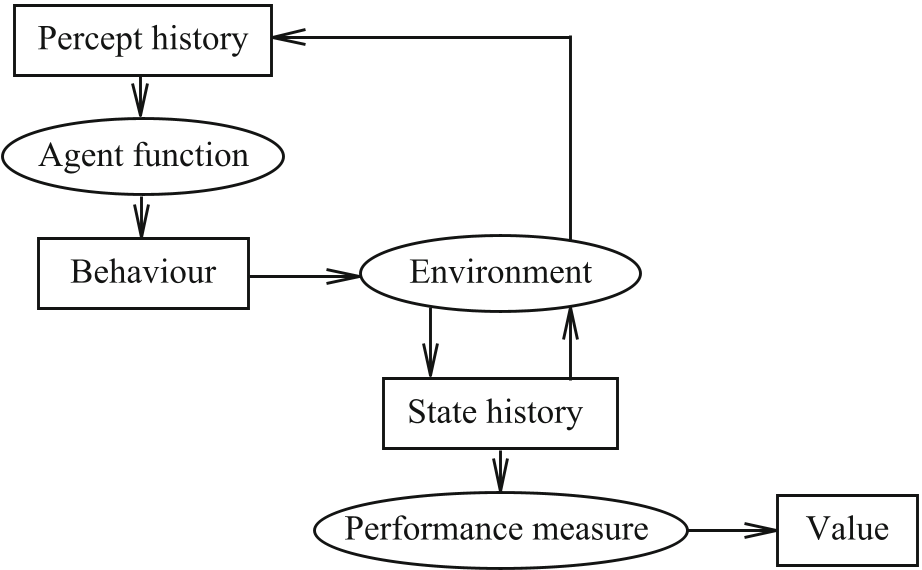
Instead of optimizing the mapping from observations to actions (Agent Function), we optimize the Program () running on a Machine ().
The core equation of Bounded Optimality is:
In this framework:
- Existence: A bounded-optimal program must exist because the space of programs for a finite machine is finite.
- Feasibility: It respects the speed and memory limits of the actual hardware.
- Complexity: It encourages complex architectures (like hierarchical reasoning) because the machine must "squeeze" as much utility as possible out of limited cycles.
Experiments and Insights: Building the Toolbox
Russell doesn't just propose a definition; he offers a roadmap for the "Calculative Toolbox."
Hierarchical Reinforcement Learning (HRL)
Modern AI agents (like those in robotics) cannot perform "flat" reinforcement learning over trillions of muscle cycles. Bounded optimality justifies Hierarchical Actions. By treating complex sequences (e.g., "Go to the kitchen") as single high-level actions, the agent reduces the computational burden of planning, reaching a state of bounded optimality that a flat-layer agent never could.
The "Doubling" Strategy for Deadlines
One fascinating takeaway from the methodology is how to handle unknown deadlines. Russell demonstrates that a compositional system—one that runs a "quick and dirty" algorithm and then iteratively refines it—can be Asymptotically Bounded Optimal (ABO).

Critical Analysis: The Future of Intelligence Design
Russell's work highlights a critical tension: Offline vs. Online Design.
- If the "Intelligence" is designed by us (offline), we are solving the complex metalinguistic optimization for the agent.
- If the "Intelligence" is learned (online), the agent must have meta-reasoning capabilities tailored to its own hardware.
Limitations: The author admits that finding is a monumental challenge for the designer—it shifts the computational burden from the agent's "thinking time" to the designer's "engineering time."
Conclusion: A Science of Intelligent Agent Design
If we are to build a true science of AI, we must stop asking "What is the perfect move?" and start asking "What is the best program for this specific robot?" Bounded optimality provides the mathematical grammar for this question. It explains why we have declarative knowledge, why we focus on certain goals, and potentially, why human intelligence is structured the way it is: a messy, but brilliantly optimized, solution to the problem of a small mind in a very large world.