
ReLauncher: Eliminating the "Long Tail" in Crowdsourcing via Dynamic Runtime Control
ReLauncher: Crowdsourcing Micro-Tasks Runtime Controller
This paper introduces ReLauncher, a runtime controller for crowdsourcing platforms like CrowdFlower that significantly reduces task completion time. It dynamically identifies "abandoned" micro-tasks—assignments started by workers but never finished—and relaunches them to ensure the "long tail" of execution doesn't delay the overall project.
TL;DR
Crowdsourcing is often surprisingly slow due to "abandoned assignments"—tasks that workers start but leave unfinished. This paper presents ReLauncher, a tool that monitors tasks in real-time, predicts when a worker has likely ghosted a task using linear regression, and proactively relaunches those tasks. The result? A 3x increase in execution speed for a mere 10% increase in budget.
Background: The Ghosting Problem in Human Computation
In platforms like CrowdFlower (now part of Appen) or Amazon Mechanical Turk, the workflow seems simple: a requester posts tasks, and workers complete them. However, a significant friction point exists: Abandoned Assignments.
Workers often open a task, realize it's too complex or get distracted, and simply close their browser tab. Because the platform doesn't know the worker has left, it "locks" that task for a fixed timeout (often 30 minutes). If your project has 100 tasks and 2 workers ghost the last 2 tasks, your entire project sits idle for half an hour waiting for a timeout. This creates the infamous "long tail" of execution.
The Insight: Why Wait for Static Timeouts?
The authors of ReLauncher realized that waiting for a static platform timeout is inefficient. They hypothesized that assignment durations follow a predictable distribution (specifically, a log-normal distribution). By observing how fast "good" workers finish tasks, we can statistically determine when a "slow" worker has likely abandoned the job.
Methodology: How ReLauncher Works
ReLauncher acts as an intelligent middleware between the requester and the crowdsourcing API.
1. Dynamic Timeout Estimation
Instead of a fixed 30-minute limit, ReLauncher calculates MaxDur on the fly. It uses a Linear Regression model based on the durations of already completed assignments. As the task progresses, the model refines what "too slow" looks like for that specific dataset.
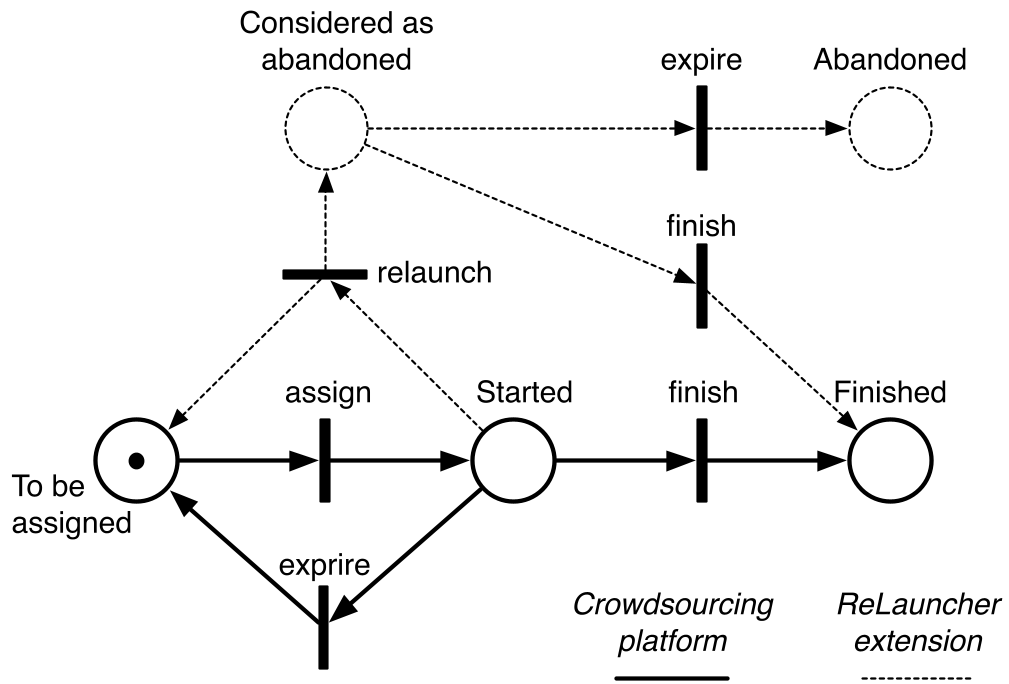 Figure: The Petri Net model showing the standard execution path (solid) vs. the ReLauncher intervention (dashed).
2. The 70% Heuristic
Intervening too early causes unnecessary costs (paying two people for the same job). The authors found that task speed usually plateaus around 85% completion. To be safe, ReLauncher starts its monitoring and relaunching logic after 70% of the assignments are finished.
3. Relaunching Logic
When a task exceeds the MaxDur, ReLauncher:
- Cancels the current data unit (to stop the platform's internal timer).
- Duplicates the data unit and posts it as a new "child" task.
- If the original "slow" worker eventually finishes, they are still paid. This ensures ethical treatment of workers while prioritizing project speed.
Experimental Results: 300% Speedup
The researchers tested ReLauncher on a receipt transcription task. The contrast was stark:
- Baseline (No ReLauncher): 3,146 seconds average completion.
- With ReLauncher: 948 seconds average completion.
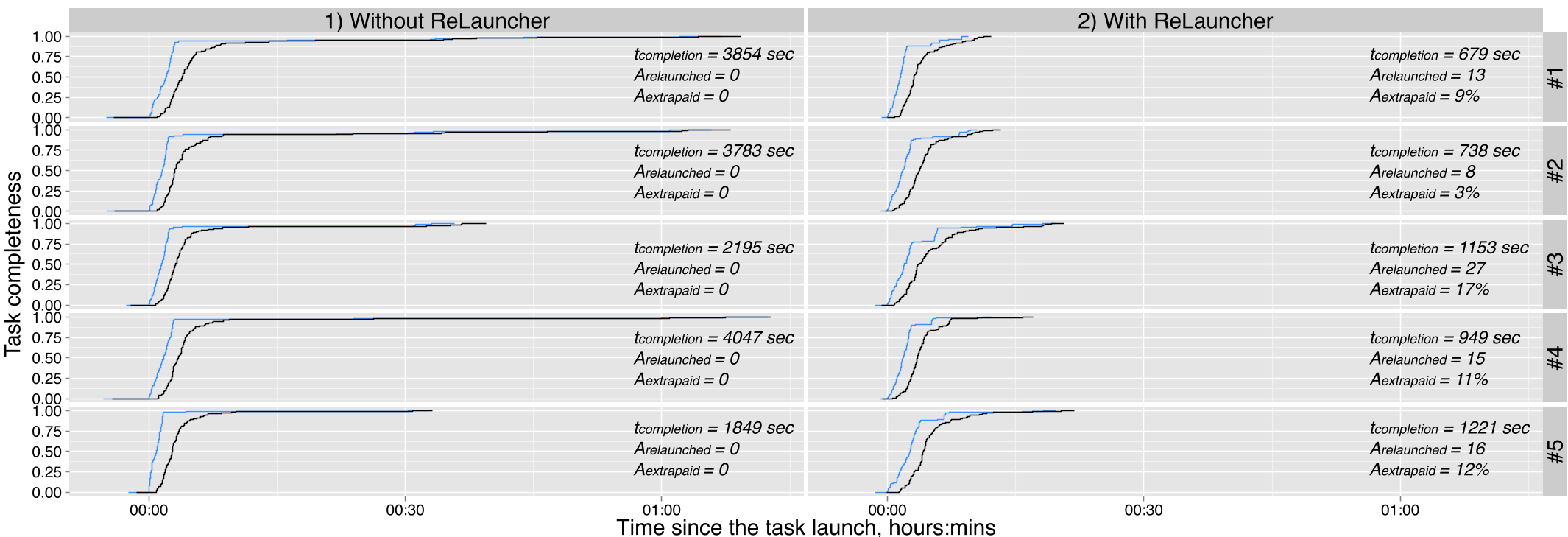 Figure: Cumulative completion curves. Note how the "With ReLauncher" curve (right) finishes abruptly, whereas the "Without" curve (left) drags on.
The "extra cost" for this speed was only about 10.4%. For most commercial or time-sensitive research applications, paying 10% more to get results 3x faster is a no-brainer.
Critical Analysis & Conclusion
ReLauncher proves that the bottleneck in crowdsourcing isn't always "slow workers"—it's often rigid platform architecture.
Takeaways:
- Predictive Latency Management: We don't need to know what a worker is doing if we can statistically model how long they should be taking.
- Cost vs. Latency Trade-off: This paper provides a quantifiable framework for requesters to trade a small amount of budget for a massive gain in speed.
Limitations: The work currently relies on API-level data. The authors suggest that injecting client-side JavaScript to monitor active browser focus could theoretically drive the "extra cost" of relaunching down to near zero, as we would only relaunch tasks where the worker has definitely closed the tab.
For developers and data scientists running large-scale human-labeling jobs, ReLauncher offers a blueprint for a "Runtime Controller" that makes crowdsourcing feel less like a black box and more like a responsive computing resource.