
Beyond "Friends Only": Reachability-Based Privacy in the Age of Social Graphs
A reachability-based access control model for online social networks
The paper introduces a reachability-based access control model specifically designed for Online Social Networks (OSNs). By utilizing graph-based path expressions, the model enables users to specify fine-grained access rules based on complex relationship chains and trust levels, achieving real-time enforcement on large-scale datasets.
TL;DR
The paper proposes a novel access control model for Online Social Networks (OSNs) that moves beyond simple "friend" lists. By treating privacy as a graph reachability problem, it allows users to specify rules like "allow friends of colleagues who I trust more than 80%." Using graph database technology, the system enforces these rules in real-time, even on networks with nearly a million users.
Contextual Positioning
Published at SIGMOD, this work sits at the intersection of Graph Theory and Cybersecurity. While prior works relied on static roles or simple distance metrics, this model introduces Path Expressions as the primary language for privacy, bridging the gap between social intuition and formal logic.
The Problem: The "Privacy-Utility" Tradeoff
Most OSNs (like Facebook or LinkedIn) force users into a binary choice: share with everyone or share with only direct contacts. This is problematic because:
- User Fatigue: Categorizing hundreds of friends into manual lists is tedious.
- Context Collapse: A photo meant for "friends of friends" often has no easy middle-ground setting.
- Dynamic Relationships: Trust isn't static; it flows through the network and decays over distance.
Methodology: Privacy as a Path
The core innovation is the Access Condition (AC). Instead of a list of IDs, an AC is a tuple: .
- Graph Representation: The OSN is a directed graph where edges carry relationship labels (e.g.,
friend,colleague) and weights (explicit trust). - Path Expressions: Users define an "authorized audience" using sequences. For example:
Friend+ [1, 2] / Colleague+ [1]allows access to friends (up to 2 hops away) who are also direct colleagues. - Trust Propagation: The system uses a function to calculate indirect trust across a path, ensuring the requester meets a minimum threshold .
 Figure 1: The Reference Monitor intercepts requests and evaluates path reachability within the social graph.
Real-Time Enforcement
A common critique of complex rule-based systems is latency. The authors solve this by:
- Utilizing Breadth-First Search (BFS) for path validation.
- Implementing the model on Neo4j, a graph-native database designed for high-speed traversals.
- Evaluating trust scores concurrently during the graph crawl.
Experimental Validation
The authors tested their "Reference Monitor" on a real-world Facebook dataset. As the network size grew to nearly 1 million nodes, the system maintained sub-second latency for most standard queries.
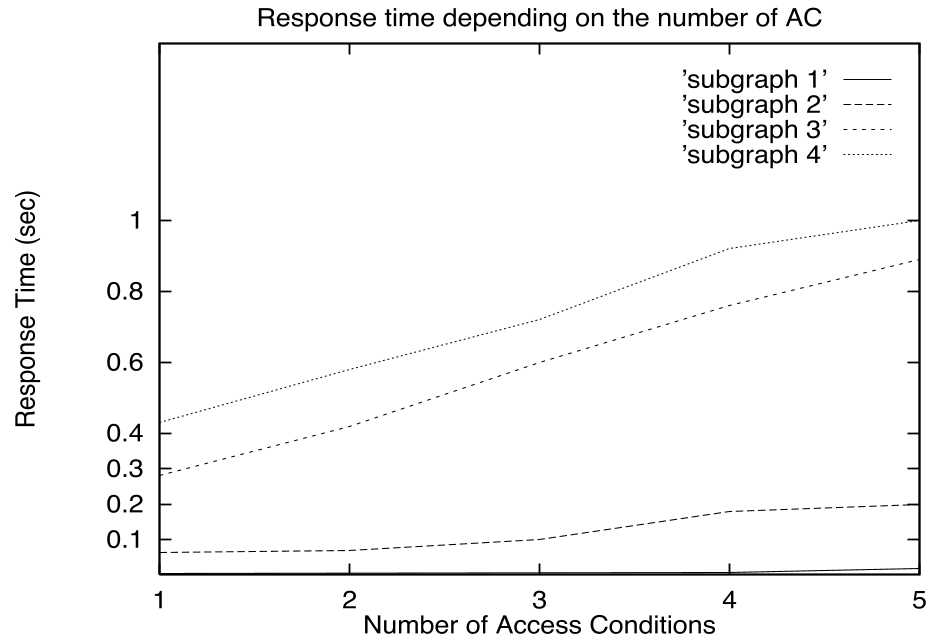 Figure 2: Response time vs. Path Depth. Even at a diameter of 35, the system handles requests efficiently.
Key Takeaways & Future Outlook
- Inductive Bias: The model assumes that social trust is transitive but decays—a powerful intuition for building automated privacy settings.
- Scalability: The shift from relational databases to graph databases is essential for modern social metadata management.
- Future Challenges: While effective, the model does not yet address "Co-ownership" (e.g., a photo featuring two people with conflicting privacy rules), which remains a fertile ground for future research.
In conclusion, reachability-based access control provides a robust framework for making OSN privacy as dynamic and nuanced as the real-world relationships they represent.