
REACT!: Demystifying AI Planning for the Next Generation of Robotics
ReAct!: An Interactive Educational Tool for AI Planning for Robotics
REACT! is an interactive educational tool designed to bridge the gap between high-level AI planning and low-level robotic control. It allows students to model complex dynamic domains and solve hybrid planning problems using state-of-the-art solvers (SAT/ASP) without needing deep expertise in logic-based formalisms or solver-specific syntaxes.
TL;DR
Integrating high-level "thinking" (AI Planning) with low-level "moving" (Geometric Reasoning) is the holy grail of cognitive robotics. However, the steep learning curve of logic programming often scares students away. REACT! is a breakthrough educational tool that provides an interactive bridge, allowing students to build "smart" robots that can solve complex tasks like the Tower of Hanoi or Housekeeping without writing a single line of raw PDDL or Answer Set Programming (ASP) code.
The "Logic Barrier" in Robotics Education
Robotics is inherently multidisciplinary, involving mechanical engineers, electronic experts, and computer scientists. While logic-based formalisms like the Action Language are powerful for reasoning about action and change, they are notoriously difficult to learn.
Before REACT!, instructors spent weeks teaching syntax and semantics. Students often got bogged down in "debugging" logical formulas rather than solving robotic challenges. The primary pain point was the integration gap: how do you tell a discrete logic planner that a certain "Move" action is physically impossible because of a wall?
Methodology: Systematic Modeling and Hybrid Integration
REACT! solves this by enforcing a structured workflow through its GUI. Instead of staring at a blank text editor, students follow a tabbed interface:
- Objects and Sorts: Define what exists (Robots, Boxes, Locations).
- Fluents and Actions: Define what changes (Robot_At, Holding_Box).
- Preconditions and Effects: Define the "Laws of the World."
The Secret Sauce: External Predicates
The most impressive technical feature is the handling of Hybrid Planning. REACT! allows students to link high-level actions to external scripts (in C++ or Prolog).
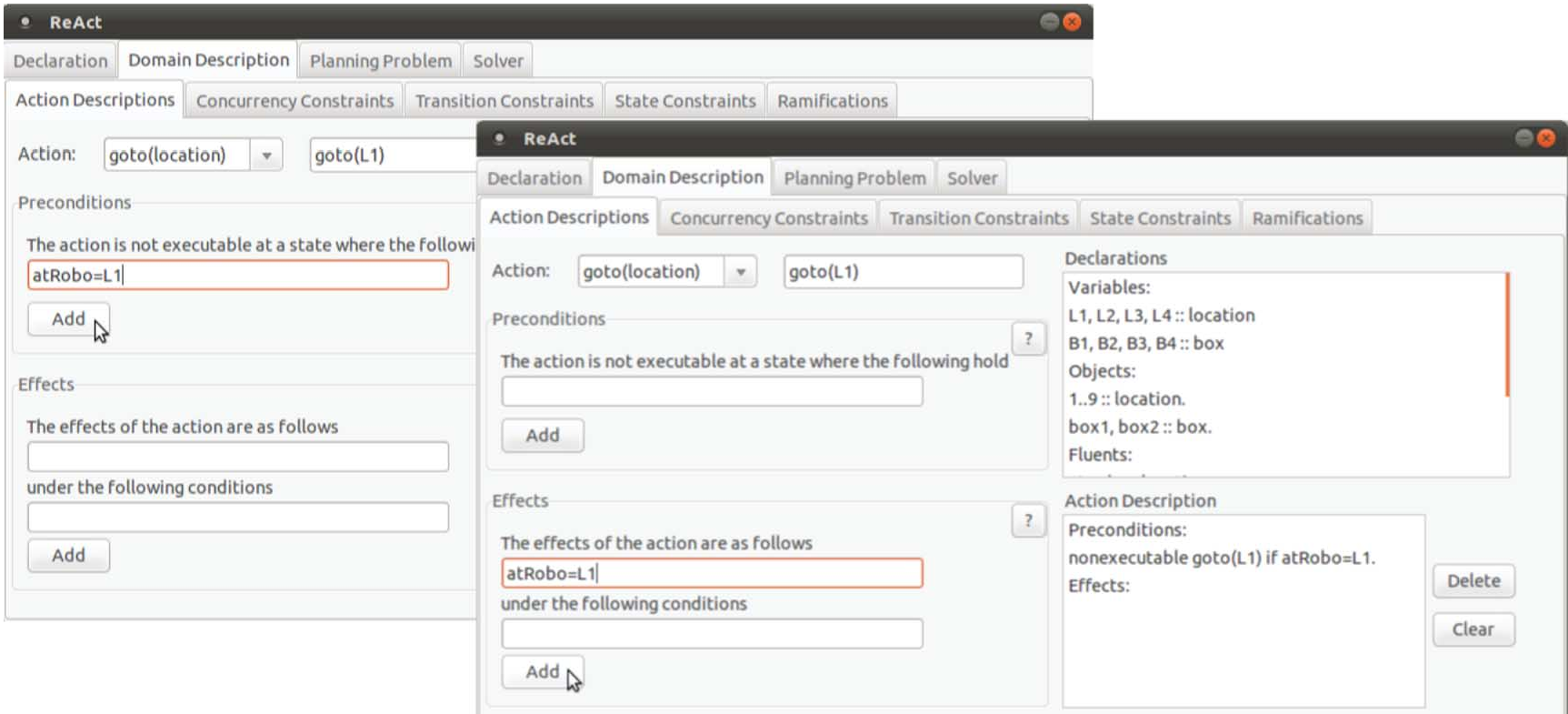 Figure 1: The interface allows users to define external calculations, such as collision checks, which are then called during the planning process.
When the SAT or ASP solver tries to find a plan, it "calls out" to a motion planner (like OpenRAVE) to check if a specific path is feasible. If the motion planner says "No," the high-level solver finds a different path automatically.
Experimental Results: From Classroom to Conference
The efficacy of REACT! was tested at Sabancı University over several years. The results were stark:
- Efficiency: Teaching time for planning concepts dropped from weeks to hours.
- Research Output: Students using REACT! were significantly more productive. In one cohort, 8 out of 9 students published their course projects at international peer-reviewed conferences (e.g., ICRA, IROS).
- Grade Improvement: The average grade rose from B+ to A, as students could focus on higher-level problem-solving rather than syntactic errors.
 Table 1: Quantitative evidence showing the jump in successful integrations and publications when using REACT!.
Deep Insight: Why This Matters
The value of REACT! isn't just in making things "easier"; it's in Cognitive Scaling. By abstracting the "how" of automated reasoning, it allows researchers to focus on the "what." This tool treats the AI solver as a black box—similar to how modern engineers treat a CAD engine or a Compiler—enabling mechatronics and mechanical students to contribute to the "Cognitive" side of robotics.
Conclusion & Limitations
While REACT! is a powerful catalyst, it currently relies on the user to provide the initial state and goal. It assumes a structured environment. Future iterations could benefit from deeper integration with perception tools like PCL (Point Cloud Library) to automatically generate the "Fluents" from camera data.
Takeaway: REACT! proves that with the right abstraction layer, logic-based AI and physical robotics can be unified, transforming a theoretical bottleneck into a practical tool for innovation.