
MESR: Breaking the Human Limit in Reading Hidden Emotions
Towards Reading Hidden Emotions: A Comparative Study of Spontaneous Micro-Expression Spotting and Recognition Methods
This paper presents the first comprehensive system (MESR) for automatic spotting and recognition of spontaneous micro-expressions (MEs) in long videos. It introduces a training-free spotting method based on feature difference contrast and an advanced recognition framework utilizing Eulerian video magnification and spatiotemporal descriptors like HIGO-TOP.
TL;DR
Micro-expressions (MEs) are the "leaks" of our true feelings—involuntary facial movements that last less than half a second. While humans struggle to see them, researchers from the University of Oulu have developed MESR, the first automatic system capable of spotting and recognizing these spontaneous flickers in long videos, outperforming human accuracy in recognition tasks and matching them in complex spotting scenarios.
Context: The Challenge of Spontaneity
In high-stakes situations like interrogations or psychotherapy, people try to mask their emotions. However, true feelings often "leak" through MEs. Historically, AI models were trained on posed data (actors pretending to move fast), which is significantly cleaner than real life. This paper shifts the focus to spontaneous MEs, where movements are fainter and often buried under eye blinks or head turns.
The Methodology: Magnifying the Invisible
The authors recognized that the primary bottleneck was the low intensity and variable duration of MEs. Their solution involves a three-pronged technical approach:
1. Motion Magnification
By applying Eulerian Video Magnification, the system amplifies subtle pixel variations. This makes a slight twitch of the mouth corner significantly more distinct for feature extractors.
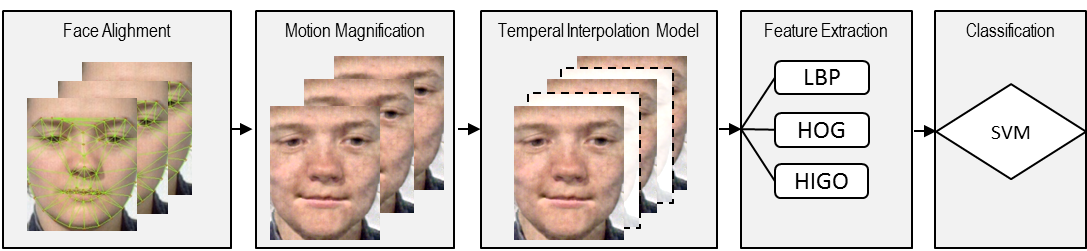 Figure: The framework of the proposed Micro-Expression Spotting and Recognition (MESR) system.
2. Temporal Interpolation (TIM)
Since MEs vary in length, the authors use TIM to map sequences to a unified length (e.g., 10 frames). This ensures the "dynamic texture" captured by the model isn't distorted by the speed of the camera.
3. HIGO Feature Descriptor
While Local Binary Patterns (LBP) were the previous standard, this paper introduces HIGO (Histogram of Image Gradient Orientation). Unlike HOG, HIGO ignores the magnitude of gradients, making it remarkably robust to illumination changes and differing muscle strengths across subjects.
Experimental Battleground: AI vs. Human
The researchers tested the system on the SMIC and CASME II databases—the gold standards for spontaneous micro-expressions.
- The Recognition Feat: On the SMIC-VIS dataset, the HIGO-based model achieved 81.69% accuracy, whereas a group of 15 human subjects averaged only 72.11%.
- The Spotting Hurdle: Spotting MEs in a continuous video stream is much harder. The system's main enemy? Eye blinks. Since blinks are rapid and involve similar facial regions, they often trigger false positives. Even so, the AI's final performance was within the standard deviation of human performance.
 Table: Comparison of MESR against various SOTA methods. Our method (HIGO+Mag) shows a clear dominance.
Deep Insight: Why Why HIGO over LBP?
The paper reveals a crucial academic insight: Gradient orientation is more "honest" than intensity. In near-infrared (NIR) settings, LBP still holds its ground because shadows are minimized. However, in standard RGB video, the local "weighted vote" in HOG can be misled by contrast. By moving to HIGO (simple votes for orientation only), the model focuses purely on the geometry of the movement, effectively filtering out the "noise" of lighting.
Conclusion & Future Outlook
The MESR system is a landmark in affective computing. While it still struggles with distinguishing eye blinks from actual expressions, its ability to outperform humans in recognition marks a turning point for forensic science and mental health monitoring. The next frontier? Deep Learning. As the authors note, moving from handcrafted features (HIGO/LBP) to automated feature learning via CNNs or Transformers will likely be the key to finally solving the "eye blink" problem.
Author's Note: This work was supported by the Academy of Finland and emphasizes the shift towards robust, real-world spontaneous emotion analysis.