
Real or Not? Unmasking Fake News via the Digital Supply Chain
Real or Not? Identifying Untrustworthy News Websites using Third-Party Partnerships
This paper introduces a novel methodology for identifying untrustworthy news websites (fake news and clickbait) by analyzing their "digital supply chains"—the network of third-party partnerships used for advertising, tracking, and functionality. By shiftng the focus from content-based analysis to infrastructure-based finger-printing, the authors achieve high-accuracy classification using machine learning and heuristic methods.
TL;DR
Researchers have developed a way to identify fake news and clickbait websites without reading a single word of their content. By analyzing the third-party services (ads, trackers, scripts) these sites use, they can identify untrustworthy domains with over 94% accuracy. The logic is simple: a website "is known by the company it keeps."
The "Beyond Content" Motivation
Detecting misinformation is usually a cat-and-mouse game of linguistics. Fact-checkers and NLP models scrutinize headlines and body text, but bad actors are experts at mimicking the "tone" of legitimate news.
The authors of this study argue that while content is easy to fake, business models are not. Legitimate news organizations and untrustworthy outlets operate on fundamentally different economic engines. These engines require different "digital supply chains"—the invisible network of third-party partners that provide advertising, analytics, and video hosting.
Why Content Analysis Fails Where Infrastructure Succeeds:
- Cost: Fact-checking is human-intensive; infrastructure scanning is automated.
- Evasion: Changing a word is easy; changing your advertising partner or analytics provider (which affects your bottom line) is difficult.
- Mutual Selection: High-reputation advertisers often refuse to work with clickbait sites, forcing untrustworthy actors into specific "shady" digital neighborhoods.
Methodology: The Digital Fingerprint
The researchers treated the presence or absence of third-party scripts as a binary vector. They utilized several distinct approaches to classify websites:
1. The Significant Third-Party (STP) Heuristic
The team identifies "exclusive" partners. For instance, certain ad-trackers appeared only on untrustworthy sites, while others (like specific Twitter ad tags) were almost exclusively found on legitimate news sites. If a site uses "untrustworthy-only" partners, it’s flagged.
2. SVM with K-Means Dimensionality Reduction
To handle the thousands of potential third-party scripts, the authors used k-means clustering to group third-parties based on their typical "clientele." They then fed these cluster ratios into a Support Vector Machine (SVM) to draw a boundary between "Real" and "Fake."
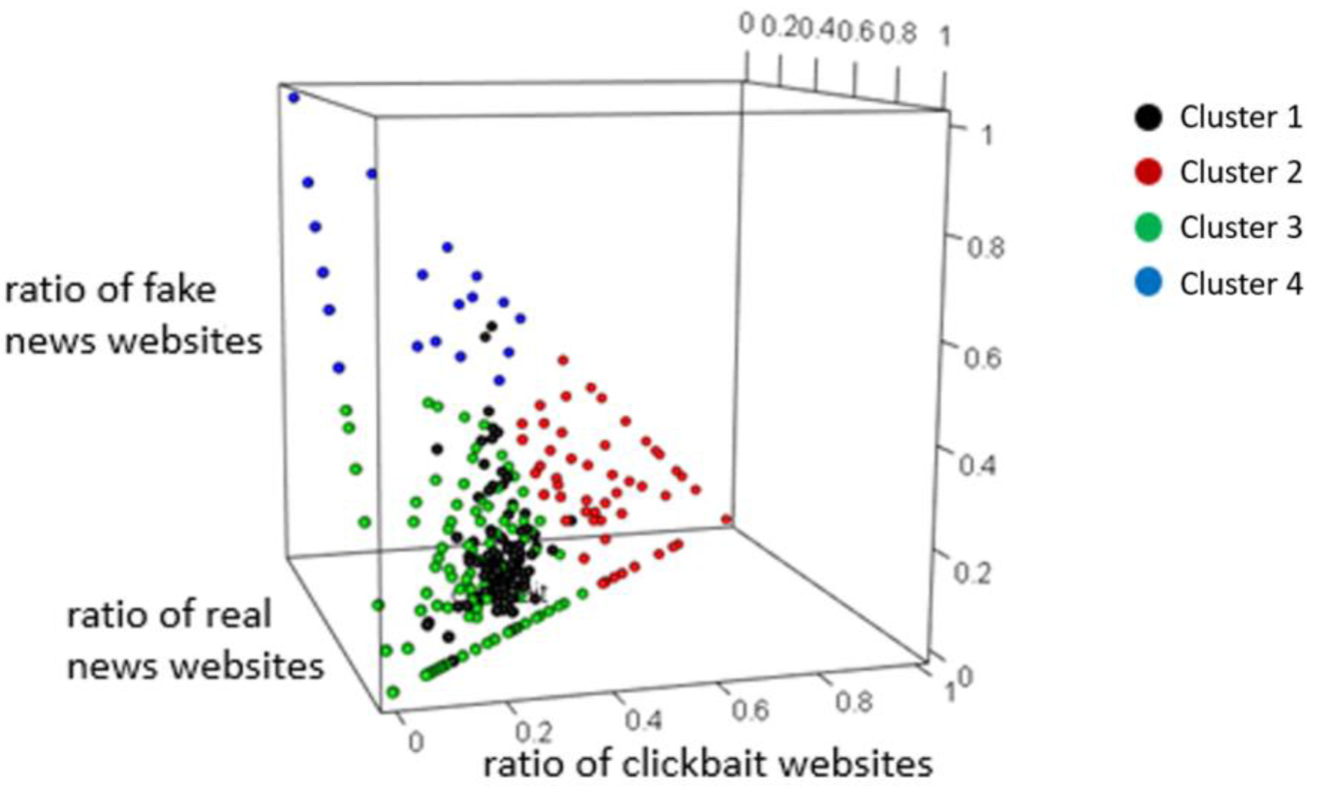 Figure: K-means clustering of third-parties (k=4) revealing a clear separation between the digital ecosystems of real news vs. clickbait.
Experiments & Results: Putting the Theory to the Test
The study compared their methods against a suite of existing industry tools (like B.S. Detector and ZenMate).
- Accuracy: The hybrid STP-SVM model achieved a staggering 94.1% accuracy.
- Robustness: A common critique might be that "real news sites are just more popular, so they have more ads." The researchers debunked this by testing against low-popularity real news sites. Even then, the "untrustworthy" signature remained distinct.
 Table: Comparison of the proposed methods (STP, SVM, CS5) against existing detectors. The proposed methods dominate in almost every metric.
Critical Insights & Future Outlook
The brilliance of this work lies in its application of the Social Embeddedness Perspective to the web. It treats a website not as an isolated island of text, but as a node in a professional network.
Key Takeaways:
- Source-Level Identification: Instead of playing "Whac-A-Mole" with individual articles, we can flag entire domains based on their business infrastructure.
- Real-Time Potential: This can be implemented in browsers to warn users before they even read a headline.
- Limitations: The "Zero Third-Party" problem. Six websites in the study had no third-party scripts at all, making them invisible to this method. Furthermore, as "fake news" becomes more profitable, bad actors might invest more in "cleaning up" their digital supply chain to mimic elite broadcasters.
Final Thought: If you want to know if a news site is lying to you, don't just look at what they say—look at who is paying them to exist.