
From Receipts to Reality: Bridging Data Mining and Multi-Agent Simulation in Retail
From Real Purchase to Realistic Populations of Simulated Customers
The paper introduces a novel framework for populating Multi-Agent Based Simulations (MABS) with realistic consumer agents by extracting behavioral "prototypes" from real-world retail receipts. Using a "Best-Match Jaccard Index" and hierarchical clustering, the authors automate the generation of prototypical shopping lists that drive agent behavior in a spatially realistic store environment.
TL;DR
Researchers Philippe Mathieu and Sébastien Picault have developed a methodology to transform raw retail receipts into "realistic" populations of artificial agents. By combining a specialized similarity metric—the Best-Match Jaccard Index—with hierarchical clustering, they can extract prototypical shopping lists that allow agents to behave autonomously in a simulated store while accurately reflecting real-world statistical distributions.
The Gap: Statistics vs. Situated Behavior
In the retail world, there is a fundamental disconnect between two analytical approaches:
- Data Mining: Great at finding "what" people buy (e.g., tea and biscuits go together), but blind to the "why" and "how" the store layout influenced that choice.
- Agent-Based Modeling (ABM): Excellent at representing "how" agents move and interact, but often crippled by the need for manual, expert-driven "rules" for every agent.
This paper solves the "Cold Start" problem for ABMs: How do we populate a virtual supermarket with 10,000 agents without guessing what they want?
Methodology: The Best-Match Jaccard Index
The core technical innovation lies in how the authors compare shopping transactions. Traditional metrics like the Jaccard Index are binary—either you bought the exact same item or you didn't.
The authors argue that if one person buys "Organic Soda" and another buys "Diet Cola," they are more similar than if one bought "Soda" and the other bought "Shampoo." They introduced a Hamming-like similarity within the Jaccard calculation to allow for "fuzzy" matches between item features.
The Workflow
- Item Encoding: Convert SKUs into tuples of integers (Category, Brand, Price, etc.).
- Clustering: Use the Best-Match Jaccard Index (JBM) to group similar receipts.
- Prototype Induction: Create "Abstract Receipts" for each group using wildcards (0) for unimportant traits.
- Simulation: Use these prototypes as the "Goals" for agents in a 3D store environment.
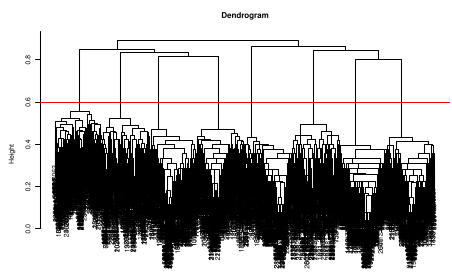 Fig 1. Dendrograms showing the identification of distinct customer clusters from transactional data.
Experiments and Robustness
To test if their method could handle the "messiness" of real life, the authors ran stochastic simulations. They introduced:
- Noise: Random extra items added to baskets.
- Missing Items: Agents failing to find things they wanted.
- Outliers: Completely random shoppers.
The results showed that at a cutting height of 0.6 in their hierarchical tree, the algorithm was incredibly resilient, consistently recovering the "hidden" shopping prototypes even in the presence of 10% noise.
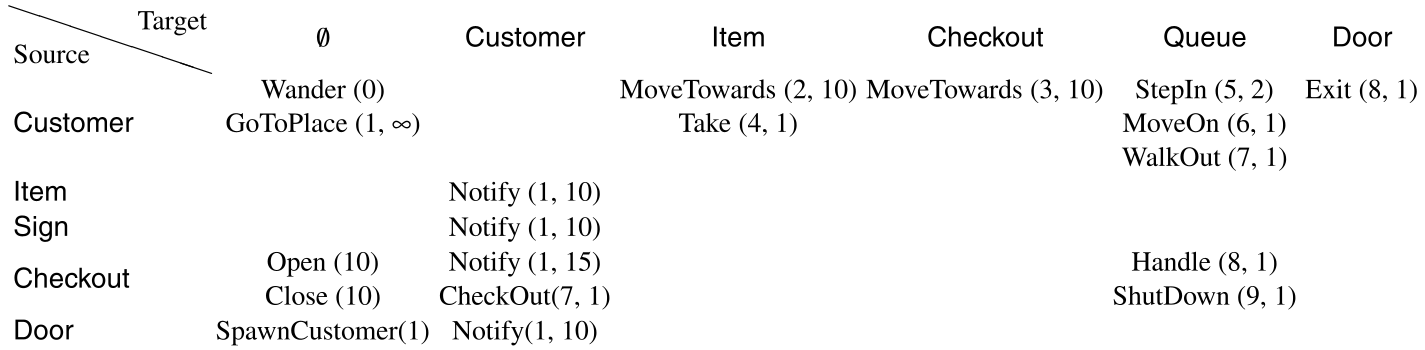 Table 1. The Interaction Matrix used to define how agents (Customers, Items, Checkouts) behave without hardcoding complex global logic.
Why This Matters for the Future
The real power of this approach isn't just in recreating the past—it's in predicting the future. By placing these "statistically realistic" agents into a new store layout, managers can see:
- Hot Zones: Which aisles become congested.
- Basket Attrition: How many items agents abandon because it takes too long to find them.
- Layout Sensitivity: How a change in the placement of "Organic Milk" impacts the sales of "Bread."
Critical Insight
The brilliance of this work is the use of Wildcards (0). By allowing an agent's goal to be "any brand of organic yogurt," the simulation preserves the diversity of real shopping behavior. It avoids the "cloning" effect where all agents in a cluster act identically, thus producing a more natural, varied emergence of patterns in the simulated environment.
Conclusion
Mathieu and Picault's work demonstrates that we don't need to choose between "big data" and "human-like simulation." By using data mining as the initialization step for multi-agent systems, we can create decision-support tools that are both statistically grounded and behaviorally rich.