
Catching Them Red-Handed: The Shift to Real-Time Aggression Detection on Social Media
Catching them red-handed: Real-time Aggression Detection on Social Media
This paper presents the first practical, real-time framework for detecting aggression on Twitter by employing a streaming machine learning paradigm. Implemented on Apache Spark Streaming, the system utilizes incremental learners like Hoeffding Trees and Adaptive Random Forests to achieve 82–93% accuracy, matching traditional batch processing performance while handling massive data volumes.
TL;DR
Social media platforms are currently losing the arms race against online toxicity because their detection systems are too slow. This paper introduces a real-time framework using Streaming Machine Learning on Apache Spark. By updating models incrementally as new tweets arrive, the system maintains a high detection accuracy (82-93%) while scaling to process millions of tweets in minutes, effectively solving the lag between content generation and moderation.
The Velocity Gap: Why Batch Processing Fails
Most academic and industrial solutions for detecting abusive behavior operate in "Batch Mode." They collect data, train a heavy model, and deploy it. However, social media is a living organism.
- Evolving Tactics: Aggressors constantly find "innovative" ways to use special characters or new slang to circumvent static filters.
- Minority Class Problem: Aggression is a needle in a haystack; waiting for a large batch to train on makes the system unresponsive to sudden surges of toxicity.
- The Data Deluge: With hundreds of millions of tweets daily, the computational cost of re-training models from scratch is prohibitive.
Methodology: The Streaming Paradigm
Instead of the traditional "Train-then-Test" cycle, the authors propose a Prequential Evaluation pipeline. Every labeled instance is first used to test the current model's accuracy and then immediately used to update the model parameters before being discarded.
The Pipeline Architecture
The framework consists of a distributed pipeline built on Apache Spark Streaming:
- Feature Generation: Extracts text (swear counts, sentiment), profile (account age), and network features (follower counts) in parallel.
- Incremental Learners: Uses algorithms like Hoeffding Trees (HT)—which can handle massive streams by making split decisions only when enough data has been seen to guarantee statistical significance—and Adaptive Random Forests (ARF).
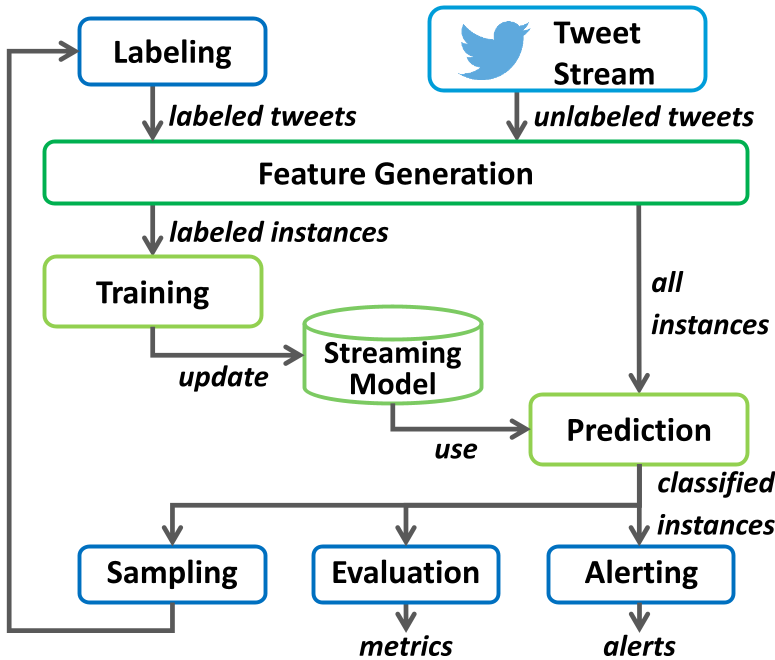 Figure 1: The real-time processing pipeline from raw tweet ingestion to automated alerting.
Key Engineering Insight: Parallelization
Streaming ML is often bottlenecked by single-threaded processing. The authors solved this by distributing micro-batches across a cluster. Local models are updated in parallel and then merged into a global model (typically <1MB), which is broadcasted back to the nodes for the next batch of predictions.
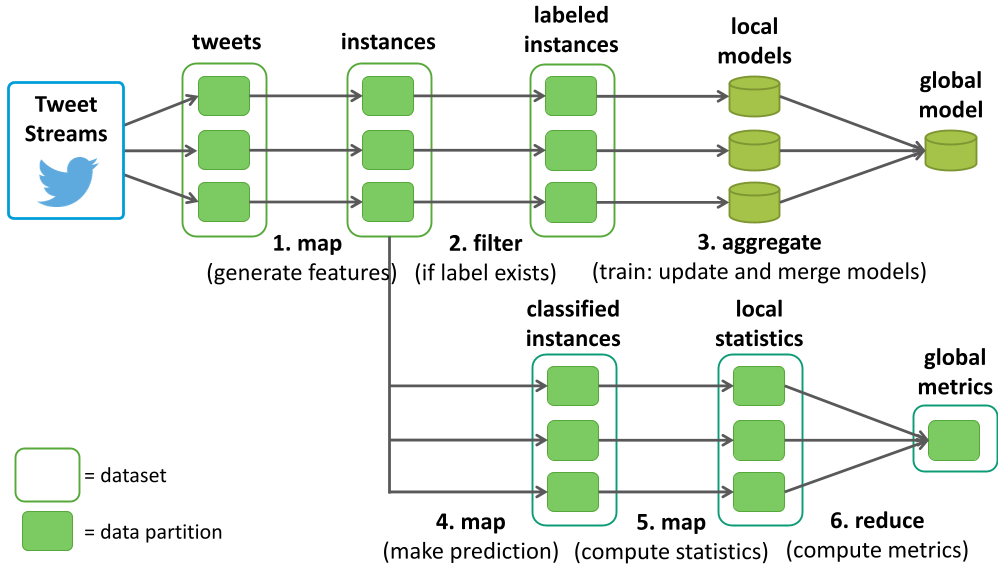 Figure 2: Spark Streaming logic for merging local updates into a global aggression detection model.
Experimental Validation
The researchers tested their framework against 86k real-world tweets.
1. Accuracy vs. Speed
The streaming models achieved an F1-score of ~88%, which is remarkably close to the 91% achieved by offline batch Decision Trees. This 3% trade-off is negligible when considering that the streaming model is always up-to-date and requires zero "downtime" for re-training.
2. Superior Scalability
When compared to MoA (the standard for stream mining), the Spark implementation showed massive gains. As the volume reached 2 million tweets, Spark’s task parallelism allowed it to finish processing 5.1 times faster than MoA.
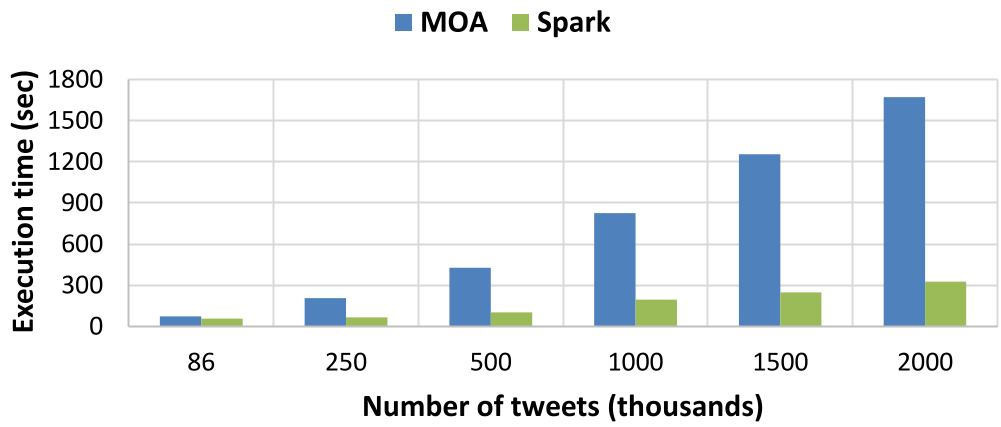 Figure 7: Execution time comparison highlighting the scalability of the Spark-based approach over traditional sequential engines.
Critical Insight & Outlook
The most important feature for detection was found to be the swear count and negative sentiment, but interestingly, account age played a significant role—aggressive accounts tend to be newer.
Limitations: While the system is fast, it currently relies on binary classification (Aggressive vs. Normal). Future iterations need to distinguish between subtle sarcasm, racism, and general "shouting" to avoid over-censorship.
Conclusion: This work proves that we don't need to sacrifice "real-time" for "accuracy." By embracing streaming paradigms, social media platforms can move from reactive cleaning to proactive protection.