
BioShare: Breaking the Black Box of Social Biometric Research
Sharing real-time biometric data across social networks: Requirements for research experiments
The paper presents BioShare, an open-source, researcher-oriented system designed for sharing real-time biometric data (e.g., heart rate) across social networks. It establishes a requirements framework and provides a modular architecture that supports live data broadcasting, real-time viewer feedback, and comprehensive interaction logging for HCI experiments.
TL;DR
BioShare is an open-source platform designed to move biometric data sharing out of closed commercial ecosystems and into the hands of researchers. By providing a modular system for real-time heart rate broadcasting, viewer feedback, and detailed interaction logging, it allows HCI scientists to study the "physiosocial space" without being hampered by proprietary API limits or rigid hardware requirements.
Position in the Field: This work serves as a foundational "infrastructure-as-research" paper, providing a much-needed standardized toolset for the growing field of social-biometric interaction.
Problem & Motivation
In an era of "Quantified Self," sharing heart rates or stress levels during a marathon or a gaming session has become common. However, researchers face a "Technical Wall":
- Vendor Lock-in: Using a Fitbit or Polar app means you can only use their visualizations and their data-sharing rules.
- System Fragility: Research prototypes often rely on a "chain of modules" (e.g., RunKeeper + IFTTT + Custom Script). If one link breaks—or a cloud service in the US has a weather outage—unpredictable data loss occurs.
- Ethical "Naive-ity": Researchers often lack control over where data goes when using third-party apps, making informed consent forms legally and ethically murky.
The authors' insight was that HCI needs a self-contained, researcher-controlled pipeline where the code is as transparent as the data.
Methodology: The BioShare Architecture
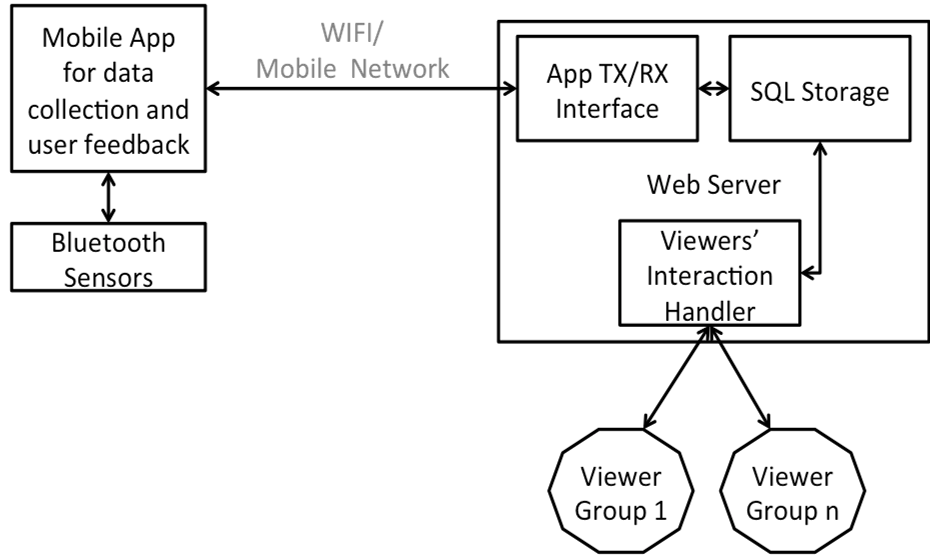
The authors derived requirements from three phases: prototype analysis, literature review, and expert interviews. The resulting BioShare system is built on three pillars:
- The Broadcast App (Android): Captures Bluetooth sensor data and transmits via HTTP/SSL.
- The Central Server (PHP/SQL): Stores data and manages the "Feedback Loop."
- The Viewer Interface (HTML5/JS): A customizable dashboard for remote spectators.
The Feedback Loop: More than just "Watching"
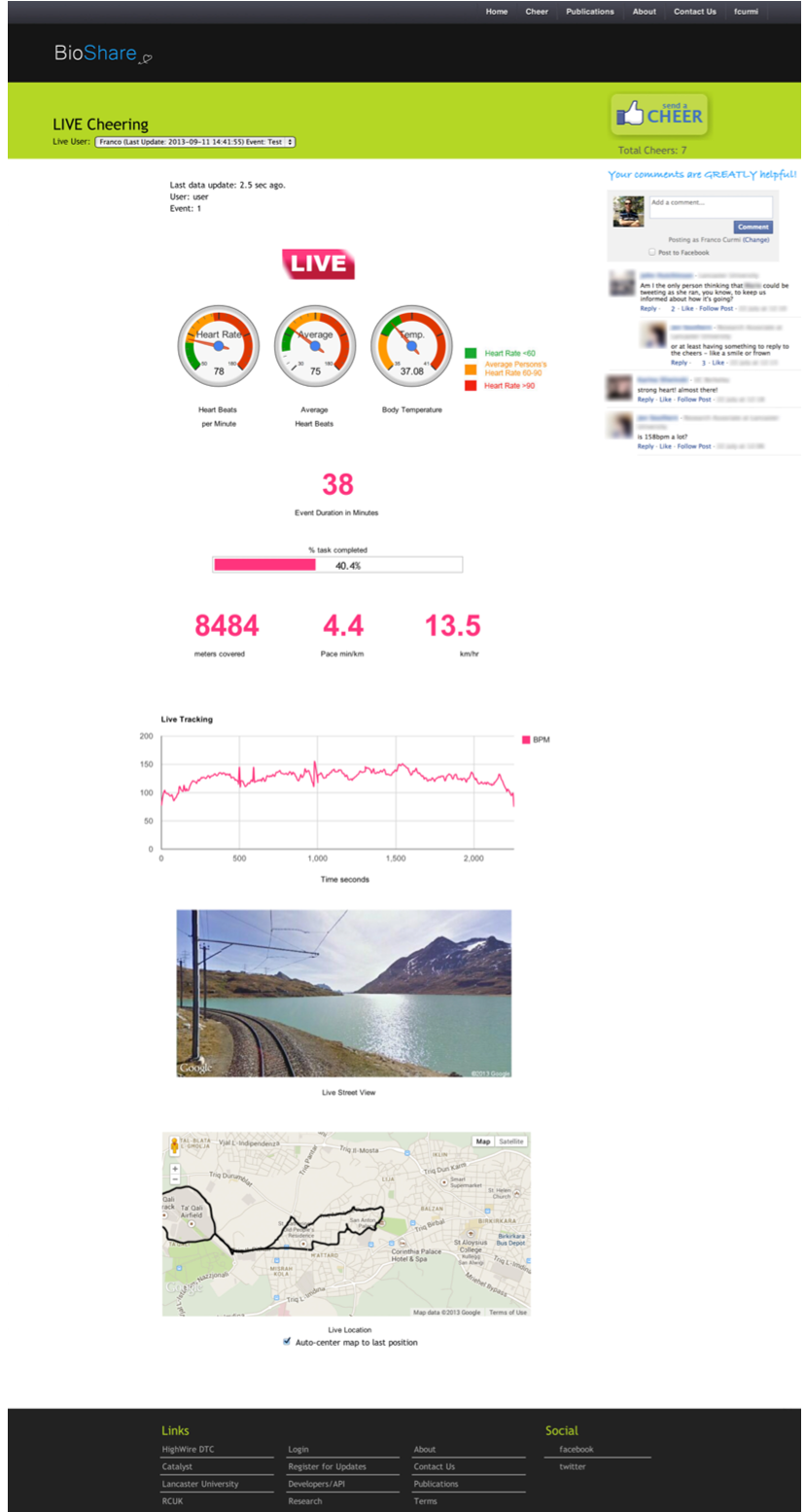
A key innovation in BioShare is the real-time feedback mechanism. When a viewer clicks a "Cheer" button on the web interface, the athlete's smartphone vibrates instantly. This creates a closed-loop social interaction that transforms biometric data from a passive "broadcast" into an active "conversation."
Experiments: Tailoring the Tool
The utility of BioShare is demonstrated through three distinct research configurations:
- A/B Testing Visuals: Randomly showing different viewers different charts to see which drives more engagement.
- Social Tie Analysis: Using lightboxes to ask viewers about their relationship to the athlete (e.g., "Are you their mother or a stranger?") and correlating this with "cheering" frequency.
- Attention Tracking: Automatically logging the viewer's scroll position to see if they prefer looking at raw heart rate numbers or geographic maps.
Critical Analysis & Conclusion
Takeaway: BioShare successfully shifts the focus from "how do we build this?" to "what does the data mean?". By democratizing access to the biometric pipeline, it enables HCI researchers to explore complex questions of empathy and social support.
Limitations:
- Connectivity: The system is heavily dependent on mobile network coverage, which can be spotty during outdoor events.
- Sense-making: As noted in the researcher interviews, we still lack a "grammar" for biometrics. While we understand "sweat = effort," we don't yet know how to visualize biometrics to tell a compelling story for remote viewers.
Future Outlook: The integration of live video alongside biometrics and the use of satellite backups (like SPOT Connect) promise to make social-biometric research more robust and immersive in "in-the-wild" settings.