
Real-Time Sociometrics: Decoding Human Interaction Through Audio
Real-Time Comprehensive Sociometrics for Two-Person Dialogs
The paper introduces a real-time system for assessing speaking mannerisms and social behavior in two-person dialogs using audio analysis. By combining low-level speech metrics and machine learning via Support Vector Machines (SVM), it achieves 80-90% accuracy in classifying sociometrics such as interest, agreement, and dominance.
TL;DR
Researchers have developed a system capable of "reading the room" in real-time. By analyzing only the non-verbal cues of a conversation—how loud you are, how often you interrupt, and your speaking rate—the system can quantify your Interest, Agreement, and Dominance with nearly 90% accuracy. This paves the way for live "social coaching" apps and robotic assistants that help improve human communication on the fly.
Problem & Motivation: Beyond "Yes or No" Social Analysis
In the current state of social signal processing, most systems are too simplistic. Usually, they only identify if a speaker is "active" or "inactive." But human social dynamics are far more nuanced. We aren't just dominant or submissive; we exist on a spectrum.
Furthermore, existing datasets often feature "clean" speech like broadcast news where people are polite. Real life involves boredom, aggression, and shouting. The authors identified that to make a useful real-time feedback tool, we need:
- Multi-level classification (5 levels of intensity instead of 2).
- Breadth of metrics covering both mannerisms (how you sound) and sociometrics (how you interact).
- Real-time capability to provide feedback while the conversation is still happening.
Methodology: From Sound Waves to Social High-Ground
The system operates through a streamlined pipeline:
- Low-Level Feature Extraction: The system extracts Conversational Cues (who talks when, interruptions, response times) and Prosodic Cues (pitch, volume, MFCCs).
- Feature Selection: Using Information Gain (IG), the researchers found that specific features act as "tells." For example, Speaking % is a massive indicator of Interest, while Interruptions and Overlap are the smoking guns for Agreement (or lack thereof).
- The Engine: An SVM (Support Vector Machine) acts as the classification engine, mapping these features to a 5-point scale.
 Figure 1: The conceptual framework for real-time sociofeedback.
Experiments & Results: High Accuracy in Chaos
The authors tested their system using a "leave-one-out" cross-validation on a custom-built dataset of 150 diverse dialogs. The results were impressive:
- Dominance Detection: Reached 93% accuracy for "Low" dominance.
- Interest Level: Achieved 86% accuracy for "High" interest.
- Real-time Performance: The system can process a 3-minute conversation in roughly 5-10 seconds, which is fast enough to give a user a "nudge" if they are being too loud or dominant during a meeting.
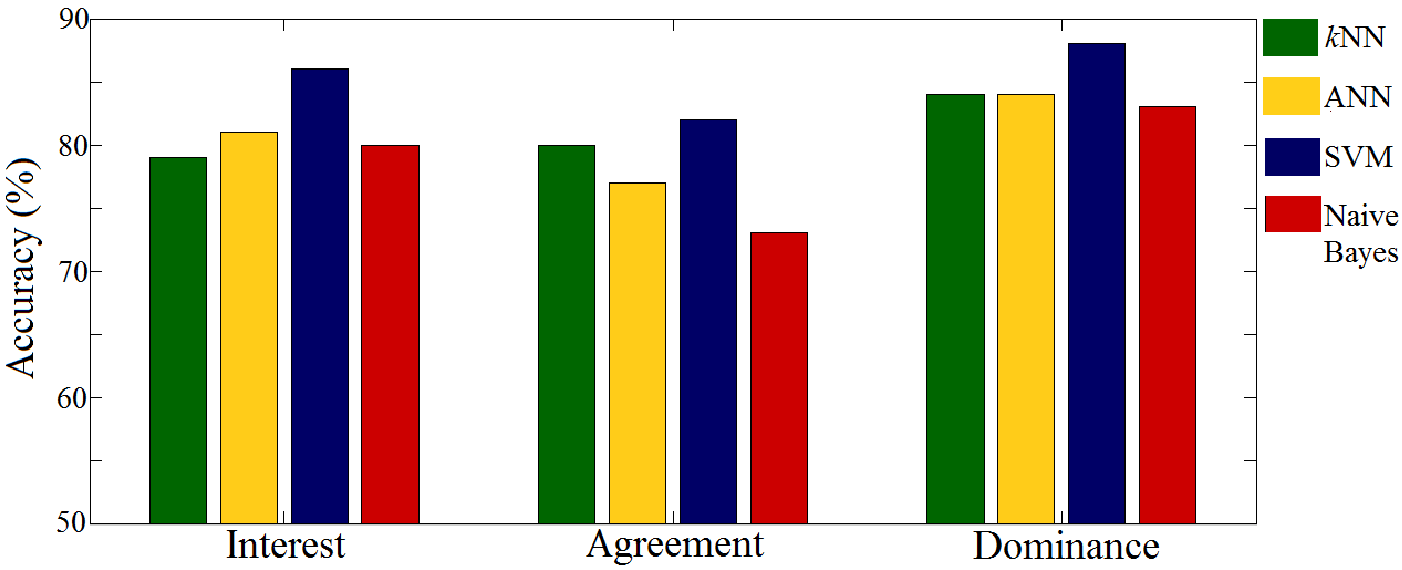 Figure 2: Comparison of different machine learning classifiers. SVM consistently outperformed ANN and Naive Bayes.
Deep Insight: Why This Works
The physical intuition here is that non-verbal cues are often more honest than words. While a person might say "I agree" (lexical content), their high pitch and frequent interruptions (prosodic and conversational cues) might tell a different story of aggression or disagreement. By focusing on the how rather than the what, this system bypasses the complexity of Natural Language Processing (NLP) and gets straight to the social "vibe."
Conclusion & Limitations
This work is a significant step toward Sociofeedback. However, it currently only deals with two-person interactions and relies solely on audio.
Takeaway: The future of this tech lies in multi-modal integration. Imagine a smartphone app or a humanoid robot that watches your body language while listening to your tone, giving you a real-time "Social Score" to help you navigate a high-stakes job interview or a sensitive therapy session. The jump to multi-party meetings remains the next great frontier for this research.