
Cross Online Matching: Breaking Silos in the Spatial Crowdsourcing Economy
Real-Time Cross Online Matching in Spatial Crowdsourcing
The paper introduces Cross Online Matching (COM), a novel spatial crowdsourcing framework that enables different platforms (e.g., DiDi and Shenzhou) to cooperatively share unoccupied workers to fulfill real-time requests. It proposes two main algorithms, DemCOM and RamCom, which integrate task assignment with incentive mechanisms to maximize total platform revenue.
TL;DR
Spatial crowdsourcing platforms like Uber or Meituan often face a "supply-demand mismatch" where requests go unfulfilled despite available workers from competing platforms being adjacent. This paper proposes Cross Online Matching (COM), a framework that allows platforms to "borrow" workers from each other. By balancing task assignment with a robust incentive mechanism, the proposed RamCom algorithm increases platform revenue by up to 17.5% over traditional methods.
Background: The Price of Isolation
Why do you sometimes see a "4.3x price surge" or a "10-minute wait" on one ride-sharing app when you can see a driver from a different company parked right across the street? The reason is Platform Isolation. Current SOTA (State-of-the-Art) algorithms focus on local optimization—matching only the platform's own workers to its requests.
The authors identify a critical "Non-uniform Distribution" pain point: workers often cluster in regions with few requests, leaving other areas under-served. While users often manually switch between apps, this is inefficient for both users and workers.
Methodology: The "Borrow-and-Incentivize" Framework
The paper formalizes the problem as a weighted bipartite matching task where "Outer Workers" (from other platforms) are integrated into the waiting list.
1. DemCOM (Deterministic Method)
DemCOM follows a greedy intuition:
- Always try to use an Inner Worker first (highest profit).
- If none are available, use Monte Carlo Sampling to estimate the "Minimum Outer Payment" (). This is the lowest price likely to entice an outer worker to switch.
2. RamCom (Randomized Method)
The authors realized DemCOM had a "Greedy Trap": it often used its best workers for low-value tasks, leaving no one for the high-value "golden" requests. RamCom introduces:
- Value Thresholding: It uses a randomized threshold () to reserve inner workers for high-value requests.
- Expected Revenue Optimization: Instead of just offering the minimum price, it calculates the , maximizing the product of the platform's profit and the probability the worker actually accepts.
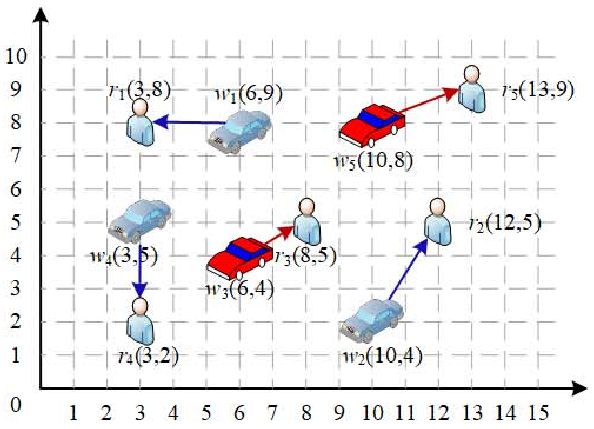 Figure 1: Comparison between isolated matching and Cross Online Matching.
Experimental Validation
Using real-world datasets from DiDi and Yueche in Chengdu and Xi'an (100k+ requests), the study confirms that cooperation pays off.
- Revenue Boost: RamCom increased daily revenue by nearly ¥70,000 per platform compared to the Traditional Online Task Assignment (TOTA).
- Acceptance Rates: By utilizing better incentive pricing, RamCom effectively increased the percentage of "borrowed" workers who actually completed the task by 400% compared to the deterministic model.
- Efficiency: Despite the complexity of Monte Carlo simulations, the average response time increased by less than 0.6ms, making it perfectly viable for production environments.
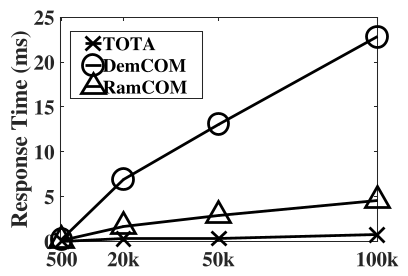 Figure 2: Response time remains nearly constant even as request volume () scales exponentially.
Critical Insight & Future Outlook
The core achievement of this paper is the mathematical bridge between Online Matching and Game-Theoretic Incentives. It proves that in highly dynamic spatial markets, the competitive ratio can be enhanced by allowing "bounded leakages" of revenue to competitors in exchange for higher fulfillment rates.
Future Directions: While COM handles the "who and how much," it doesn't yet account for the Route Planning of the borrowed workers. Incorporating real-time traffic and multi-stop routing would be the next logical step in perfecting the "borrowing" economy.
Conclusion
The COM framework provides a win-win-win:
- Users get faster service and lower prices.
- Workers find more tasks across multiple platforms.
- Platforms increase total revenue by reducing rejected requests. It is a powerful step toward a more integrated and efficient urban mobility landscape.