
CRD: Overcoming Selfishness in 5G Vehicular Social Networks for Real-time Emergency Alerts
Real-time dissemination of emergency warning messages in 5G enabled selfish vehicular social networks
This paper introduces CRD (Cooperative Real-time Dissemination), a 5G-enabled framework for distributing Emergency Warning Messages (EWMs) in Vehicular Social Networks (VSNs). It utilizes social intelligence and a recursive evolutionary algorithm to identify "super-spreader" nodes while mitigating the impact of selfish behaviors, achieving near-perfect delivery ratios in high-mobility scenarios.
TL;DR
In the high-stakes world of Autonomous Moving Platforms (AMPs), a single missed emergency alert can be fatal. This paper presents CRD (Cooperative Real-time Dissemination), a framework that leverages 5G connectivity and Social Intelligence to identify non-cooperative (selfish) vehicles and select "super-spreaders" for rapid message diffusion. By treating vehicles as social entities, CRD achieves a 99% delivery ratio with minimal latency.
The "Selfish" Bottleneck in VSNs
Modern Vehicular Social Networks (VSNs) are no longer just about hardware pings; they reflect human-centric social patterns. However, they face a massive hurdle: Node Selfishness.
- Purely Selfish Nodes: Only transmit their own data.
- Socially Selfish Nodes: Only relay messages if there is a perceived social benefit (e.g., to a friend).
Prior works using DSRC (Dedicated Short Range Communication) often failed under high mobility or dense traffic due to limited range and the "broadcast storm" effect. CRD moves the battlefield to 5G, providing the ubiquitous connectivity needed to manage these social dynamics in real-time.
Methodology: The Social Intelligence Core
The brilliance of CRD lies in its ability to quantify "cooperation" through three distinct phases:
1. Identifying the Selfish
The system calculates a Tie-Strength (TS) metric. Unlike simple proximity-based models, TS in CRD is a log-normal value derived from:
- Similarity: Shared interests or social features.
- Intimacy: The duration and frequency of historical interactions.
- Mobility Patterns: Common groups and visited locations.
2. The Super-Spreader Selection
Once nodes are categorized, CRD uses a Recursive Evolutionary Algorithm to calculate a State-Transition Probability. Nodes move through four states: Uninformed, Informed, Super-spreader, and Acknowledged.
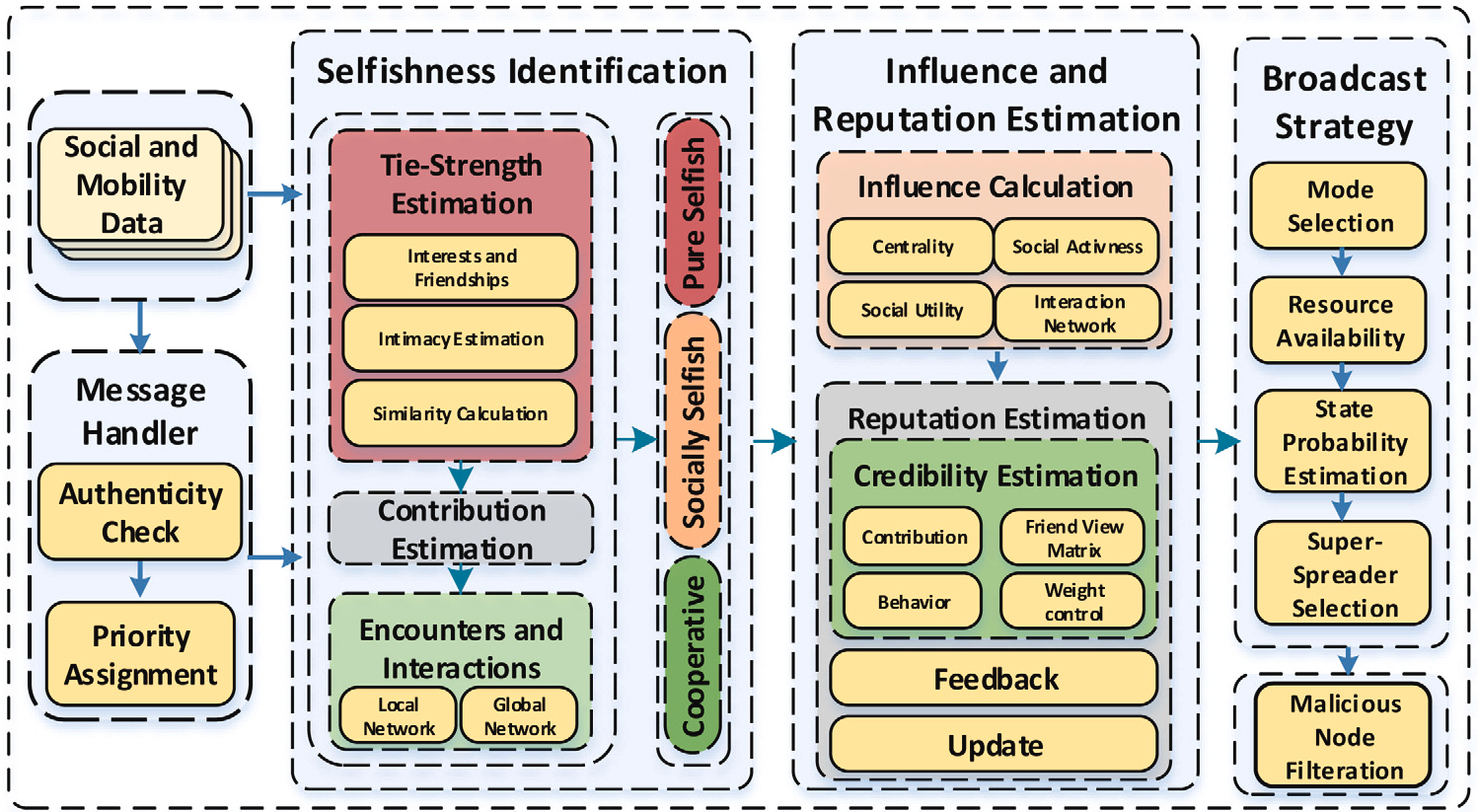 Fig 1: The CRD Architecture, highlighting the flow from 5G sensing to reputation-based dissemination.
Experimental Results: SOTA Comparison
Using realistic mobility traces from 13,750 taxis in Shanghai, the authors compared CRD against three benchmarks: SCARF, CDF, and TDS.
Delivery Ratio & Stability
CRD maintained a 99% delivery ratio even when 50% of the network was composed of selfish nodes. While other models saw performance plummet as vehicle speed increased to 120 km/h, CRD remained remarkably stable.
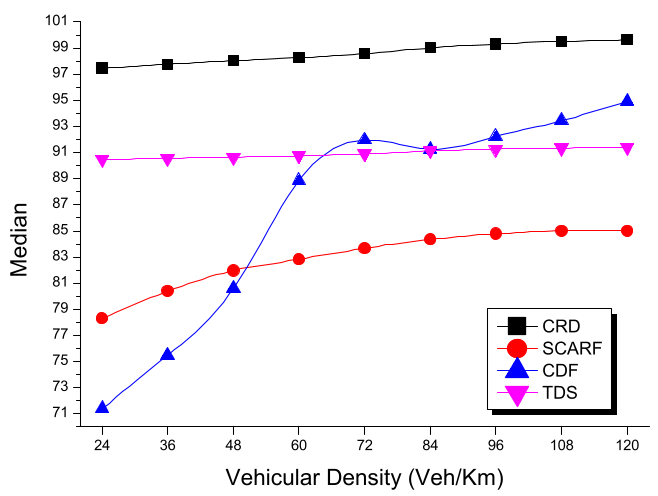 Fig 2: Delivery ratio comparison across varying vehicular and selfish node densities.
Efficiency: Delay and Overhead
- Latency: CRD reduced transmission delay to 3.79–6.1 ms, a nearly 60% improvement over SCARF.
- Network Health: Because CRD intelligently selects super-spreaders, it avoids the "flood" approach, significantly reducing the total number of transmissions and preventing network congestion.
Critical Insight: Why it Works
The "Secret Sauce" is the integration of Percolation Centrality with Social Utility. By estimating the likelihood of a node "infecting" its neighbors with an emergency alert based on its social reputation, the algorithm mirrors the efficiency of biological virus propagation.
Conclusion & Future Look
CRD proves that Social Awareness is not just a theoretical layer but a practical tool for resource management in 5G networks. While the current model focuses on highway-like scenarios, the shift toward urban mobility and privacy-preserving AI-driven social sensing (to protect driver data) represents the next frontier for this research.
Takeaway: For future Intelligent Transportation Systems, the "social" status of a vehicle is as critical as its physical location.