
Optimized Real-Time Emotion Classification: Balancing Precision and Latency in the Twitter Stream
Real-time emotion classification of Tweets
This paper presents a real-time emotion classification system for Twitter, utilizing six machine learning algorithms (SGD, SVM, LIBLINEAR, MNB, BNB, and NC). The authors achieved a precision of 66.65% for seven emotion categories, establishing a new SOTA performance at the time of publication.
TL;DR
This research tackles the challenge of identifying emotions in the high-velocity world of Twitter. By refining feature extraction through N-grams and TF-IDF and leveraging sparse-matrix compatible algorithms, the authors improved emotion classification precision by 5.02% (reaching 66.65%) while maintaining a blistering processing speed of 60 microseconds per tweet.
Background & Motivation: Why Textual Emotion is Hard
Emotion recognition is no longer confined to the lab. While physiological sensors (like skin conductance) provide direct feedback, they aren't practical for daily mobile use. Text is the most accessible medium, but it poses two significant hurdles:
- Implicit Emotions: Users often express feelings without using explicit keywords (e.g., "scare" or "angry").
- Keyword Ambiguity: A single word like "hate" can technically fall into multiple emotional categories like anger or embarrassment depending on the context.
The authors' goal was to build a system that is not only more accurate than existing models but fast enough to drive interactive applications, such as games that adjust their difficulty based on a user's frustration level detected via tweets.
Methodology: The Core Architecture
The researchers utilized a dataset of tweets annotated via hashtags (e.g., #joy, #irritating). To convert these short text bursts into a format computers can understand, they employed a specific pipeline:
- Syntactic Pattern Preservation: By using N-grams, the model captures the order of words, which is crucial for understanding sentiment.
- Handling Class Imbalance: Not all emotions are tweeted equally (Joy and Sadness are more common than Surprise). TF-IDF (Term Frequency-Inverse Document Frequency) was used to weight features appropriately, preventing the model from simply ignoring minority classes.
- Computational Efficiency: The authors selected six algorithms—SGD, SVM, LIBLINEAR, MNB, BNB, and NC—specifically for their ability to handle sparse matrices. This choice minimizes memory usage and maximizes throughput.
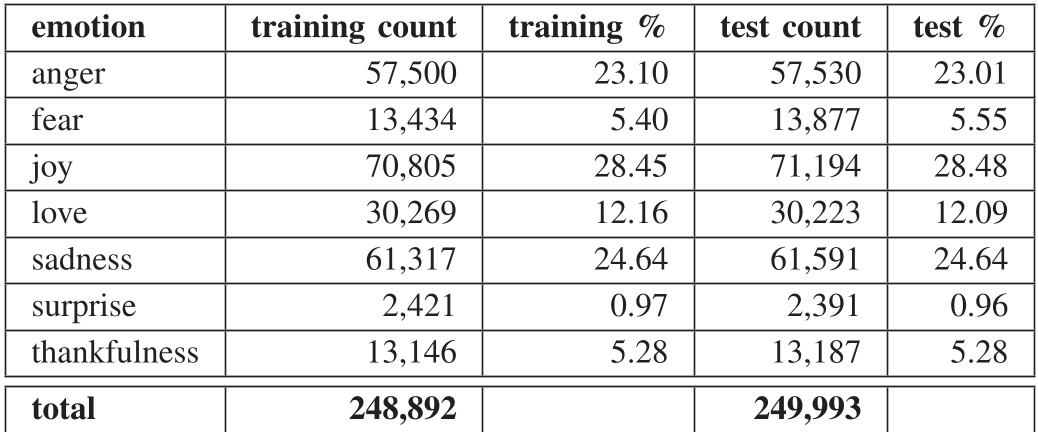 Table 1: The distribution of emotions in the training and test sets, showing a significant class imbalance.
Experiments & Results: SOTA Performance in Microseconds
The results confirm that simpler, well-optimized models can be highly effective. The Stochastic Gradient Descent (SGD) algorithm emerged as the winner, specifically in terms of precision.
Performance Gains
- Accuracy: The average precision reached 66.65%, a notable jump from the previous 61.63% reported by Wang et al.
- Latency: The system averaged 60.31 μs to 61.79 μs per tweet for the entire pipeline (transformation plus classification). This suggests the system could handle millions of tweets per hour on modest hardware.
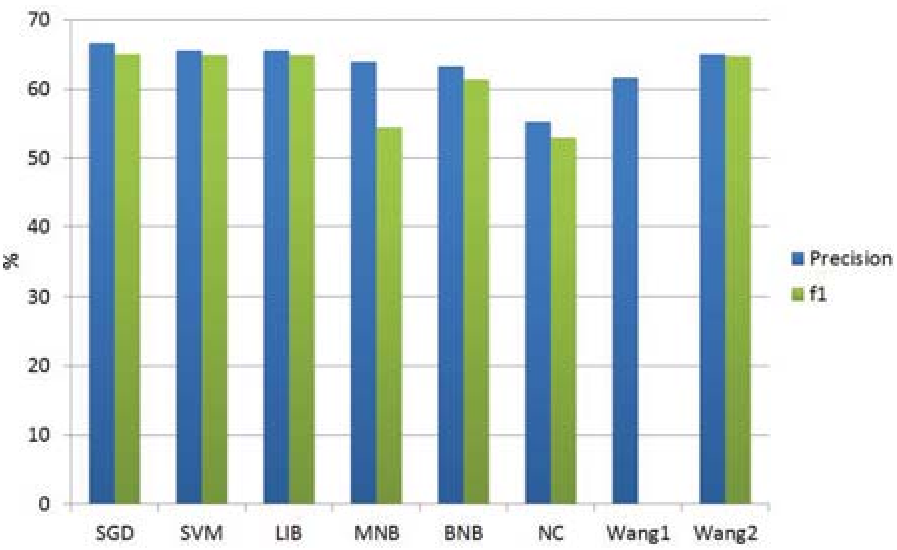 Fig 1: Precision and f1-score of the six algorithms compared against the previous state-of-the-art.
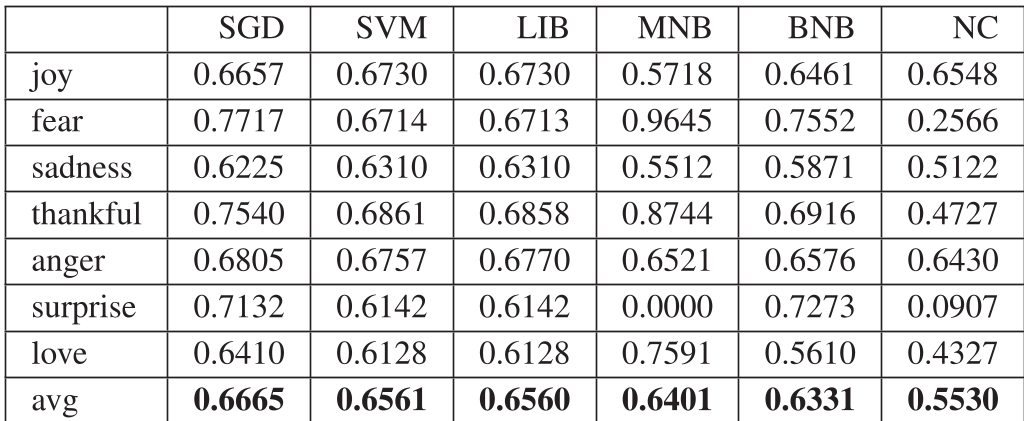 Table 2: Breakdown of precision across specific emotions. Note high performance in 'Joy' and 'Anger', which were the most prevalent in the training data.
Critical Insight & Conclusion
The significance of this work lies in its efficiency. While modern LLMs can achieve higher accuracy today, they often require massive GPU clusters. This paper shows that for specific tasks like emotion classification, inductive biases introduced through N-grams and the use of sparse-matrix mathematics allow for deployment on edge devices like smartphones or tablets.
Takeaway: Effective AI isn't just about reaching the highest accuracy; it's about achieving high performance within the constraints of real-time application environments.
Limitations
Despite the improvements, the model still shows a performance dip on rare emotions like "Surprise" (which had a low count in the training set). This highlights the ongoing challenge of "long-tail" data in social media analysis—a problem that even modern research continues to struggle with.