
High Stakes, High Signals: Real-Time Emotion Recognition in Online Poker via EEG
Real-Time Emotion Recognition for EEG Signals Recollected from Online Poker Game Participants
This study presents a real-time emotion recognition system leveraging EEG signals collected during active online poker gameplay. Using a 14-channel Emotiv EPOCx BCI headset and machine learning classifiers (kNN, Random Forest, MLP), the authors successfully classified emotions within the Valence-Arousal space with up to 68.94% accuracy.
TL;DR
Researchers have successfully decoded the emotional rollercoaster of online poker using commercial-grade Brain-Computer Interfaces (BCI). By monitoring participants playing for real money, the study achieved nearly 69% accuracy in classifying emotions like excitement, frustration, and calm, proving that "active elicitation" is far superior to watching boring videos in a lab.
Background Positioning
In the landscape of affective computing, this work moves away from Passive Elicitation (showing subjects pictures of puppies or car crashes) toward Active Elicitation. It positions itself as a practical application of BCI technology in high-pressure digital environments, bridging the gap between theoretical neurobiology and real-world behavioral analysis.
The Problem: The "Boredom" of Laboratory Stimuli
Most emotion recognition research suffers from a "stimulus gap." Pavlovian responses to curated image datasets (like IAPS) don't mirror the complex cognitive-emotional load of real-life decision-making. Poker is uniquely suited for this because:
- Sudden Volatility: A single card can flip a player from "Positive Valence/Low Arousal" (Calm) to "Negative Valence/High Arousal" (Anger/Frustration).
- Consequences: Using real money ensures the physiological response is authentic, not simulated.
Methodology: Mapping the Poker Brain
The team utilized the Emotiv EPOCx, a 14-channel wireless EEG headset. Unlike medical-grade caps that require hours of setup, this "wet electrode" BCI is designed for rapid deployment.
The Feature Pipeline
- Data Collection: 6 participants played "Sit-and-Go" tournaments (~45 mins) while self-labeling their emotional states using the Self-Assessment Manikin (SAM).
- Signal Processing: Raw EEG signals were transformed into the frequency domain using Fast Fourier Transform (FFT).
- Feature Extraction: The researchers targeted four specific brainwave bands:
- Theta (4-8Hz): Relaxation/Idling.
- Alpha (8-12Hz): Relaxed alertness.
- Beta (12-25Hz): Active concentration and "thinking."
- Gamma (25-45Hz): High-level cognitive processing during demanding tasks.
 Figure 1: The BCI device and electrode mapping used to capture temporal and frontal lobe activity during gameplay.
Analysis of Results: Performance vs. Speed
The study compared three primary Machine Learning (ML) architectures. While the accuracy across the board centered around 68.5% - 69%, the real story lies in the trade-offs:
- kNN (k-Nearest Neighbors): Highest accuracy (68.94%) but computationally "lazy," potentially slowing down as more data is collected.
- MLP (Multi-Layer Perceptron): Robust performance (68.82%) but the slowest to train/converge.
- Random Forest: The efficiency champion. It reached 68.58% accuracy while being 5x faster than MLP. For a real-time system where milliseconds matter (like a poker "tilt" warning), Random Forest is the clear winner.
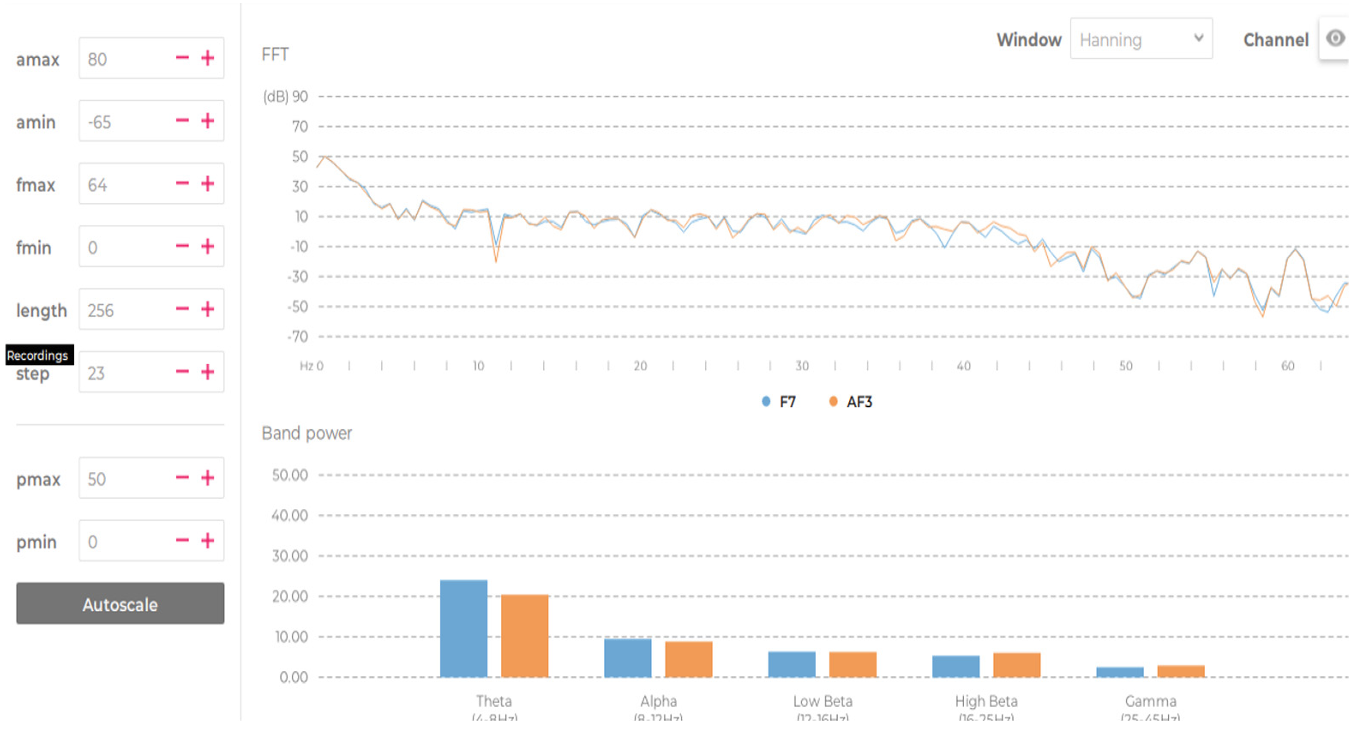 Figure 2: FFT and band comparison between channels F7 and AF3, illustrating the spectral power differences during emotional shifts.
Critical Insights: Beyond the Accuracy
The significance of this work isn't just the 69% accuracy—it's the ecological validity. By using the Valence-Arousal space (Fig 2 in the paper), the researchers demonstrated that "Negative Valence/High Arousal" (the precursor to "tilt") has a distinct EEG signature that can be caught before a player makes a bankrupting mistake.
Limitations & Future Work
- Sample Size: With only 6 participants, certain "poker faces" (emotional suppression) might skew the data.
- Noise: Online gaming environments are electrically "noisy"; while the filters worked, more advanced artifacts removal (like ICA) could boost accuracy past 75%.
Conclusion
This research confirms that your brain "speaks" its emotions even when your face is a mask. Whether it's for training professional players to maintain "Zen" or helping stock traders avoid panic-selling, the combination of active elicitation and BCI is a powerful new tool in the affective computing arsenal.
Takeaway: The next time you're playing poker, it's not just your opponent watching you—your brainwaves might be giving away your biggest bluff.