
Beyond Pointing: Decoding Human Intention and Emotion through Eye-Gaze
Real-Time Eye-Gaze Based Interaction for Human Intention Prediction and Emotion Analysis
The paper presents a real-time eye-gaze and head-motion interaction framework for predicting human intention and analyzing emotional states. It introduces an eye-object movement attention model and a feature preference model using machine learning (SVM, Decision Tree, Label Propagation) to achieve high-precision interaction in HCI and HRI contexts.
TL;DR
Researchers from Xiamen University have developed a real-time framework that transforms eye-tracking from a simple "mouse replacement" into a sophisticated tool for Intention Prediction and Affective Computing. By modeling how our eyes follow different types of motion and mapping head poses to the PAD emotion scale, they’ve created a system that is 6x faster than touch interfaces for specific robot-assisted tasks.
Context: Why Gaze Matters More Than You Think
In the world of Human-Computer Interaction (HCI), eye-tracking has long been the "next big thing." Yet, most implementations stop at "where is the user looking?" This paper argues that the way we look at things—our visual preference for colors, shapes, and the physics of moving objects—contains untapped psychological data. The challenge lies in processing this high-frequency, noisy data in real-time to predict what a user intends to do before they do it.
Methodology: The Architecture of Attention
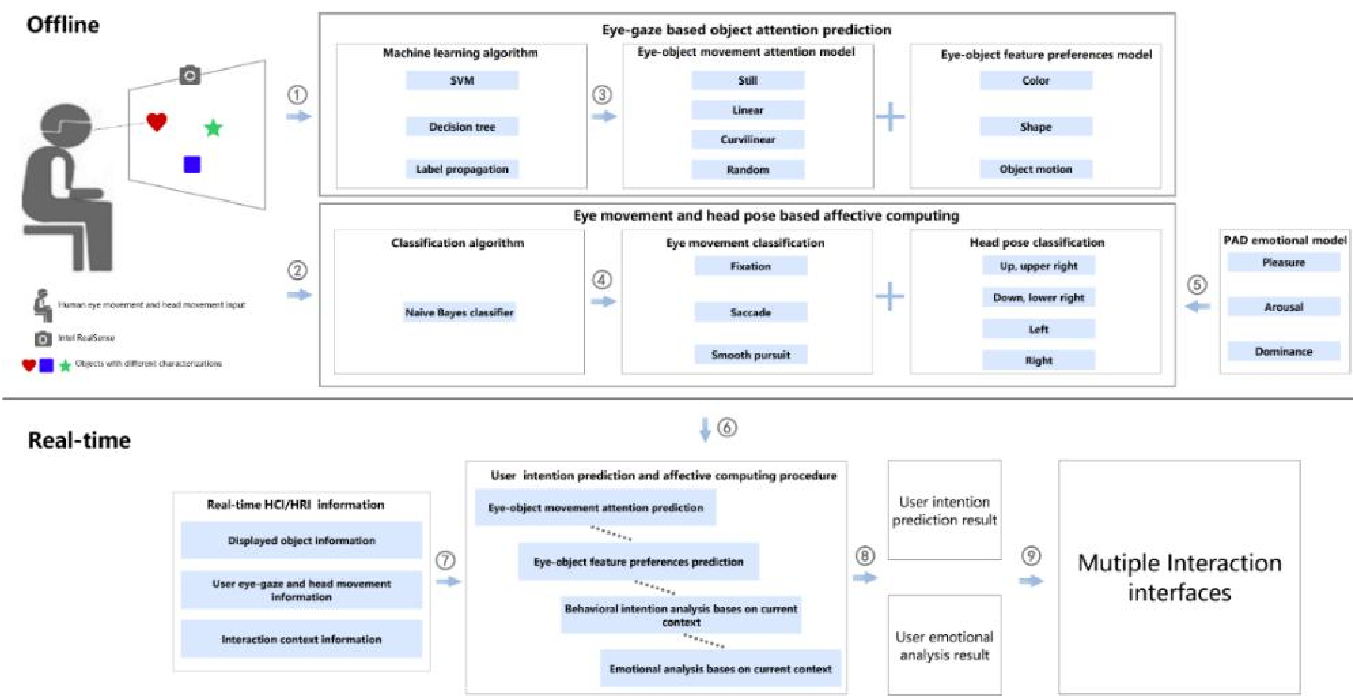
The authors propose a dual-stream architecture. One stream handles Task Intention (What do you want?), while the other handles Affective State (How do you feel?).
1. Intention Prediction Models
The framework uses three machine learning algorithms (SVM, Label Propagation, and Decision Trees) to build two critical models:
- Eye-Object Movement Attention Model: It learns to distinguish focus patterns for different kinematics: Still, Linear, Curvilinear, and Random motion.
- Eye-Object Feature Preference Model: It captures individual biases toward specific shapes or colors, allowing the system to "guess" which object a user will likely target in a cluttered environment.
2. The Affective Computing Bridge
Using a Naive Bayes classifier, the system categorizes eye movements into Fixation, Saccade, Smooth Pursuit, and Divergence. By correlating these movements with head poses (Yaw and Pitch) and applying the PAD (Pleasure-Arousal-Dominance) model, the system can infer emotional states such as contempt, excitement, or guilt without the user saying a word.
Experimental Results & Real-World Use Cases
The efficacy of the system was validated through four diverse scenarios:
- Cursor-Aided Shooting: The system predicts target selection based on gaze, allowing for "lock-on" speeds that feel nearly telepathic.
- Social Robots (Hands-Free): In a "Kungfu Tea" making scenario where the user's hands are occupied, the robot perceives interest areas to switch tutorial steps.
- Efficiency: Comparisons showed that eye-gaze based interaction was 5 to 6 times faster than traditional touch-screen navigation.
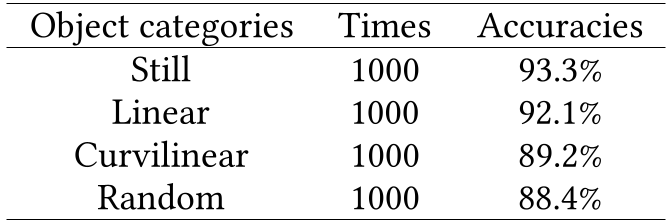 Table: Accuracy levels for different movement categories, showcasing over 90% accuracy for still and linear targets.
Critical Insight: The "Why" Behind the Success
The breakthrough here isn't just the tracking technology (which uses Intel RealSense), but the probabilistic mapping of physical motion to psychological states. By acknowledging that a user's attention is a combination of object physics and personal preference, the models move beyond simple coordinate matching to true semantic understanding.
Conclusion & Future Look
The work by He et al. moves HCI toward a "Natural User Interface" (NUI) where the machine adapts to the human, not the other way around. While the current classification relies on classical ML techniques, the shift toward deep learning could further refine these models, especially in complex, multi-person environments.
Takeaway: Future interfaces will likely prioritize "gaze-intent" as a primary input, particularly in AR/VR and robotics, where speed and "lower cognitive load" are paramount.
Disclaimer: This analysis is based on the 2018 research paper from CGI 2018.