
Real-time 3D Body Shape Analysis: A Superior Approach to Gender Recognition in Robotics
Real-time gender recognition based on 3D human body shape for human-robot interaction
This paper presents a real-time gender recognition system specifically designed for Human-Robot Interaction (HRI) using 3D human body shape data from a single RGB-D camera (Kinect). By extracting anatomical features like shoulder width and chest statistics, the authors achieve high-accuracy classification using a Support Vector Machine (SVM) running at 30 FPS.
TL;DR
Researchers at National Taiwan University have developed a real-time gender recognition system tailored for Human-Robot Interaction (HRI). Moving away from traditional 2D face or gait analysis, this system uses 3D skeletal data and chest geometry from an RGB-D camera. This method achieves 95% accuracy at 30 FPS, proving that body shape is a robust, lighting-independent alternative for social robots.
Problem & Motivation
In social robotics, knowing a user's gender is vital because human-to-human proxemics (the physical distance people maintain) are heavily influenced by gender roles. However, traditional vision-based methods fail in real-world HRI:
- Face-based methods fail when the user isn't looking directly at the robot or when the lighting is poor.
- Gait-based methods require significant walking distance and time, which isn't available in close-range interactions.
- 3D Laser Scans offer high accuracy but are far too slow for a robot that needs to react instantly.
The authors' insight was to utilize the depth image—a modality that is invariant to lighting and contains significant anthropometric data—specifically targeting the upper body, which is usually the only part visible during close-range robot interactions.
Methodology: The Geometry of Gender
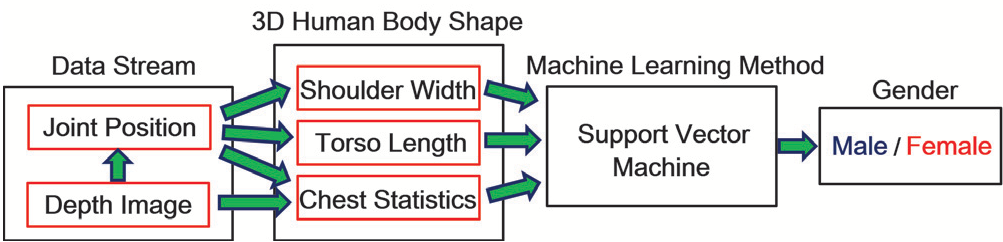
The system processes depth images to extract skeletal joints and 3D surface information. Specifically, it focuses on two main feature sets:
1. Upper Body Proportions
The system calculates Shoulder Width and Torso Length using joint coordinates. Statistically, males possess broader shoulders and longer torsos, providing a baseline for classification.
2. Chest Statistics (The Discriminator)
The most innovative part of the method is the analysis of the chest region (CR). Using the vector cross products of skeletal joints to define the "Man's Orientation" (MO), the system calculates:
- Chest Altitude: The Maximum depth variation across the chest plane.
- Surface Normal Distribution: How the angles of points on the chest differ from the global orientation. Flat chests (typical of males) show significantly lower variance and mean angles ( and ) compared to female anatomy.
3. Classification
These features are fed into a Support Vector Machine (SVM) with a Radial Basis Function (RBF) kernel. The RBF kernel allows the model to find non-linear decision boundaries between the multi-dimensional anthropometric features.
Experiments & Results
Since no standard "RGB-D Gender Dataset" existed for HRI at the time, the team collected data from 60 individuals.
| Metric | Result |
|---|---|
| Accuracy | 95% |
| Processing Speed | 30 FPS (Real-time) |
| Input Data | Depth only (Privacy-friendly) |
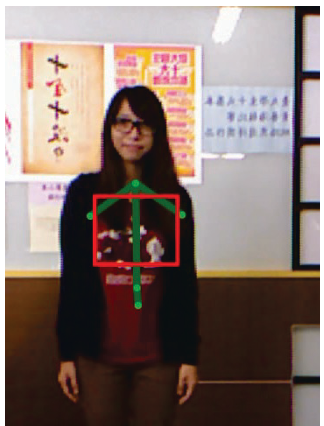 Execution result showing gender classification (Blue = Male, Red = Female) based on chest region analysis.
The results suggest that even with a relatively small training set (40 individuals), the geometric features of the human body are distinct enough to allow for high generalization.
Critical Analysis & Conclusion
The core contribution of this work is proving that Upper Body Shape is a viable, real-time descriptor for gender. While 2D vision can be fooled by makeup or lighting, the skeletal and volumetric data of a depth camera are much harder to obfuscate.
Takeaway: For the HRI community, this shifts the focus from "Who is this?" (Face ID) to "What are the physical attributes of the person I am helping?" This allows for more natural social distancing and interaction strategies for service robots.
Limitations: The system's reliance on "Chest Altitude" might face challenges with heavy clothing (like winter jackets) which would mask the surface normals of the chest. Future work could benefit from integrating these 3D features with lightweight temporal models to ensure consistency over time even when the user's silhouette is partially obscured.