
Deep-RR-SSSL: Decoding the Universal Signature of Human Aging Across Races
Real-time human cross-race aging-related face appearance detection with deep convolution architecture
2019-08-09
Summary
Problem
Method
Results
Takeaways
Abstract
This paper presents RR-SSSL-GL-O, a deep convolution-based framework for real-time human age estimation (AE) that specifically leverages cross-race facial aging commonalities. The authors combine spatial structure preservation, joint feature selection, and automated covariance learning to achieve SOTA performance across diverse ethnic groups.
## Executive Summary
**TL;DR**: This research addresses the challenge of accurate age estimation (AE) across diverse racial groups by proposing a unified deep learning framework, **RR-SSSL-GL-O**. By integrating spatial smoothing and automated cross-race correlation learning, the model identifies universal facial aging markers (like wrinkles around eyes and cheekbones) that are shared across ethnicities, resulting in superior accuracy and real-time inference.
**Background**: In the landscape of computer vision, age estimation is often hampered by the high variance of facial appearances. This work positions itself as a specialized "bridge" between traditional manifold learning and modern deep convolution architectures, specifically targeting the biological intuition that all humans, regardless of race, share common aging trajectories.
## Problem & Motivation: The "Silo" Trap in Age Estimation
Prior works in AE typically falls into two categories: classification (treating ages as discrete bins) or regression (treating age as a continuous variable). However, most models treat different ethnic groups—European, African, Hispanic, and Asian—as independent silos. This approach has several flaws:
1. **Redundancy**: It fails to recognize that aging markers (e.g., glabella wrinkles) are anatomically similar across humans.
2. **Spatial Loss**: Converting a 2D face into a 1D vector for regression destroys the neighbor similarity of pixels.
3. **Data Imbalance**: Minority groups (like the "Other" category in the Morph dataset) suffer from poor generalization because their specific models lack sufficient training data.
The authors' insight is simple yet powerful: **Automating the discovery of shared features and racial correlations can regularize the learning process and improve performance for everyone.**
## Methodology: The Architecture of Shared Aging
The core of the methodology lies in the objective function of the **RR-SSSL-GL-O** model. It combines four critical components:
1. **Spatial Smooth Subspace Learning (SSSL)**: Uses a Kronecker-based smoothing operator to ensure the regression weights respect the 2D topology of the face.
2. **Group-Lasso (GL)**: An $l_{2,1}$ norm that enforces "group sparsity," selecting a subset of features that are useful for *all* races simultaneously.
3. **Automated Correlation Learning ($\Omega$)**: Instead of assuming how races relate, the model learns a covariance matrix that captures the latent relationships between the regression vectors of different ethnic groups.
4. **Deep Feature Extension**: The framework replaces hand-crafted features with a modified VGG-16 backbone to extract high-level semantic information.
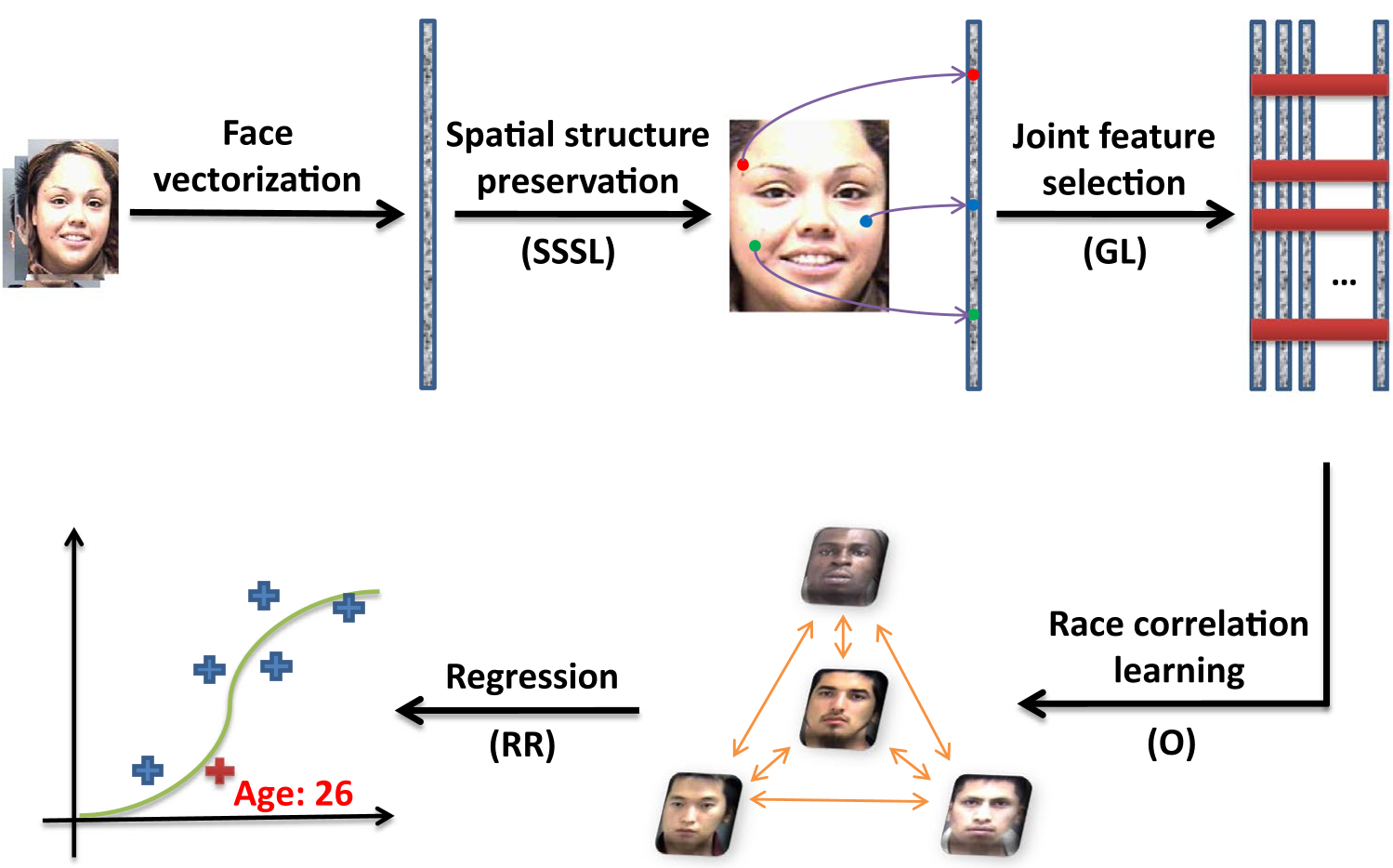
*Fig 1: The workflow from facial images to joint feature selection and cross-race correlation modeling.*
## Experiments & Results: SOTA Performance
The researchers utilized the **Morph (Album II)** database, the largest longitudinal aging database. The results were clear: as the percentage of training samples increased, the MAE dropped significantly across all ethnicities.
### Key Findings:
* **Feature Refinement**: Visualization of the projection vectors (Fig 5 in the paper) reveals that the model successfully focuses on the eyes, mouth, and cheekbone regions—the "high-amplitude" aging zones.
* **Deep Learning Advantage**: The "Deep" version of the model outperformed the shallow version by a wide margin, proving the necessity of hierarchical feature extraction in AE.
* **Real-Time Speed**: The testing latency is virtually negligible, making it suitable for security monitoring and real-time consumer recommendations.
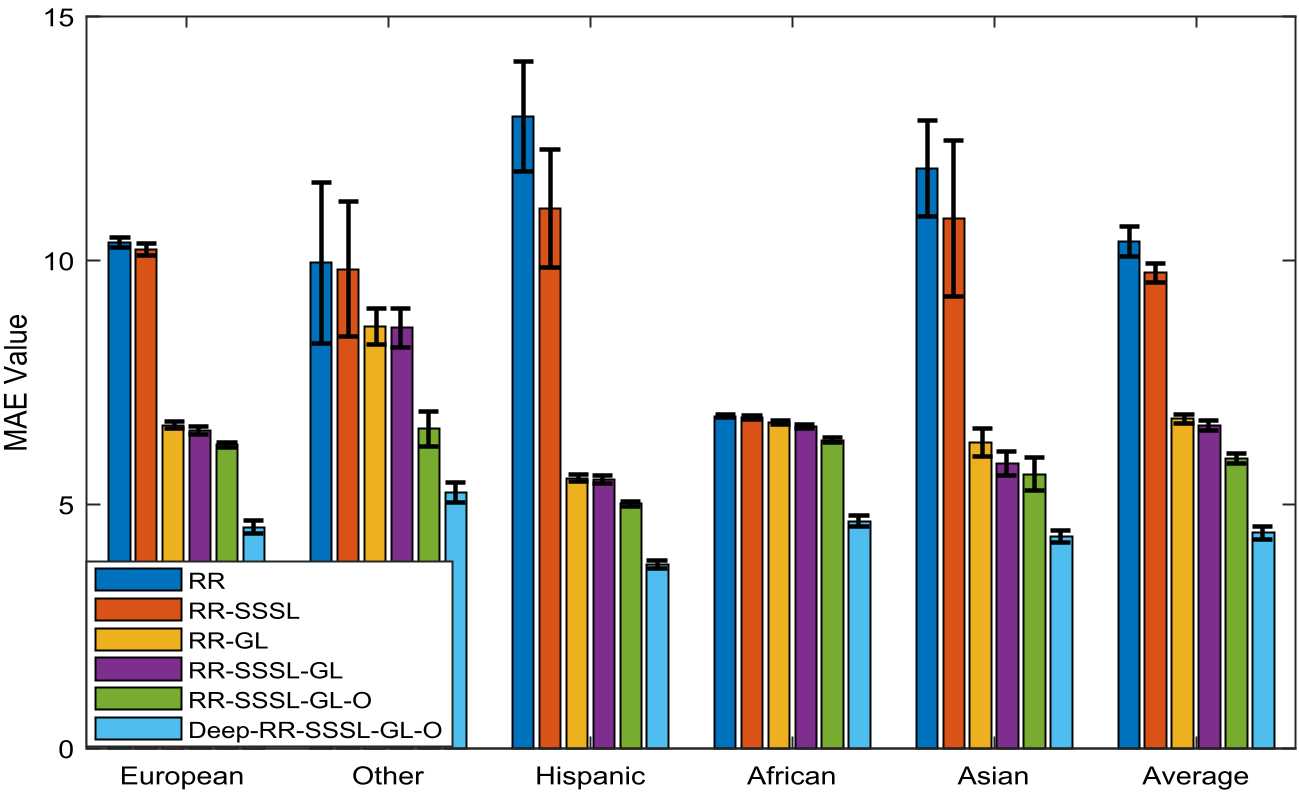
*Fig 2: Comparison of MAE across various methods. Deep-RR-SSSL-GL-O maintains a consistent lead.*
## Critical Analysis & Conclusion
**Takeaway**: This paper successfully demonstrates that racial differences in facial appearance do not imply different aging mechanisms. By mathematically modeling the "common ground," the authors have created a framework that is both biologically plausible and computationally efficient.
**Limitations**: While the model excels at cross-race estimation, it still relies on centralized data. The authors noted in their conclusion that the next frontier involves **privacy-preservation** and distributed data scenarios, ensuring that sensitive biometric data remains secure while the model learns.
**Future Work**: Integrating "In-the-wild" datasets (like AgeDB) more aggressively could further test the robustness of the spatial smoothing components against extreme head poses and lighting conditions.