
Sentry in the Soil: Real-Time Chainsaw Detection via k-NN and Buried Sensors
Towards Real-Time Illegal Logging Monitoring: Gas-Powered Chainsaw Logging Detection System using K-Nearest Neighbors
This paper presents a real-time illegal logging detection system that utilizes K-Nearest Neighbors (k-NN) to identify the specific acoustic signature of gas-powered chainsaws. The solution integrates a buried, modular hardware prototype with a centralized graphical user interface (Sentry) to provide immediate alerts and spatial visualization of deforestation activities.
TL;DR
Illegal logging remains a critical threat to global biodiversity, particularly in the Philippines. This paper introduces a hardware-software ecosystem that "listens" for the distinct roar of gas-powered chainsaws. By deploying buried Raspberry Pi-powered nodes running a K-Nearest Neighbors (k-NN) classifier, the system achieves a 96% detection accuracy, providing forest rangers with real-time alerts via a dedicated GUI named "Sentry."
The Gap: Why Satellites aren't Enough
While satellite programs like Global Forest Watch provide excellent macro-scale data, they are essentially "post-mortem" tools—they show you where the forest used to be. For law enforcement, the "Why" is simple: they need an immediate trigger to catch loggers in the act. However, the forest is a noisy place. Distinguishing a chainsaw from a heavy truck or a high-pitched bird requires a robust feature extraction pipeline and a power-efficient classification model.
Methodology: High-Fidelity Listening at the Edge
The researchers focused on a three-tier architecture: Acoustic Surveillance, Wireless Communication, and Visualization.
1. The Detection Pipeline
Instead of complex Deep Learning models that might tax a microcomputer, the team utilized k-NN.
- Feature Extraction: Audio is segmented into 5-second intervals. Short-term spectral features are extracted to form the feature vector.
- The Algorithm: Using and Euclidean distance, the model compares live audio against a pre-trained library of forest sounds and chainsaw signatures.
- Validation Logic: To prevent false positives from transient noises, the alarm only triggers if a chainsaw is detected four times consecutively.
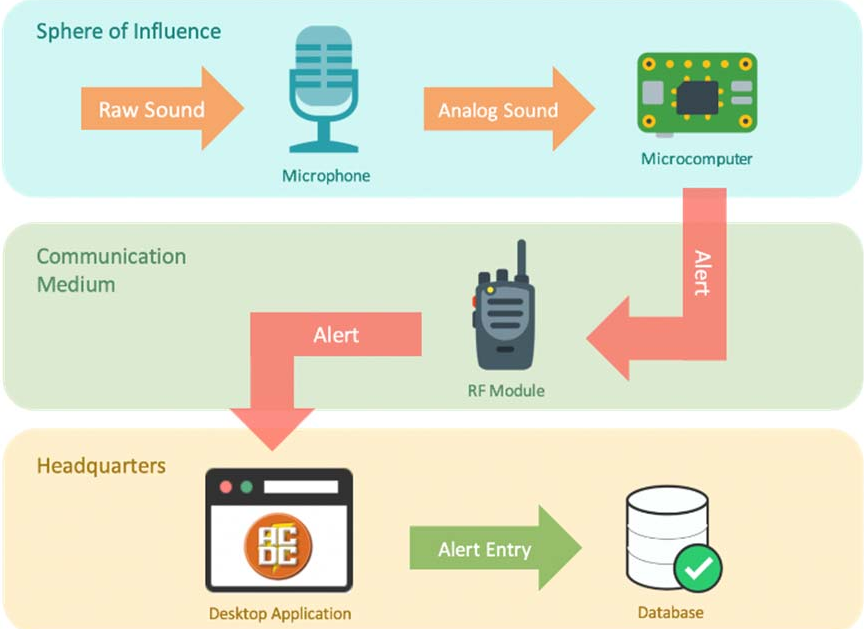 Figure 1: The overall architecture showing the flow from sound stimulus to the Sentry GUI.
2. Hardware "Stealth" Design
A standout feature of this work is the deployment strategy. To avoid theft or tampering by illegal loggers, the device is designed to be buried underground. It uses a high-gain microphone with adjustable patterns to capture surface sounds while the electronics stay protected in a 3D-printed polyester chassis.
Experimental Results
The model was validated using a "Deployment Dataset" consisting of actual local chainsaw recordings mixed with forest background noise.
| Metric | Result |
|---|---|
| Accuracy | 96.00% |
| F1-Score | 94.34% |
| Precision | 89.29% |
| Recall | 100.00% |
The 100% recall is particularly noteworthy—it means the system did not miss a single actual logging event during the test, though it had a few false positives (leading to lower precision).
 Figure 2: Confusion Matrix showing the high classification performance on the deployment set.
Critical Insight: Efficiency Meets Utility
The choice of k-NN over a Transformer or CNN-based architecture is a calculated move for Real-Time Edge AI. In a remote forest where power is scarce (the device lasts ~5 days on a 100Wh battery), the low computational overhead of k-NN ensures that the Raspberry Pi can maintain a high sampling rate without overheating or draining the battery instantly.
The "Sentry" GUI rounds out the system by providing a "War Room" view for forest agencies, showing exactly which "Sphere of Influence" has been breached.
Limitations & Future Outlook
While the system is robust, its 1km RF range is a limitation for vast rainforests. Transitioning to LoRaWAN or satellite-link backhauls (like Starlink) could extend this reach significantly. Additionally, while the "buried" design protects the hardware, it likely acts as a low-pass filter for high-frequency chainsaw harmonics—future iterations could benefit from specialized acoustic waveguides to improve clarity.
Ultimately, this work proves that effective environmental monitoring doesn't always require "Big AI"—sometimes, a smart "Small AI" approach in a ruggedized package is exactly what the planet needs.