
RT-MAS: Bridging the Gap Between Distributed Intelligence and Hard Real-Time Reliability
Real-time multi-agent systems: rationality, formal model, and empirical results
The paper introduces RT-MAS, a formal mathematical model for Real-Time Multi-Agent Systems. It integrates Earliest Deadline First (EDF) local scheduling with a novel Reservation-Based Negotiation (RBN) protocol to ensure timing predictability and zero deadline misses in safety-critical Cyber-Physical Systems (CPS).
TL;DR
Artificial Intelligence is moving from the cloud to the physical world (Cyber-Physical Systems). However, most current Multi-Agent Systems (MAS) are inherently "time-blind." This paper formalizes RT-MAS, a framework that combines real-time scheduling theory with agent negotiation to guarantee that autonomous agents don't just find the right answer, but find it before the deadline.
The "Speed vs. Predictability" Deception
A common misconception in AI development is that "real-time" means "fast." If a system responds in microseconds on average, we call it real-time. This is wrong.
In safety-critical systems—like a surgical robot or an automated power grid—an "average" response time is useless. We need a Worst-Case Execution Time (WCET) guarantee. Current MAS platforms (like JADE or Jason) use Round-Robin (RR) or FCFS schedulers. These are "best-effort" mechanisms; if the system load spikes, deadlines are missed, and in a physical environment, that means failure.
Methodology: The RT-MAS Formal Model
The authors argue that real-time compliance is a "chain" that is only as strong as its weakest link. They identify three pillars that must be synchronized:
1. The Internal Scheduler (The Brain)
Instead of simple queues, each agent uses Earliest Deadline First (EDF). This is a dynamic priority algorithm that always executes the task closest to its deadline. To handle unpredictable (aperiodic) tasks, they utilize a Constant Bandwidth Server (CBS), which reserves a slice of CPU time to ensure that "surprise" tasks don't starve critical periodic ones.
2. Reservation-Based Negotiation (RBN)
In a typical MAS, an agent might accept a task via a "Contract Net Protocol" simply because it has the capability. In RT-MAS, the agent performs a Schedulability Test (Equation 17 in the paper) during the negotiation.
- The Logic: "I will only bid on this task if my current CPU utilization plus the new task's load is the utilization bound ."
3. Predictable Communication
Without a bounded delay in the network, the best scheduler in the world fails. The model assumes a middleware with guaranteed latency (like Time-Sensitive Networking).
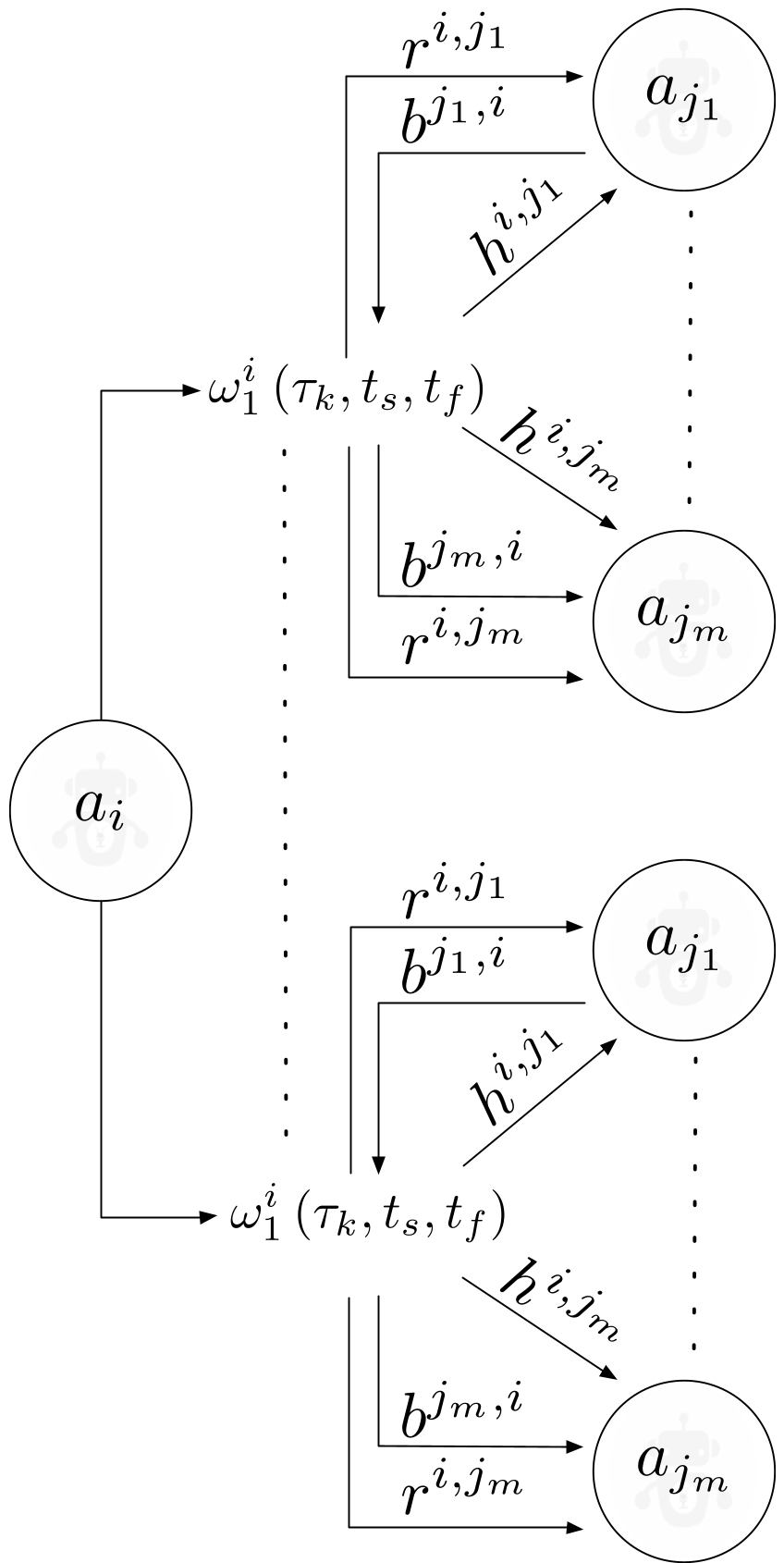 Figure 1: The interaction between the local scheduler and the negotiation protocol in an RT-MAS.
Proving the Theory: Zero-Miss Performance
The researchers used the MAXIM-GPRT simulator to pit RT-MAS against standard "General Purpose" (GP) MAS.
Experimental Setup
- Agents: 10 agents.
- Task Models: Periodic (regular sensing), Periodic-in-interval, and Sporadic (emergency events).
- Load: Varying from Low () to High ( CPU utilization).
The Results
The contrast was stark. In scenarios with sporadic tasks (the most realistic CPS scenario), standard MAS platforms saw deadline miss ratios soar to 97%. Under the exact same conditions, RT-MAS maintained 0% misses.
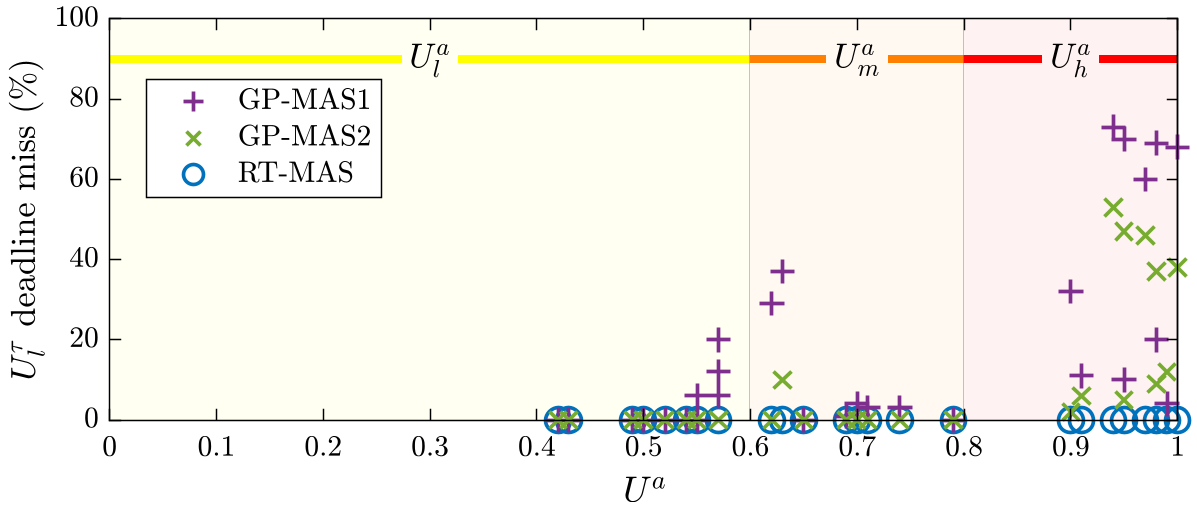 Figure 2: Deadline miss percentages. While GP-MAS (top lines) fails as load increases, RT-MAS (bottom line) remains at zero.
Critical Insight & Future Directions
The value of this work lies in its formalization. It moves MAS from a "heuristic-driven" field to a "provable" discipline. However, the model has limits:
- Hardware Dependency: Calculating WCET is notoriously difficult on modern multi-core processors with complex caches.
- Network Assumptions: The model assumes "bounded delays," which are easy to simulate but hard to achieve in open wireless environments (like 5G or Wi-Fi).
Future Work: The authors are currently integrating these models into a framework called SEAMLESS, focusing on wearable inertial sensors for physical rehabilitation—a perfect use case where a "late" data packet could mean a missed movement detection for a patient.
Conclusion
As we delegate more authority to autonomous agents in the physical world, we must stop asking "how fast can it reason?" and start asking "can it guarantee it will reason in time?" RT-MAS provides the mathematical foundation to answer "Yes."