
RMGP: Scaling Multi-Criteria Social Graph Partitioning via Game Theory
Real-Time Multi-Criteria Social Graph Partitioning: A Game Theoretic Approach
This paper introduces RMGP (Real-time Multi-criteria Graph Partitioning), a framework for grouping social network users based on both social connectivity and similarity to input classes. The authors propose a game-theoretic approach where each user acts as a player seeking to minimize an individual cost function, achieving high-quality partitions with significantly better scalability than traditional Uniform Metric Labeling (UML) solvers.
TL;DR
Partitioning large-scale social graphs based on both who you know and where you want to go (or what you like) is a computationally "heavy" task. While traditional methods crumble under the weight of millions of edges, the RMGP framework treats every user as a rational player in a strategic game. By reaching a Nash Equilibrium through best-response dynamics, RMGP achieves 3 orders of magnitude speedup over traditional solvers, making real-time, large-scale geo-social recommendations a reality.
The Scalability Wall in Social Partitioning
Imagine you are organizing events across a city. You want to invite people who are (1) physically close to the venue and (2) likely to attend because their friends are going too. Mathematically, this is Uniform Metric Labeling (UML).
The problem? Standard UML solvers are notoriously slow. Using Linear Programming (LP) relaxations, they hit a complexity of roughly . For a social network like Foursquare with millions of users, "real-time" is a pipe dream for these algorithms. Furthermore, global optimization often ignores the "individual incentive"—if the system places you in a group far from your interests just to satisfy a global social metric, you simply won't follow the recommendation.
The Insight: Users as Strategic Players
The authors' core intuition is that social partitioning can be modeled as a Potential Game.
- The Player: Every user in the social graph.
- The Strategy: Choosing which "class" (event, ad category, or location) to join.
- The Cost: A weighted balance () between the cost of the assignment (e.g., travel distance) and the "social cost" (the weight of friends who are in different classes).
Because this is an Exact Potential Game, the authors prove that when users greedily switch to their "Best Response," the entire system is guaranteed to converge to a Nash Equilibrium. This equilibrium corresponds to a local minimum of the global objective function.

Technical Deep Dive: Making it Fast
Simply running "Best Response" isn't enough for millions of users. The paper introduces three "secret sauces" for performance:
- Strategy Elimination: If an event is so far away that even if all your friends went there, your total cost would still be higher than your current closest option, that event is pruned from your search space immediately.
- Graph Coloring for Parallelism: Users who aren't friends can make decisions simultaneously without causing "oscillations" in the game. By coloring the graph, all users of the same color can update their strategies in parallel.
- The Global Table: By maintaining a table of current costs, the algorithm only re-evaluates "unhappy" players—those whose current class is no longer their best option due to their friends moving.
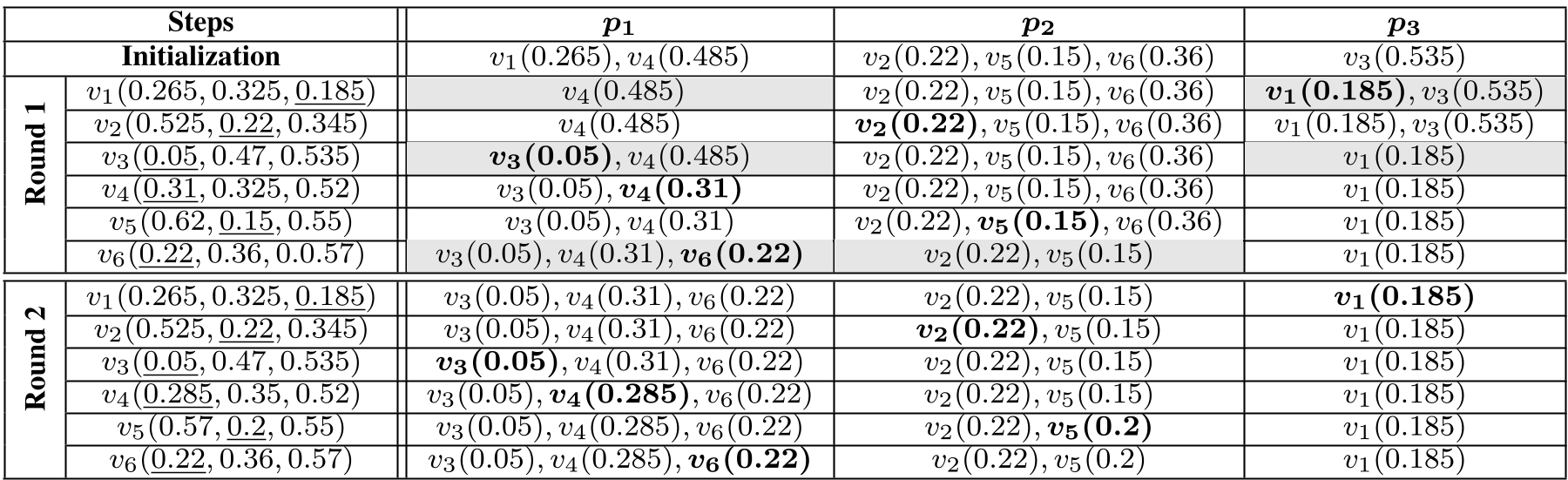 Table 1: Step-by-step execution of the RMGP baseline, showing how players shift until no one has an incentive to deviate.
Experimental Results: Speed vs. Quality
Using the Gowalla and Foursquare datasets, the authors compared RMGP against the gold-standard LP solvers.
- Speed: RMGP is massively faster. While LP solvers were tested on only 200 nodes (taking seconds), RMGP processed 2 million users in roughly the same timeframe.
- Approximation Quality: Despite being a "local" search, the Price of Stability (PoS) is bounded by 2. In practice, RMGP's solutions are remarkably close to the global optimum found by LP.
- The Normalization Factor: One critical finding was that distances (meters) and social weights (0-1) are on different scales. The authors introduced a normalization constant () to ensure that the parameter actually reflects user intent, rather than just being drowned out by large coordinate values.
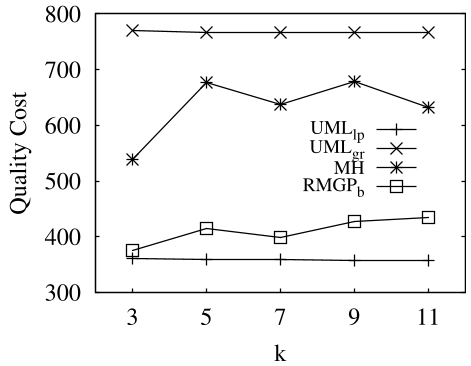 Comparison showing RMGP (red line) maintaining high speed even as the number of classes (k) increases, whereas UML methods scale poorly.
Critical Analysis & Future Outlook
RMGP effectively bridges the gap between theoretical game theory and practical database systems. Key strengths include its decentralized capability, allowing it to run across distributed servers (like Facebook's TAO) without centralizing the whole social graph.
Limitations: The model assumes "Uniform" social costs (any class difference costs the same). In reality, some "mis-assignments" might be worse than others (e.g., being in a adjacent city vs. across the country). Future work could explore non-uniform metric labeling while maintaining the convergence speed of potential games.
Conclusion
This work proves that we don't need to fear the NP-Hard nature of graph partitioning. By relaxing the requirement for a global optimum and focusing on a stable local equilibrium (Nash Equilibrium), we can build social recommendation engines that are not only lightning-fast but also "user-aligned"—because they simulate exactly how a rational user would choose their own community.