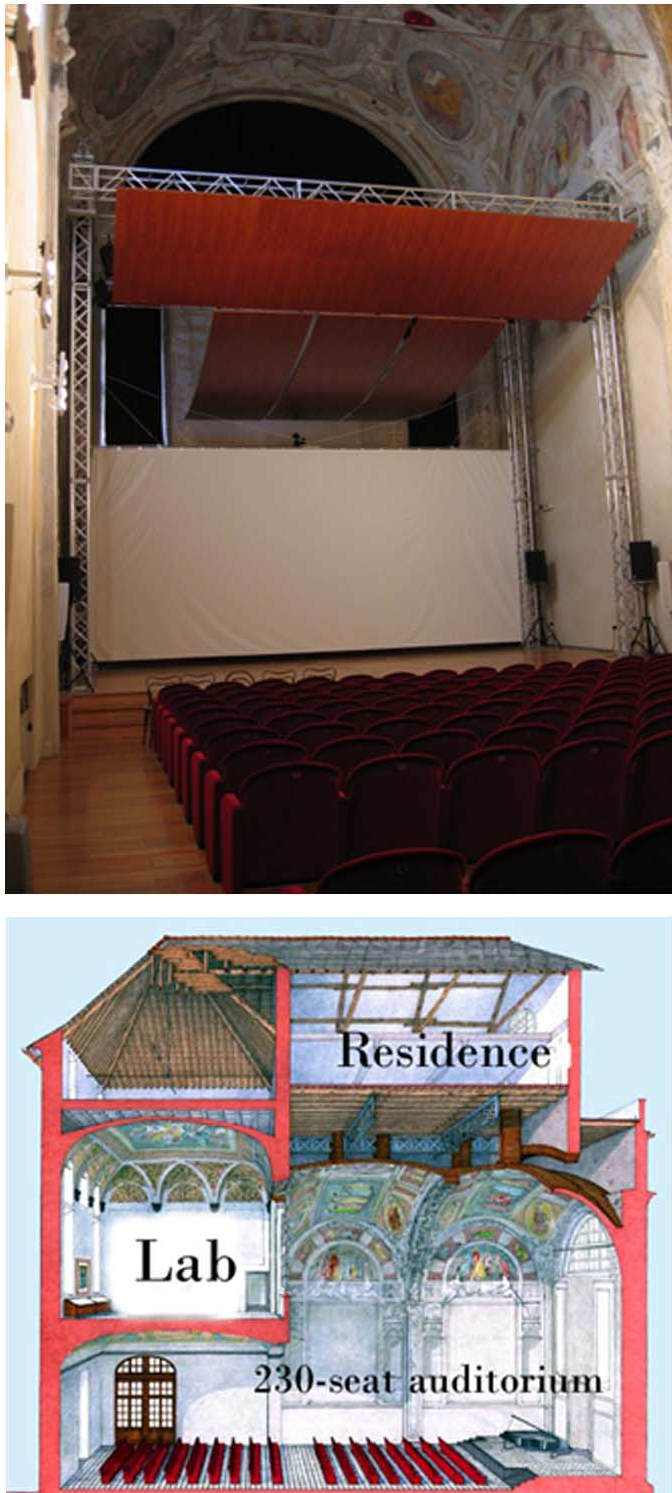
Real-Time Social Signal Processing: Quantifying the "Vibe" in Human Interaction
A system for real-time multimodal analysis of nonverbal affective social interaction in user-centric media
This paper presents a real-time multimodal system designed to analyze nonverbal affective social interactions within small groups, specifically focusing on synchronization and leadership. Leveraged through the EyesWeb XMI platform, the system uses music performance (violin duos and string quartets) as a testbed to quantify social signals and has been successfully deployed in user-centric "active listening" applications.
TL;DR
Researchers have developed a multimodal system capable of detecting synchronization and leadership in small groups in real-time. By analyzing movement and audio beats from musicians, the system provides a quantitative framework for social dynamics, moving beyond simple emotion recognition to the complex realm of group empathy and dominance.
Background: Moving Beyond the Individual
Most AI affective systems are "lonely"—they look at one face or one voice to decide if a person is happy or sad. However, human emotion is inherently social. We mirror each other, we lead, and we follow. This paper shifts the focus from "What is this person feeling?" to "How is this group interacting?" using music as the ultimate laboratory for social coordination.
Problem & Motivation: The Lack of Real-Time Social Metrics
Existing methods for assessing group dynamics (like team cohesion or leadership) usually rely on post-hoc surveys or manual coding by psychologists. These are slow and subjective. The authors argue that if we want "user-centric media"—where music or videos react to our group energy—we need a system that can see and hear the synchronization of affective behavior as it happens.
Methodology: The Physics of Social Interaction
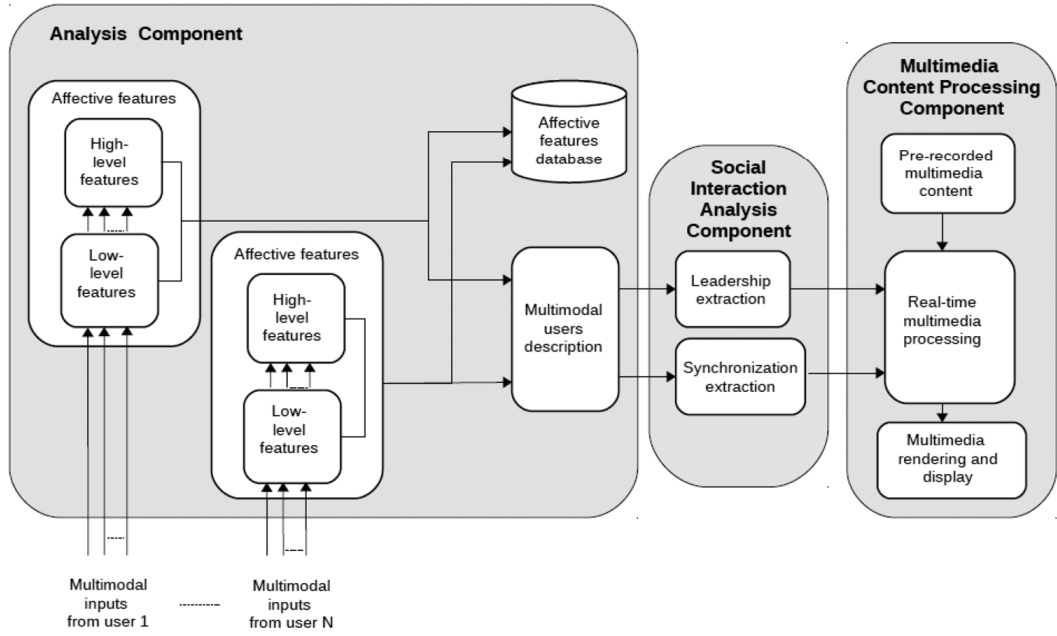
The authors treat a group of humans like a complex system of interacting oscillators. The core of their approach lies in two sophisticated mathematical modules:
- Synchronization Extraction (CPR Index): Using Recurrence Quantification Analysis (RQA), the system measures how often a person's "state" (a vector of movement, speed, and energy) repeats itself in tandem with another person. They use the Correlation Probability of Recurrence (CPR) to quantify phase locking between users.
- Leadership Extraction: This identifies the "driver" of the interaction. By using Event Synchronization, the system counts how often one user's gesture or audio beat precedes another's within a tiny time window ().
Experiments: Duos, Quartets, and "Sync’n’Move"
The researchers tested their system in three main scenarios:
1. The Violin Duo
Four players performed J.S. Bach in different emotional states (Anger, Joy, etc.). The system found that auditory feedback was actually a stronger trigger for synchronization than visual contact. Interestingly, positive emotions (Joy/Pleasure) tended to foster higher synchronization than negative ones.
2. The String Quartet
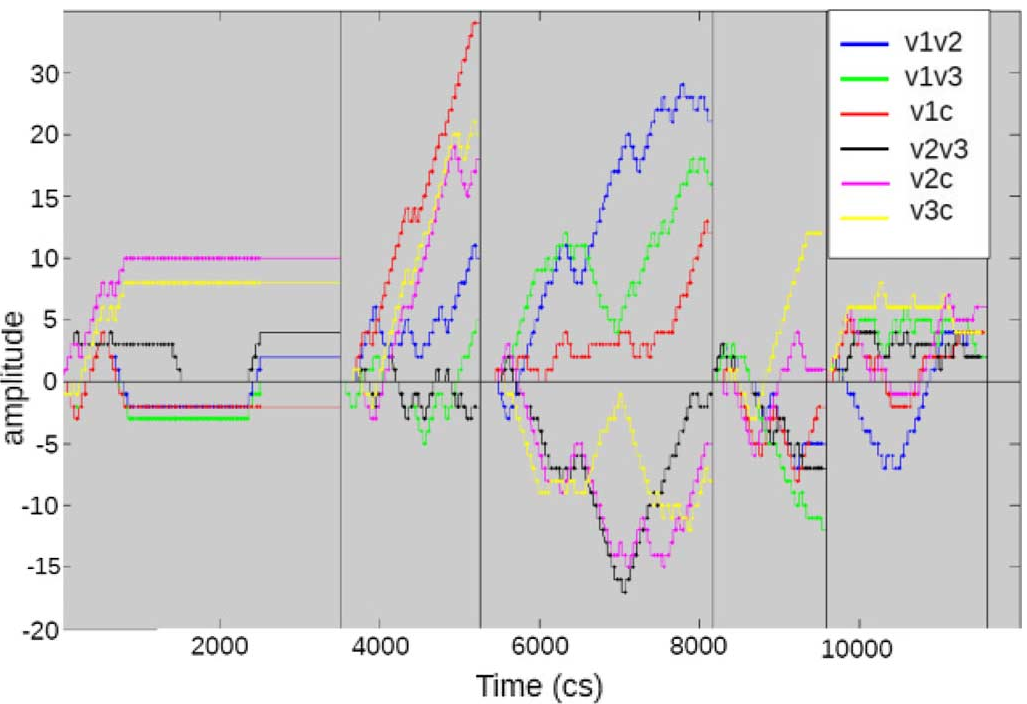
In a quartet, the "First Violin" is the traditional leader. The system confirmed this in "regular" performances. However, in "over-expressive" performances, the Viola often emerged as the temporal leader. Why? Because the viola's rhythmic "rubato" (expressive timing) forced the other players to adjust their beats to match, effectively "driving" the group.
3. Sync’n’Move: Active Music Listening
The authors turned their research into a consumer application. In Sync’n’Move, two users hold smartphones. As they move together and synchronize their gestures, the music they are listening to becomes richer and more orchestrated. If they fall out of sync, the music strips back to a basic melody.
Critical Analysis & Conclusion
The real strength of this system is its multimodal flexibility. It can ingest video tracking, accelerometer data, and audio beats interchangeably.
Takeaway: This research proves that "soft" social concepts like leadership and synchronization have a hard mathematical signature.
Limitations:
- Empathy vs. Sync: The authors admit that while synchronization is necessary for empathy, it isn't sufficient. You can be perfectly in sync with an opponent in a fight without feeling empathy!
- Computational Load: While real-time, the system currently requires significant CPU resources (~70-80% on standard hardware) for complex video-based features.
Future Outlook: This technology paves the way for "Embodied Social Networks." Imagine a virtual museum tour where the lighting and guide's voice adapt based on how well the visiting group is "vibing" or who has emerged as the natural group leader.