
ReMECS: Pioneering Real-Time Multimodal Emotion Intelligence in E-Learning
Real-Time Multimodal Emotion Classification System in E-Learning Context
The paper introduces ReMECS, a Real-time Multimodal Emotion Classification System designed for e-learning environments. It leverages multiple physiological data streams (EEG, EDA, and Respiratory Belt) and utilizes a Feed-Forward Neural Network (FFNN) trained with Incremental Stochastic Gradient Descent (ISGD) to achieve SOTA real-time performance on the DEAP dataset.
TL;DR
The shift towards digital education has highlighted a critical gap: the lack of emotional feedback between students and teachers. ReMECS (Real-time Multimodal Emotion Classification System) bridges this by processing EEG, EDA, and Respiratory signals in real-time. By moving away from heavy offline models toward an agile, online-trained Feed-Forward Neural Network, the researchers achieved up to 95.5% accuracy in arousal detection, outperforming established deep learning benchmarks.
Problem & Motivation: The "Single-Pass" Challenge
In a physical classroom, a teacher adjusts their pace by reading the room—glancing at confused faces or slumped shoulders. In e-learning, this "emotional loop" is broken. While researchers have tried using AI to fix this, they face two massive hurdles:
- Latency vs. Accuracy: SOTA models like Stacked Auto-encoders (SAE) or CNNs are often too computationally heavy for real-time streaming; they thrive in offline environments where data is looped multiple times.
- Modality Blindness: Relying on a single sensor (like just an EEG) provides a narrow view. Emotions are physiological "symphonies" involving heart rate, skin conductance, and brain activity.
The authors' insight? Use Incremental Stochastic Gradient Descent (ISGD). Instead of waiting for a full batch of data, the model learns from data tuples as they arrive—one single pass, real-time update.
Methodology: The FFNN Trio & Weighted Fusion
The ReMECS architecture is specialized for the "Test-then-Train" paradigm. Each modality gets its own dedicated "worker" model.
1. The Multi-Stream Pipeline
The system processes three distinct physiological streams:
- EEG (Brainwaves): 32 channels.
- EDA (Electrodermal Activity): Measuring skin sweat/arousal.
- RB (Respiratory Belt): Measuring breathing patterns.
2. Feature Extraction & Architecture
Features are extracted using Wavelet Decomposition (Daubechies 4), which is ideal for the non-stationary nature of biological signals. These features feed into three parallel 3-layer Feed-Forward Neural Networks.
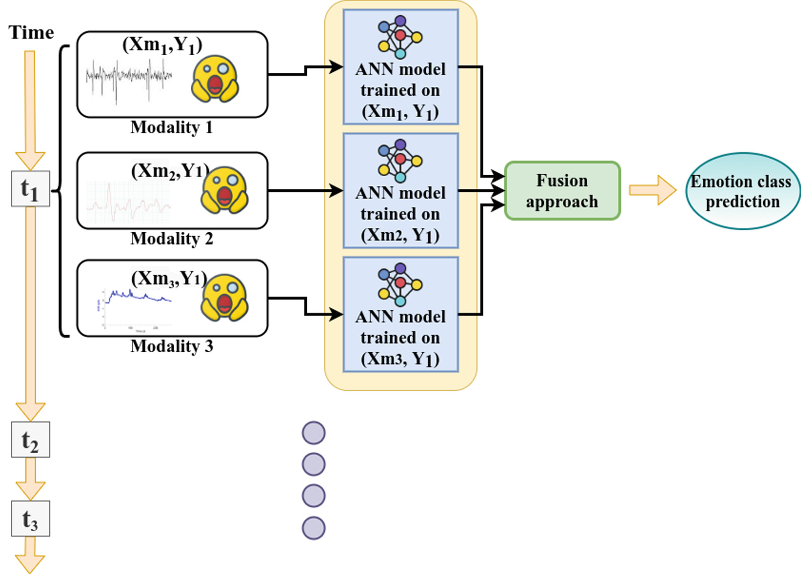 Figure 1: Conceptual view of learning from multimodal data streams over time.
3. Decision Fusion via Weighted Majority Voting (WMV)
Instead of merging data at the feature level (which is messy given different sampling rates), ReMECS uses Decision Level Fusion.
- Each FFNN casts a "vote" for an emotion (e.g., High vs. Low Valence).
- The Weighted Majority Voting algorithm assigns weights to each classifier based on its accuracy.
- If a modality (like RB) consistently predicts accurately, its vote carries more weight.
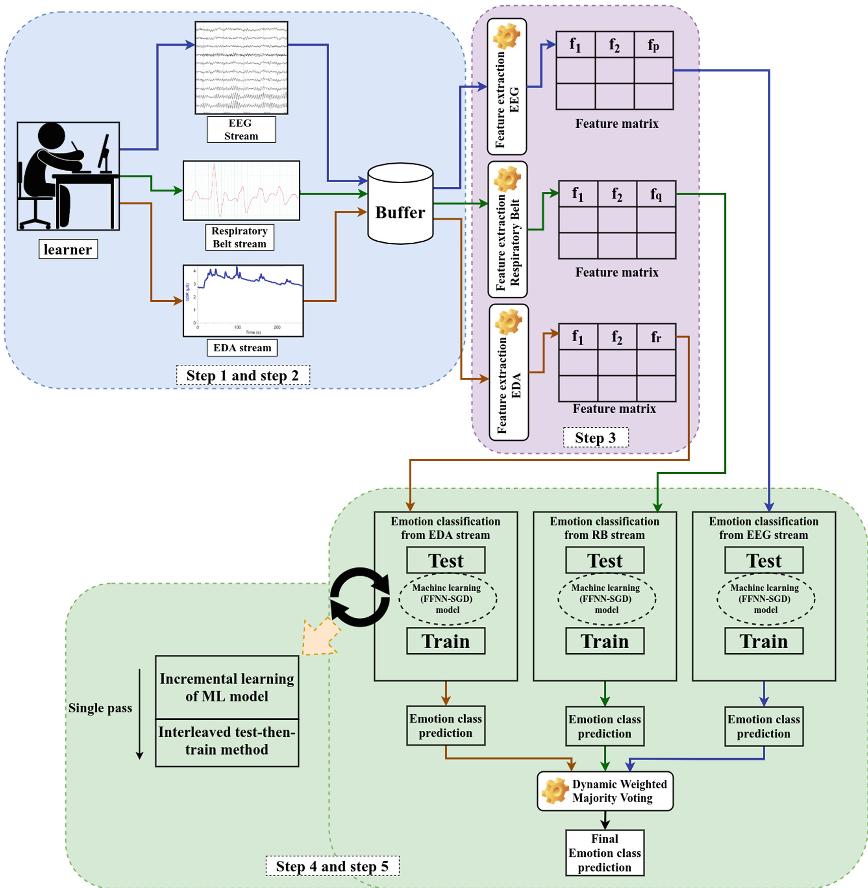 Figure 2: The ReMECS framework: From raw physiological streams to unified emotion classification.
Experiments & Results: Crushing the Baselines
The researchers tested ReMECS on the DEAP dataset. The results were a significant validation of the "less is more" approach for streaming data.
Performance Gains
ReMECS outperformed not only its own previous single-modality versions (RECS) but also specialized offline deep learning models:
- Arousal Accuracy: ReMECS hit 95.51%, compared to 84.7% for Hierarchical Fusion CNNs (HFCNN).
- Valence Accuracy: ReMECS achieved 84.77%, surpassing the ensemble of stacked auto-encoders (MESAE) which sat at 77.1%.
| Approach | Valence Acc | Arousal Acc | Arousal F1 |
|---|---|---|---|
| Single EEG Stream | 76.35% | 71.96% | 0.74 |
| ReMECS (Multimodal) | 84.77% | 95.51% | 0.95 |
Why does it work?
The Ablation Insight: The Respiratory Belt (RB) proved to be a surprisingly strong signal for Arousal, while the fusion of all three modalities stabilized the much harder-to-predict Valence dimension. The online nature of ISGD allowed the model to adapt to the specific idiosyncrasies of a user's physiological responses during the 60-second video trials.
Critical Analysis & Future Outlook
ReMECS proves that complexity isn't always king. By using lightweight FFNNs and an intelligent voting system, they achieved better real-time responsiveness than deep CNNs.
Limitations:
- Cold Start: The model initially performs poorly as it has "seen" no data. In a real-world classroom, the first few minutes of data might be unreliable until the online learner stabilizes.
- Hardware Intrusiveness: Wearing EEG caps and respiratory belts is still a barrier for casual e-learning.
The Future: The authors plan to deploy this in Eurecat’s materials laboratory, where a teacher's dashboard will display the emotional state of students in real-time. This marks a significant step toward "Augmented Workspaces"—where the software is as emotionally aware as a human tutor.
Conclusion
ReMECS shifts the paradigm from "Big Data" to "Fast Data." In the context of e-learning, being able to detect that a student is frustrated or bored in the moment is exponentially more valuable than a deep analysis performed after the lesson is over.