
CubeTA: Revolutionizing Real-Time Personalized Search in the Social Era
Real time personalized search on social networks
This paper introduces a novel framework for Real-Time Personalized Search on Social Network Platforms (SNPs). It presents the 3D Cube Inverted Index and the CubeTA algorithm, which unify time freshness, social relevance, and textual similarity to achieve high-performance top-k retrieval in dynamic social graphs.
TL;DR
Social Network Platforms (SNPs) demand search results that are not just relevant in text, but also fresh in time and personalized to the user's social circle. This paper proposes a 3D Cube Inverted Index and a specialized CubeTA algorithm. By treating search as a multi-dimensional geometry problem—Time, Social, and Text—the authors achieve sub-millisecond personalized search on graphs with millions of users.
The "Search Incompatibility" Problem
Searching on Twitter or Facebook is fundamentally different from a Google search. SNPs have two brutal constraints:
- High Update Rate: Millions of posts per day must be indexed instantly.
- Small World Phenomenon: Everyone is roughly 4.7 steps away from each other, making "Social Distance" a computationally expensive nightmare to calculate on-the-fly.
Existing solutions are usually "half-baked": they either sort by time (ignoring your friends) or stay static (ignoring the latest news). The bottleneck? Computing the shortest path between a query user and every potential content author in a massive, power-law graph.
Methodology: The 3D Cube Inverted Index
The core innovation is the transformation of an inverted list into a 3D Grid. Every record is mapped to a "cube" defined by:
- X-axis (Time): Recent slices are prioritized.
- Y-axis (Social): Groups of users partitioned by graph connectivity.
- Z-axis (Textual): TF-IDF based frequency intervals.
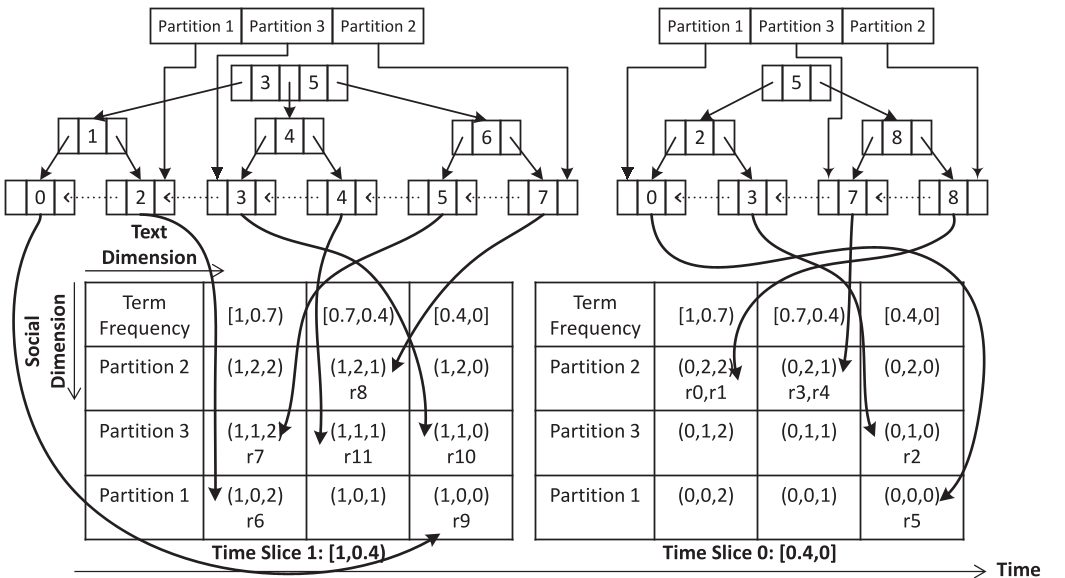
Instead of scanning a list, the CubeTA algorithm traverses these cubes based on an estimated "Best Score" bound. If the best possible score in a cube is lower than the current top-k threshold, the entire cube (and its neighbors) is pruned.
Solving the Social Bottleneck: Out-of-Circle Pruning
The "Social Relevance" component is the most expensive to compute. To fix this, the authors moved beyond the standard Dijkstra's Algorithm (DA):
- Warm-up Queue: They model social distance as a Mixture of Gaussians. By evaluating a few likely-close records first, they quickly find a tight candidate bound (), allowing them to prune far-away users much earlier.
- Out-of-circle Pruning: By pre-computing 2-hop nearest neighbor distances, they can determine if a user is "too far" to ever make the top-k list before the graph traversal actually reaches that node.
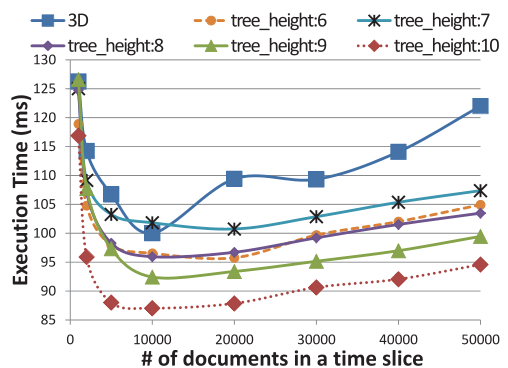
Experiments & Real-World Impact
Tested on a massive Twitter dataset (476M tweets), the 3D Index outperformed Time-Pruning (TP) and Frequency-Pruning (FP) significantly:
- Speed: 4x-8x faster than traditional Top-k algorithms.
- Efficiency: Distance queries on 10M-node graphs took less than 1μs.
- Stability: Unlike text-only indices, the query time remains nearly constant even as the number of records triples.
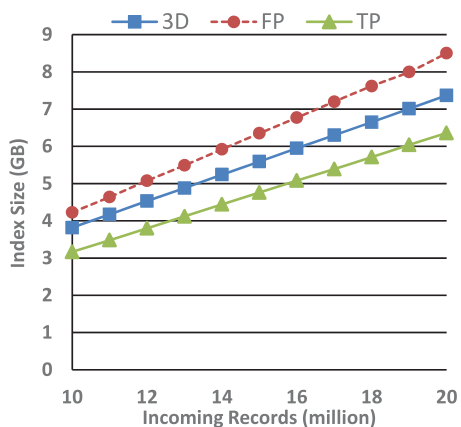
Critical Insight & Future Outlook
The genius of this work lies in Hierarchical Partitioning. By dynamically merging and splitting social partitions within the index, the system reflects real-world "bursty" social activity. However, a remaining challenge is the Inductive Bias of the linear ranking function; manual tuning of parameters is still required.
Future systems might replace these static weights with Learning-to-Rank (LTR) models, but the 3D Cube Index will likely remain the gold standard for the underlying retrieval architecture due to its hardware-friendly design and pruning power.